Why Human-in-the-Loop AI Is the New Standard for Localization

AI has transformed localization more in the past two years than in the previous twenty. What once took days can now take minutes. What required extensive workflows now launches in a single click. Teams are moving faster, content volumes are exploding, and leaders are rightfully asking the big question: 

When is AI enough, and when does a human need to step in? 

Across every regulated industry we serve — healthcare, legal, insurance, manufacturing — executives are looking for clarity. Not hype. Not fear. A framework. Something that helps them balance speed with safety, efficiency with compliance, automation with accountability. 

That’s where Human-in-the-Loop (HITL) comes in: a governance-driven approach where AI accelerates the work, and humans secure the outcome. 

It’s quickly becoming the localization standard, and the standard we’re perfecting as your partner in Strategic Globalization. 


Why Organizations Are Moving Toward HITL 

Early conversations around AI in localization were dominated by replacement narratives. 

“AI will eliminate translators.”
“AI will automate entire workflows.”
“AI will make localization instant and free.” 

Today, the organizations we advise are asking a different and more strategic question: 

“How do we integrate AI responsibly, with guardrails that protect quality, cultural accuracy, and compliance?” 
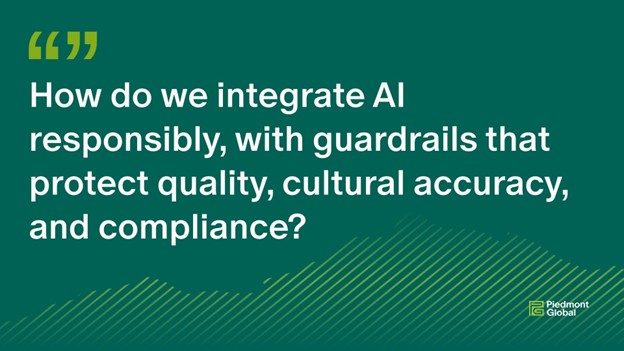
Graphis that reads How do we integrate AI responsibly, with guardrails that protect quality, cultural accuracy, and compliance?

Enterprises aren’t rejecting AI. They’re operationalizing it. They’re formalizing HITL frameworks because the risks of LLM-only localization models are too significant to ignore: 

  • Undetected hallucinations 
  • Cultural misinterpretations 
  • Missing legal terminology 
  • Inconsistent tone or style 
  • Data privacy concerns 
  • Regulatory exposure

In industries where a single mistranslation can lead to patient harm, legal liability, safety failures, or financial risk, fully autonomous AI simply isn’t an option. HITL is safer, more scalable, and ultimately more cost-efficient. 


The “Right Touch” Model: Calibrating Human Involvement by Risk Level 

One of Piedmont Global’s principles around AI is simple: 

Not all content needs the same level of human involvement, but all content needs the right level of human involvement. 

We help organizations evaluate content through a Right Touch Framework across four dimensions:


1. Content Risk 

Is the content informational, instructional, legal, or safety-critical?


2. Audience Risk 

Could misunderstandings impact patient health, financial decisions, legal outcomes, or public safety?


3. Cultural Risk 

Does the content require cultural nuance, lived experience, or contextual understanding?


4. Compliance Requirements 

Is certified translation required? Does the content support regulated workflows? 

From here, we calibrate human involvement.
Some content is AI-first, human-verified.
Some is human-edited AI.
Some is human-led, AI-assisted.
And some remains human-only. 

This is the operational clarity leaders are asking for, and the foundation of future-ready language programs. 


Where AI Fails and Why Humans Still Matter 

LLMs are extraordinary pattern-recognizers. But culture is not a pattern; it’s context, identity, lived experience, and interpretation. 

AI struggles with: 

  • Humor and idioms 
  • Taboo language 
  • Sensitive topics 
  • Emotionally charged content 
  • Region-specific norms 
  • Social values and beliefs 
  • Industry-specific cultural expectations 
  • And more 

Humans don’t just translate words. They interpret meaning. 

That’s why we integrate cultural subject matter experts (SMEs) as quality governors inside AI systems, training models to reflect real-world nuance. It’s why we rely on human oversight to catch errors AI can’t see. And it’s why, ultimately, HITL is an upgrade and not a compromise. 


Post-Editing Maturity: How Teams Evolve with AI 

Most global organizations are somewhere on a post-editing maturity path:


1. AI Curiosity 

Teams experiment in pockets with generative AI, but usage is inconsistent.


2. AI Adoption 

Machine translation and post-editing enter the workflow, often without governance.


3. AI Alignment 

Teams create formal guidelines for post-editing, quality, risk, and review.


4. AI Embedding 

Enterprises develop custom HITL workflows, quality frameworks, and escalation paths.


5. AI Optimization 

Data, cultural insights, and human feedback loops train models to improve over time. 

Wherever you sit on this path, one principle remains the same:  

AI requires professional human oversight to achieve enterprise-grade accuracy. 


HITL in Regulated Industries: Where It Matters Most 

Healthcare 

  • Clinical accuracy 
  • Patient safety 
  • Informed consent 
  • Certified medical translations 
  • Multilingual patient communication 

Legal 

  • Legal terminology 
  • Case evidence 
  • Contracts & compliance 
  • Certified translations for court 

Insurance 

  • Policy accuracy 
  • Claim adjudication 
  • Regulatory alignment 
  • Customer rights & responsibilities 

Manufacturing & Government 

  • Safety documentation 
  • Technical manuals 
  • Recall notices 
  • Public communication 

In these sectors, quality is not a preference. It’s a legal requirement. HITL ensures organizations meet those obligations without sacrificing speed. 


How AI Is Reshaping Localization Teams 

Modern localization teams look different than they did even a year ago. 

Leaders are restructuring around: 

  • AI quality managers 
  • Culturally fluent SMEs 
  • AI-assisted project managers 
  • Data governance and compliance leads 
  • Tech + human hybrid workflows 
  • New escalation paths and review loops 

The future isn’t “AI vs. human.” The future is AI + human, integrated into a system where each strengthens the other. 

Graphic that reads The future isn't AI vs Human. The future is AI + human, integrated into a system where each strengthens the other.

The Future Standard: Human-in-the-Loop AI 

HITL is no longer a trend. It’s a strategic imperative for organizations that operate globally, responsibly, and at scale. 

It delivers: 

  • Faster workflows 
  • Higher accuracy 
  • Better cultural alignment 
  • Stronger governance 
  • Reduced risk 
  • Increased confidence 
  • Clearer compliance paths 
  • Improved customer experiences 

Organizations need clarity, calibration, and a partner who understands both the possibilities of AI and the realities of global communication. 

That’s why Piedmont Global exists. To help you lead globally, fluently, and confidently. 

If you’re evaluating how to integrate AI into your global workflows, we can help you design a Human-in-the-Loop model that accelerates your operations while protecting what matters most.
Explore Piedmont Global’s custom solutions → 

Property & Casualty Insurance: Best Practices for Serving LEP Policyholders

Of the nearly 30 million Americans identifying as limited-English proficient (LEP), 39 percent are homeowners, per Fannie Mae, and 28.7 percent regularly drive to work, per the 2023 American Community Survey. Whether you advertise to LEP policyholders or not, insurers can expect to work with customers who speak languages other than English at home and may require additional support to communicate effectively.

Claims are complex: ensuring the requirements and details are understood is paramount to success. By ensuring language access services are embedded within claims and customer service workflows, property and casualty insurers have an opportunity to convert and retain a larger share of the LEP market.

Which best practices differentiate P&C insurers from competitors that overlook this particular customer segment? We’ve rounded up actionable tips to level up multilingual service delivery, with the aim of enhancing productivity metrics and sustaining long-term policyholder retention.


Best Practices for Multilingual Claims Processing

While most policyholders chase lower costs when switching to a new insurer, a positive experience with claims can deter attrition. Clear communication could make all the difference, particularly when dealing with language barriers.

The United States LEP population continues to rise, exceeding more than 80 percent growth since 1990. Multilingualism has and will persist as a defining factor of American society, and the insurers who engage these customer segments effectively will be poised for growth.

A separate, climate-driven reality is the increased frequency, severity, and cleanup costs of natural disasters. Reviewing which years saw the largest number of natural disasters (where damages per disaster exceeded $1 billion) reveals that nine occurred in the last ten years. In response, claims adjusters have been expected to increase their velocity, while productivity and customer satisfaction metrics remain under a microscope. Streamlined processes allow these teams to work as diligently and efficiently as possible.

Considering these external factors will continue influencing the policyholder market, the following best practices offer insights to help teams optimize workflows during high volume periods and improve multilingual client service. 


Best Practice #1: Map the Claims Process for LEP Policyholders

According to SQM Group, an acceptable average wait time for customer service is 2 minutes or less. Policyholders value their time, and they expect process optimization from established companies.

With that in mind, your company has likely already mapped the claims process for continuous evaluation and improvement. However, does your team have a process map for LEP policyholders that also explains how to deploy language services? By identifying each contact point during the process and aligning it with a language access resource, claims adjusters will know how to act faster and more effectively when on the line with an LEP policyholder. 


Best Practice #2: Train Claims and Field Adjusters on Language Access

If claims adjusters and managers don’t know which questions to ask or how to access an over-the-phone (OPI) interpreter, their inquiries from multilingual policyholders will inevitably be more challenging to resolve. By helping adjusters immediately identify if a policyholder needs language access and how to take swift action to get an interpreter on the line, the first notice of loss (FNOL) and follow-up calls can proceed with greater ease.

Similarly, when field adjusters assess damages in person, equipping them with video-enabled devices for virtual remote interpreting (VRI) can enhance comprehension and ensure a swifter, more accurate resolution.


Best Practice #3: Create AHT Metrics for Multilingual Claims

Interpreting increases call times. If phone calls with LEP policyholders are measured by the same average handle time (AHT) standard as English-only calls, you might inadvertently foster an environment that disincentivizes agents to provide optimal service to multilingual customers.

Creating AHT metrics specific to LEP claims counters this effect, allowing not only for optimal service, but opportunities to make process improvements.


Best Practices for Multilingual Customer Service in P&C Insurance

According to TechTarget, the first call resolution (FCR) rate reveals much about a call center’s performance. If a customer’s needs frequently cannot be resolved at the first point of contact, your call center’s operational efficiency might be lower than it could be. An FCR below 75% indicates room for improvement.

Trained customer service representatives can deploy language services faster, reducing the need for repeat calls, abandoned inquiries, or extra time spent on the line with multilingual policyholders. Here are two key steps you can take to facilitate greater efficiency. 


Best Practice #4: Invest in a Multilingual Self-Service Library

Check the trends: which languages other than English do your customers primarily speak? Once the number of customers speaking Spanish, Mandarin, Vietnamese, French, Hmong, or other regionally specific languages reaches critical mass, it might be worth investing in translations of your self-service customer service library.

An efficient way to translate your library is to work with a language service provider specializing in insurance content. Better yet, you can count on maximum efficiency and value if they use AI-powered, linguist-supervised processes.


Best Practice #5: Train Call Center Agents on Language Access

Small changes that are broadly propagated can have a major impact on productivity and efficiency. For example, if language access resources are not readily available, or customer service agents have not received sufficient training, remedying this can support higher rates of firstcall resolution. Ensuring agents know how to deploy language services and providing them with chat-based and phone-based options for language support can and will move the needle.


Interpretation Services for P&C Insurance Companies

Often overlooked and underserved, the LEP policyholder landscape offers significant opportunities for new customer acquisition. However, to attract and retain these new customers, insurers must come prepared with a comprehensive language access plan to achieve uninterrupted service delivery when a claim or inquiry occurs.

Piedmont Global works with enterprise, mid-market, and small P&C insurance companies to elevate multilingual policyholder service, satisfaction, and retention. As your strategic partner, our services help insurers differentiate their offering and provide optimal service through: 

  • Translations, including policy documents, marketing content, chat-based support content, certified documents for court cases, and more 

Are you ready to capture a greater share of the multilingual policyholder market? Schedule a call with one of our experts today.