The Partnership Shift: How Strategic Globalization Transforms Operations

In a world where complexity is rising and connection is constant, cross-cultural leadership requires more than translation or technology. It takes a partner.

For years, organizations have outsourced interpretation, localization, or training to fill specific gaps. But in today’s operating environment, those gaps are wider, deeper and harder to navigate. That’s why forward-looking teams are seeking more than service providers and transactional vendors. They’re seeking strategic partners that can embed, evolve, and scale with them.

At Piedmont Global, we believe meaningful connection starts with strategic alignment—not transactional tasks. Here’s what it means to be a Strategic Globalization Partner—and why it matters now more than ever.


From Provider to Partner: What’s the Difference?

Service providers complete tasks. Strategic partners accelerate outcomes.

A vendor may translate a document. A partner will ask: What is this content meant to accomplish, and how do we design it to work across audiences, systems, and languages?

A vendor may provide an interpreter. A partner will ask: Who is in the room, what’s at stake in this conversation, and how do we ensure everyone is truly heard and understood—across languages and cultures?

Here’s how true strategic partners show up:

  • They understand your business strategy and align to your vision
  • They help you navigate cultural, regulatory, and operational complexity
  • They build systems and capabilities that adapt as you scale
  • They build long-term value, not just short-term project deliverables

The key difference is this: vendors solve isolated problems; partners design systems that reduce friction, increase impact, and grow with you. Vendors execute. Partners embed. And that difference is everything.


Why Strategic Globalization

Globalization isn’t new. But maintaining clarity, cohesion, and compliance across diverse audiences, markets and geographies is harder than ever.

So how we approach it must change.

Consider this:

  • Your workforce may span five continents, a dozen languages, and multiple time zones.
  • Your customer base expects personalized, seamless experiences—regardless of language, culture, or region.
  • Your compliance risks, operational systems, and community relationships are all influenced by cultural context.

And yet, many organizations still rely on siloed solutions to manage cross-cultural complexity.

That’s where Strategic Globalization comes in. It’s an integrated approach that blends:

  • Cultural Fluency: Deep knowledge and nuanced understanding of language, culture, and context
  • Custom Technology: Agile platforms and AI-enhanced workflows that adapt to your systems
  • Strategic Insight: Market intelligence, risk mitigation, and tailored growth planning

This integrated model fuels connected, scalable growth—ensuring organizations aren’t just seen and heard but trusted and understood across every audience and environment.


The Piedmont Global Approach

As a Strategic Globalization Partner, we don’t show up with a playbook and leave.

We integrate with your teams and systems. We align to your mission. We evolve with you.

Whether you’re:

  • A healthcare leader working to improve patient outcomes across language barriers,
  • A government agency trying to reach every resident with clarity,
  • Or an education provider building inclusive learning systems,

We help you build the capabilities—not just content—you need to lead across cultures.

It’s not about being everywhere. It’s about showing up the right way. With the right systems. The right context. And the right partner.


Why It Matters Now

Every organization is under pressure to do more—with fewer silos, fewer vendors, and fewer missteps. But good intentions don’t bridge cultural gaps. Systems do. Strategy does. So does alignment, agility, and cultural intelligence.

That’s what Strategic Globalization delivers.

And it’s why Piedmont Global exists: to make cross-cultural operations easier, smarter, and more human—for every team, every system, and every community.

Ready to Rethink What Partnership Can Look Like?

If your organization is evolving and growing, your support model should evolve with it. Strategic Globalization isn’t a trend. It’s a capability. And we’re here to help you build it.
Why It’s Time to Rethink Global Growth: From Translation to Transformation

In today’s hyper-connected, fast-paced world, companies aren’t just growing geographically, they’re working with diverse populations, integrating across systems, and dealing with growing cultural and operational complexity. For decades, translation has been the default solution for global communications. But stakes are rising, and speed is quickening, and it’s no longer enough.

At Piedmont Global, we believe it’s time for something more.

It’s time to move from translation to transformation.


The Global Reality Has Changed — Has Your Strategy?

There was a time when translating a website or brochure was sufficient to “go global.” But today’s organizations have a different challenge. Whether you are in healthcare, government, or education, your audiences are no longer limited by borders, and neither are your teams, vendors, or stakeholders.

Language is only one layer of what it takes to do business and scale across cultures today. Cultural expectations, regulatory landscapes, evolving tech infrastructures, and operational workflows all intersect. Growth now requires a new kind of fluency: not just in language, but in strategy, systems, and human connection.

The Weakness of Translation-Only Models

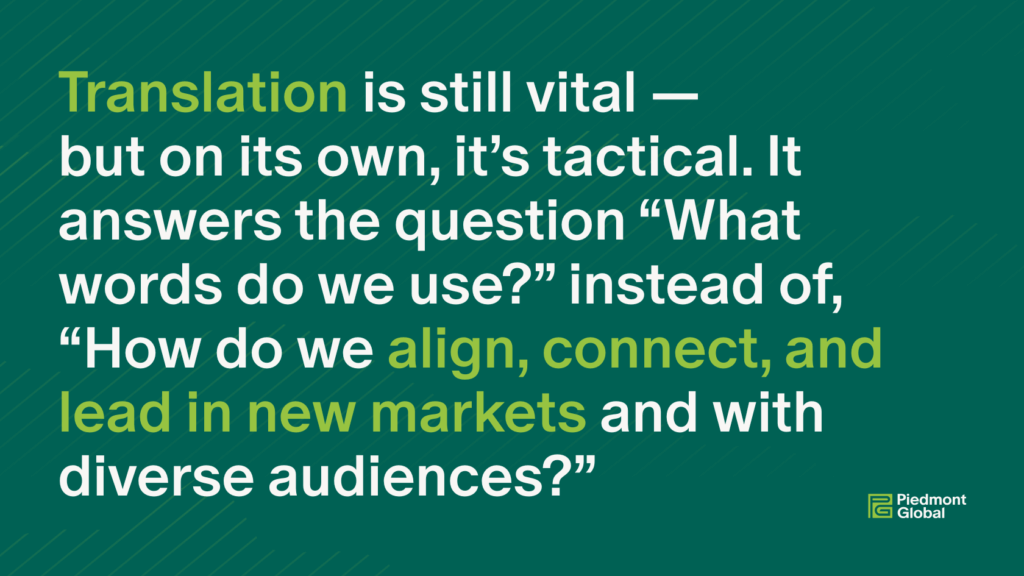
Translation is still vital, but on its own, it’s tactical. It answers the question “what words do we use?” rather than “how do we align, connect, and lead in new markets and with diverse audiences?”

When language is commodified as a transactional service, it tends to result in:

  • Disjointed customer experiences across languages
  • Delayed market entry due to lack of scalable infrastructure
  • Overlooked compliance requirements or cultural faux pas
  • Fragmented internal communication across global teams
  • Limited ROI from global marketing, training, and support programs

Translation solves for communication. Strategic Globalization solves for coordination, connection, and impact.


Strategic Globalization is a new category — and a new way forward for organizations operating across borders, systems and cultures.

More than a one-size-fits-all solution, it’s a comprehensive, scalable methodology that combines cultural fluency, human expertise, custom technology, and actionable strategy. It’s designed to assist with each phase of your growth journey, from expanding into new markets to serving diverse audiences with clarity and confidence.

It means:

  • Embedding expertise – from interpreters and localization experts to consultants and cultural advisors – directly into your workflows
  • Integrating global readiness into customer experience, compliance training, and service delivery systems through multilingual capability and support.
  • Designing programs and processes that work for every audience, across cultures and contexts.
  • Infusing cultural intelligence into marketing, HR, supply chain and technology operations
  • Aligning strategy, people, and technology to drive smarter growth and more equitable outcomes

From Vendor to Partner: A New Kind of Support

At Piedmont Global, we don’t parachute in with a playbook and then vanish. We embed. We learn your systems, get to know your audiences, and evolve with you.

This approach creates real advantages:

  • You go to market faster — without the language lag
  • Your teams remain in sync — across departments and borders
  • Your customer experience improves — in every language, for every individual
  • You minimize and mitigate risk — and meet growing compliance expectations

Our clients don’t just need words translated; they need us to build lasting capabilities that scale.


Why Now?

Because the stakes have never been higher. Organizations are being asked to do more — across more languages, cultures, and channels — with greater precision and speed than ever before.

Because employee and customer populations are more diverse. Expectations are rising. And equity matters.

Because quick fixes won’t get you to the future.

And because the organizations that rethink global growth now will be the ones that lead tomorrow.


What’s Next

As we get ready to launch our new brand identity, we’re excited to share more about how we’re redefining what it means to be a global partner. Over the next several weeks, we’ll explore the building blocks of Strategic Globalization — and how Piedmont Global is delivering smarter, more human, more scalable solutions for a changing world.