Supporting Multilingual Learners in Special Education

A conversation with Mark Byrne and Dr. Ashley Crown 

Introduction 

Mark Byrne:
Thanks for joining us today. We’ll keep this to about 30 minutes, with time for Q&A at the end. This discussion matters — supporting multilingual learners in special education is not a political issue. It’s about one thing: parent engagement as a catalyst for student success. 

I’m joined by Dr. Ashley Crown from Libertyville District 70 Schools. Ashley, would you introduce yourself and share a bit about your work? 

Dr. Ashley Crown:
Absolutely. This is my 18th year in District 70. I spent most of that time as a school psychologist, and in the last couple of years I’ve moved into a district-level coordinator role. I’ve been working closely with our multilingual teachers and supporting initiatives to better serve multilingual learners. One major improvement has been partnering with Piedmont Global to secure translation and interpretation services — tools that help ensure parents and students have access when it matters most. 


Why interpreters matter in Special Education 

Mark:
When we talk about interpretation, we’re talking about more than word-for-word language transfer. It’s about clarity, trust, and connection. It’s about giving parents meaningful participation in their child’s education. 

Technology gives us a lot of helpful tools — Google Translate, speech-to-text, AI translation devices — but in special education settings, well-trained human interpreters are irreplaceable. 

We want families to feel heard and able to engage in the process. Their understanding directly supports student achievement. Ashley, can you share how you’ve seen this play out in your district? 

Dr. Crown:
Parents are the most important members of our teams. They know their child best, and we need their authentic voice. Interpretation supports that voice. It ensures parents can contribute meaningfully — whether we’re sharing progress, reviewing interventions, or making decisions about services. 

Language access isn’t optional; it’s how parents know they are part of the team and that their input matters. 


Preparing interpreters for success 

Mark:
We also need interpreters to feel like they’re part of the team. When you have a complex IEP or an expulsion hearing, giving interpreters context in advance is critical. 

It’s like hiring an attorney and not telling them anything about your case — they can’t represent you effectively without context. 

Ashley, what does clarifying expectations look like on your end? 

Dr. Crown:
A few pieces: 

  • Explain the purpose of the meeting
  • Outline what we hope to accomplish
  • Share whether the parent wants full interpretation or support as needed

Sometimes parents are comfortable in English but want an interpreter for clarity. Preparing interpreters for that dynamic helps the meeting run smoothly. 


Using clear language and avoiding jargon 

Mark:
Another best practice: using short, simple sentences and avoiding idioms and slang. These often don’t translate well. 

I once told a former boss I could “play ball” on a project — she thought I meant something totally different. It was a humbling reminder that casual language creates confusion. 

Dr. Crown:
Education is full of jargon and acronyms — MTSS, RTI, IEP, FBA. We talk about this often in our district: spell things out. Use the full term. Avoid abbreviations. 

Even things like class names can be confusing. “Studio One” means homeroom to us, but to others, it means nothing without context. 

These are good practices in any meeting — but essential when an interpreter is involved. 


Respecting the interpreter’s role 

Mark:
We need to slow down, give interpreters time to interpret, and allow parents time to think and respond. Silence is purposeful. Interpretation isn’t instant. 

Interpreters also follow strict professional standards — confidentiality, neutrality, FERPA, HIPAA compliance. It’s a serious responsibility. 

How do you communicate this to your teams? 

Dr. Crown:
We remind staff that interpreters need processing time. We also emphasize that some special education concepts don’t translate directly, so clarity takes extra time. 

We encourage teams not to rush, not to fill silence, and to give interpreters the space they need to provide accurate information. 


Cultural awareness and trust-building 

Mark:
Building trust isn’t just linguistic — cultural awareness matters too. Tone, body language, even the color you mark on a test can carry different meanings across cultures. 

Educators already work hard to create respectful, welcoming environments. Cultural awareness strengthens those efforts. 

Dr. Crown:
Exactly. Our cultural work impacts everything we do. When families come from multiple languages and cultures, being intentional becomes even more important. 


Scheduling interpreters effectively 

Mark:
Let’s talk logistics. Planning ahead is key. When districts pre-schedule interpreters: 

  • We can match you with someone with special education expertise
  • You avoid last-minute gaps
  • We can share documents beforehand

If you know the meeting date, schedule the interpreter. 

Dr. Crown:
And remember — language access in special education is a legal right. Not a convenience. We need to take it seriously. 

Mark:
We use the 50% rule: if a meeting is usually an hour, schedule 90 minutes when an interpreter is involved. 

Dr. Crown:
We also create buffer time at the beginning to brief the interpreter, and time at the end for questions. Overscheduling is better than rushing. 


Choosing the right modality 

Mark:
We offer onsite, video remote (VRI), and telephonic interpretation. Different situations call for different tools. 

Your team even created a “modality cheat sheet,” right? 

Dr. Crown:
Yes — our ML department mapped which modality is best for which meeting type, plus what technology each requires. It prevents surprises and ensures consistency. 


Using trained, qualified interpreters 

Mark:
Compliance is tightening, especially in states like Illinois. Pulling a bilingual teacher or gym coach into a meeting isn’t best practice. 

We categorize interpreters by specialty — education, mental health, healthcare — so districts can choose the right fit. 

Dr. Crown:
That has been huge. When we expect emotional conversations or mental health concerns, choosing a mental health–trained interpreter makes all the difference. 


Translation requirements and legislation 

Mark:
Let’s talk about new legislation around IEP translation. 

Dr. Crown:
There are strict timelines around drafts, notices, and final documents. Districts must ask parents if they need translations, document that they asked, and provide the materials in time for parents to review them. 

Google Translate helps in limited ways — but special education terminology often requires a more sophisticated process. Parents need to understand what they’re consenting to. 

Mark:
Exactly. We often use machine translation with post-editing, supported by glossaries and translation memories, which keeps costs manageable while ensuring accuracy. 


Being proactive, not reactive 

Mark:
One district shared that 95% of their telephonic interpretation calls were for behavior issues. That’s a huge missed opportunity. 

I want to flip that. A quick positive call home, delivered in a family’s language, can transform trust and connection. Telephonic interpretation costs pennies compared to the impact it creates. 

We can’t wait until there’s a problem to communicate. 


Low-incidence languages 

Dr. Crown:
We’ve always been able to get interpreters for low-incidence languages through Piedmont Global — scheduling ahead makes it easier. 

Mark:
We support 100+ on-demand languages and 200+ overall. The key is identifying the right modality and having internal systems so staff know who to contact when a need arises. 


Building systems that outlast individuals 

Dr. Crown:
We trained ML teachers and principals in all buildings so every school has someone who knows how to use our interpretation platform. 

Mark:
Yes — language access can’t depend on one champion. It needs structure, training, and clear processes so that access is consistent district-wide. 


Q&A highlights 

Do schools have to provide IEP translations?
Yes. It is a legal requirement. Districts handle this in different ways, but accuracy and readability matter. 

How is AI impacting translation?
AI tools have existed for decades in the form of CAT tools, translation memories, and glossaries. They reduce cost and improve consistency — especially for repetitive documents like IEPs. 

How do we support low-incidence languages?
Use the right modality, schedule early when possible, and make sure staff know the internal point of contact. 

How do we build trust with multilingual families?
Proactive outreach. Clear communication. Personal phone calls with interpreters. Notifying families of their rights. Making language access visible, not hidden. 

How do we give feedback about interpreters?
Use the rating system in the portal. Share positives and concerns. We can reassign interpreters based on dialect, cultural fit, or feedback. 


Closing thoughts 

Mark:
This is privileged work. Every day we have the chance to help families participate meaningfully in their child’s education. Thank you to Dr. Crown, District 70, and everyone doing this work on the front lines. 

If you have questions, reach out — I’m always here to help. 


Ready to strengthen language access across your district? 

Book a consultation with a Piedmont Global Language Access Consultant and start building a system that supports every student, every family, and every school.

Meet with Mark → Schedule 15-minute kickoff call
Family Engagement Drives EL Student Success: How Language Access Makes a Difference

More than 50 years of research from the U.S. Department of Education shows the irreplaceable impact of family engagement on student achievement. From higher grades and test scores to increased teacher morale and graduation rates, K-12 schools benefit from investments in family engagement.

Considering that English-learner (EL) students traditionally lag behind their peers’ academic performance, family engagement offers a bridge to better outcomes. However, most EL students have parents or caregivers who do not speak English fluently. Building and sustaining these relationships requires a strategic approach to generate measurable results.

Whether you are noticing an increase in EL students in your district or are considering how to improve outcomes for your existing EL students, family engagement must play a central role. While bridging the gap between languages and cultures can be daunting, a comprehensive K-12 language access plan identifies the necessary structure and resources to engage effectively with multilingual families.

Do you need help advocating for an increase in language access planning and resources in your district? We’ve rounded up the most common language access-related challenges facing K-12 schools today and paired them with solutions that are time-tested and supported by data. 


Challenge: Addressing Language Barriers between Teachers and Multilingual Parents/Caregivers

The majority of EL students come from households where English isn’t the primary language. Without meaningful language support, it’s much harder for schools to engage families in discussions about their child’s progress. This leaves EL students vulnerable to the adverse effects of minimal familial support, which will not help them catch up with their native English-speaking peers, who benefit from academic support at home. Also, when announcements and events are released only in English, multilingual families are excluded from socially integrating into the school community.

No matter what language is spoken at home, most parents are interested in tracking their students’ academic progress and working with teachers to support learning outcomes. Parents know their children are more likely to show better attendance, grades, and social development if they’re involved. The challenge facing K-12 schools is tackling the language and cultural barriers between them.


Solution: Factor Family Engagement into Your Interpreting and Translation Budget

To improve engagement, consider how and where schools communicate with families. Which conversations, resources, and events can lead to the greatest impact?  

Parent meetings are among the most important, high-touch opportunities to address student academic needs, so this should be one of your top priorities. If employing an on-site linguist is not an option, virtual remote interpretation is a cost-effective alternative that allows for greater flexibility and language variance. Creating a system for submitting interpreter requests in advance can help bring down costs further.

Next, official materials, such as handbooks, codes of conduct, and other essential information, should be made available in the languages spoken at home by families. Considering some of these resources are often perennial, with minor year-over-year updates, this investment can be of value for years to come.


Challenge: Ensuring EL Students with Special Needs Are Accommodated

EL students with special needs deserve additional attention to help ensure they receive adequate accommodations at school and support at home. Parents may lack the financial resources to help their children thrive inside and outside the classroom. Transparent communication with them is imperative and can significantly improve the students’ quality of life.

Special education often uses complex terms that can be hard to understand—especially for families who speak a language other than English. Multilingual parents of Deaf or hard-of-hearing students may feel excluded and overwhelmed when navigating the system.


Solution: Language Access Planning for Students with IEP and 504 Plans

In these cases, the IEP and 504 coordinators and language access coordinators need to team up. Language access planning must be inclusive of students with disabilities or special needs. Strategically considering this student population will allow educators, paraeducators, and coordinators to provide the appropriate accommodations and make informed decisions around budgets.

Since sensitive conversations, such as 504 and IEP planning sessions, chart a definitive path forward for EL students, parental involvement in the decision-making process is critical. Interpreters must be provided for these conversations to comply with Title VI non-discrimination requirements, whether for spoken language or ASL interpreting. Beyond compliance, interpreters provide much-needed precision and assurance when the stakes are high, enhancing trust in parent-teacher relationships. 


Challenge: Facing the Budget Conversation

If you’re tasked with family engagement and language access and simultaneously concerned about how to advocate for your budget, you’re not alone. It may sound simple, but framing the ask correctly is important. The administration’s job is to allocate spending to efforts that will be compliant, efficient, and beneficial to students. Your job is to help them understand why language access needs to be a priority line item. 


Solution: Align Your Ask with Data

As an advocate for EL students and families, you can help the administration see how family engagement enriches students’ academic experiences and builds trust with the community. 

The best approach to the budget conversation is to lead with data. Connect the dots between language access and family engagement, which they may (or may not) already know supports better student outcomes, test scores, teacher retention, and other key metrics.

Also, conclude with data. Demonstrate how your investment will lead to measurable outcomes aligning with your district’s priorities. Overall, budget decision-makers should walk away from your conversation understanding that in more ways than one, getting multilingual families more involved is a win for everyone. 


Challenge: Inconsistent Implementation of Existing Language Access Resources

Are you noticing inconsistencies across how different faculty members deploy language access resources? This is yet another common challenge. Between the long-term teachers with routines that are not easily disrupted, newer staff members still learning the ropes, or others who remain skeptical, uneven implementation of language access could allow EL students and families to slip through the cracks. This is especially disheartening after working hard to obtain budget and resources. 


Solution: Schoolwide K-12 Language Access Planning and Training

When training faculty on how and when to deploy language access, give them a purpose to hold onto—and focus their attention on the positive impacts. Sometimes, folks need a “why” answer before embracing change. This might seem simple, but it goes a long way toward turning skeptics into champions of language access. 

Partner with the expert PGLS team for K-12 language access planning and implementation. Learn more here and get in touch. 

2025 Language Access Symposium: Positive Parental Engagement and EL Student Outcomes

In partnership with Fairfax County Public Schools Language Services, Piedmont Global hosted its second annual Language Access Symposium on May 8. Attended by educators from various school districts within the DMV area, the event brought together language access champions for an engaging half-day of conversations and camaraderie.

The question on everyone’s mind was, “What does the future hold for language access?” Bill Rivers spoke to the legal compliance focus of language access and the importance of continued advocacy on the Hill. While multilingual families and students are still protected by the Office of Civil Rights and Title VI, advocating for the value of language access is more important than ever.

As educators continue to connect the dots between spending and efficacy, much of the discussion centered on solutions and strategies to promote English learner (EL) student growth, with a special focus on engaging parents, analyzing data for trends, and creating stories of impact.


In Review: Family Engagement and EL Student Growth

As a group of evidence-based educators, symposium attendees brought a wealth of knowledge (and experience) to the conversation about EL student outcomes.

Plenty of research indicates that when parents are involved, children do better in school: advancing in socio-emotional learningtesting higher, and exhibiting more predictable behavior. However, when it comes to the impact of parental engagement on EL student growth, available data is lacking in specifics. This may account for some of the challenges educators face when engaging with EL families.

Most school districts invest time and resources into parent engagement. However, English-speaking families often have different relationships with teachers and administrators compared to EL families. Language access is a bridge to understanding, but if interpreter resources are not easy to use or not explicitly encouraged, educators may only use them sparingly, or only in reaction to a problem that needs to be solved urgently. As a result, the only conversations between teachers and EL families might be negative or challenging: disciplinary matters, poor academic performance, or other difficult conversations.

Many agreed there is room for improvement. Alternative strategies were discussed. For example, what would prioritizing proactive, positive engagement with EL families look like? Which academic milestones or school events should trigger a conversation, and how can language access leaders encourage teachers to take the initiative?

Another symposium speaker, Jason Velasco, also spoke to AI advancements that can help school districts bolster multilingual communication in the classroom.

While the heart of parental engagement is driving connection and building trust, determining measurable impact must also be factored into the plan.


How Language Access Leaders Can Make Their Case with Data

Symposium attendees also shared best practices surrounding data and storytelling. The group discussed ways that school districts can leverage student assessments and test scores to develop insights and points of reference for supporting EL student growth.

For example, looking at local norms, such as how the district’s students are performing, and modeling EL student data against these norms establishes a baseline. These figures can be helpful in figuring out what is working for EL students and what is not.

Prior to trying anything new, educators should have these baselines handy for comparison. If improvements to EL student performance are observable after implementing changes, such as a proactive parent engagement strategy, language access leaders can clearly spell out the impact of their programs.

Measuring long-tail impacts can be challenging, which is why educators need to find the lowest-hanging fruit. Educators need to look at not just grades, but also socio-emotional learning, attendance records, behavioral incidents, and other key indicators. Much of this data is readily available and can make all the difference when needing to advocate for resources, especially when budgets are tight.


The Future of Language Access is Bright!

Al Radford, director of Public Relations and Community Relations at Manassas City Public Schools, told Piedmont Global, “I had a lot of key takeaways to bring back to my district. I learned a lot that got me excited about family engagement.” On the value of coming together, Al also said, “Community is important. It helps us to understand that none of us are islands. We don’t have to work in isolation. At the core, all of us are about providing services to our families. Being able to talk with each other and share ideas is paramount.

This group of language access leaders shares an optimistic view of the future. As more schools prioritize relationships with EL students and families and adopt language access best practices, programs can continue to expand to meet their needs and give students the best chance at success.

Piedmont Global looks forward to our next opportunity to convene the DMV’s language access community in 2026. Thank you to our attendees and to our host, Fairfax County Public Schools Language Services, for providing such a great experience.

Stay tuned for more insights and discussion about language access in K-12 schools. If you would like to host a Language Access Symposium in your region, we’d love to hear from you.

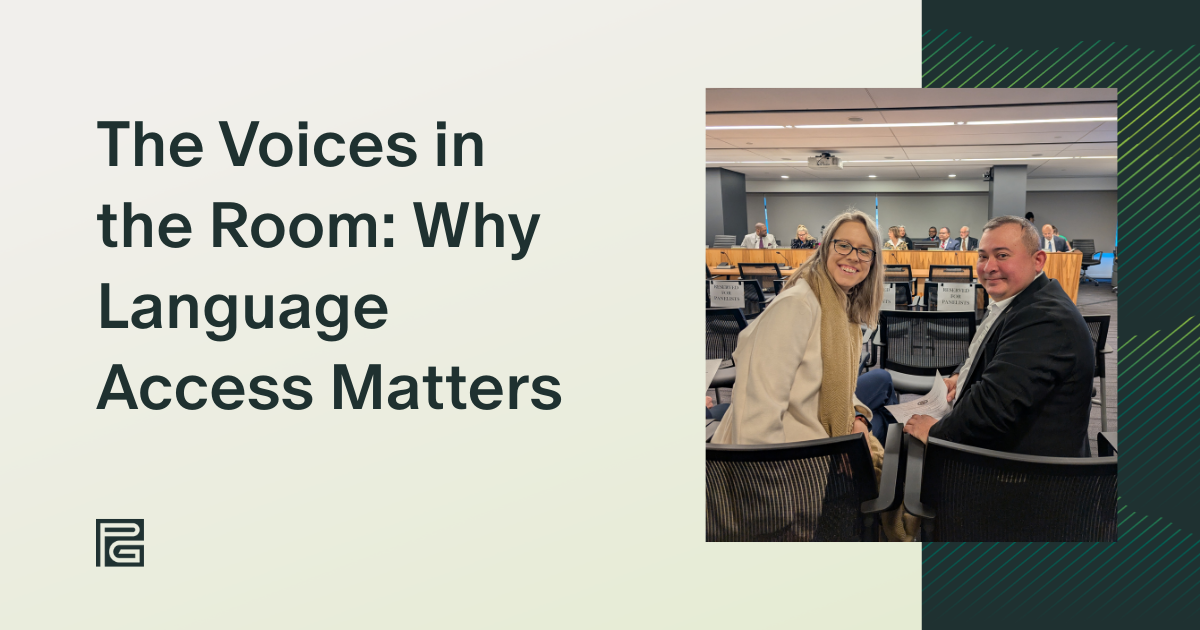
The Voices in the Room: Why Language Access Matters

There’s clarity that only comes when you’re in the room.

On March 25, we attended the U.S. Commission on Civil Rights (USCCR) briefing, Language Access for Individuals with Limited English Proficiency. We had read the agenda. We had seen the talking points. But nothing prepared us for the raw honesty of the testimony shared. For those who only watched the livestream, it is hard to convey how charged, human, and deeply personal the testimony felt in that room.

We didn’t testify—we were there to listen. As leaders in language operations and technology, we felt a responsibility to bear witness, reflect on what it means for our industry, and ask how we can do more.

As we sat listening, one thing was undeniably clear: Language access isn’t a nice-to-have or a bureaucratic box to check. It’s a public safety imperative. A moral obligation. And yes, a business issue.


A Personal Reflection: Clare

For me, it was deeply personal. I’m relatively new to the language access world—but I’m not new to what it feels like to be in a room where language is a barrier to belonging. As I sat, notebook in hand, memories came flooding back of the neighborhood I grew up in, where neighbors didn’t always share a language but shared everything else: meals, rides, childcare, laughter. I thought of my mom, who often stepped in to interpret for our neighbor, Aritza. She helped her navigate everything from coordinating with city maintenance workers to communicating with healthcare providers and law enforcement.

At the time, I saw it simply as neighborly support. But sitting in the hearing, I understood it differently. The burden of trying to make your world understandable without the right tools and support suddenly felt much heavier. Especially when I heard story after story of children interpreting for their parents in emergencies or translating complex forms at school. The emotional toll and the responsibility are too much for anyone, let alone a child.

As Ms. Tran reminded us during her testimony, “Interpreting is a specialized skill—one that requires training, accuracy, and cultural sensitivity. It’s not something you can ask someone to do just because they happen to speak the language.”


A Personal Reflection: Gilbert

From a basic accessibility lens, this is a failure to understand fundamental needs and requirements. If we’re not delivering the message clearly, consistently, and equitably, then we’re not solving the problem—we’re compounding it.

Poor design in communication isn’t just frustrating, it doesn’t just cost money; it’s dangerous. If you don’t build language access into civic interfaces from the start, you’re designing for failure. It’s not enough to simply translate a message. We have to deliver it in a way that is clear, unambiguous, in context, and accessible, whether that’s a posted evacuation plan, a courtroom proceeding, or a parent-teacher meeting. Language access isn’t a bolt-on feature. It has to be part of the blueprint. The consequences of mislabelling something are universally bad, and all languages and people deserve it; the collective costs are far outweighed by the modest investment in language access. It’s an investment in the community–we heard repeatedly that it’s not just about speaking their language, but in understanding their story. True access comes when communities shape the message, not just receive it.

It also struck me how often the children as interpreters came up—not just as witnesses to their parents’ struggle, but as participants, carrying burdens they should never have to bear. It’s a sign of quiet desperation when a child becomes a system’s last line of defense.


Stories of Barriers, Advocacy, and Solutions


When Translation Isn’t Enough: The Call for Meaningful Access

Mr. Lynip, a teacher and advocate in Richland School District in Columbia, South Carolina, spoke not just about tools or technology—but about the gap between communication and comprehension. And how students suffer when families are unheard.

He challenged the Commission to take seriously a term in its own mission statement: meaningful access.

“It’s not just a matter of having translated or interpreted materials. Parental voice has to be meaningful. It has to be loud enough for us to hear.”

He shared real stories of students:

  • A student delayed for over a year in receiving educational testing because the family couldn’t navigate the system.
  • A child who missed two weeks of school—not because of illness or truancy, but because her family didn’t know that having a scheduled vaccination appointment was enough to attend.
  • A young girl placed in fourth grade against her mother’s wishes—only to discover later that the child had missed the first two years of school entirely.

These weren’t translation problems. They were listening problems. Design problems. System problems.

However, Mr. Lynip also offered hope, pointing to local innovations like Healthy Learners, a program that eliminates healthcare access barriers by transporting students directly to appointments. He called for more intentional collaboration—across hospitals, schools, civic groups—to remove friction points and build systems where families are seen, heard, and served.


“She’s Only Nine Years Old”

Ms. Tran, an attorney at Community Legal Services of Philadelphia, shared her personal story and professional perspective.

As the child of Cambodian refugees, she often served as an interpreter for her parents in legal, medical, and emergency settings. One memory stood out:

“A police officer entered my family’s restaurant and asked my mother to interpret for a man outside. She explained she couldn’t leave the counter—she was the only one working. The officer pointed at me and said, ‘Well, what about her?’ My mother, in disbelief, replied, ‘No, she’s only nine years old.’”

Ms. Tran wasn’t forced to go outside that night—but she recalled many times she did interpret as a child, witnessing situations she never should have been part of.

“This experience is not atypical for children of people with limited English proficiency. It is still happening today.”

Professionally, Ms. Tran now leads language access advocacy work and represents individuals with disabilities navigating Social Security. She shared the ways in which inconsistent, unreliable interpretation services can derail an already difficult process—like the story of her client Kay, who was forced to testify in English due to audio issues with her Vietnamese interpreter. The hearing had already taken six months to schedule. Kay complied rather than risk another delay.

“The failure to provide reliable interpretation services resulted in wasted time and resources, and placed an undue burden on K—adding frustration and anxiety to an already stressful process.”

Ms. Tran’s message was clear: this is not a one-off. These are recurring systemic failures. Her recommendations emphasized the need for stronger legal protections, faster complaint resolution, and the kind of enforcement that makes civil rights real.


A Personal Mission, Made Professional

Ms. Muñoz, a compliance officer at DHR Health, didn’t just talk about policy—she talked about people. And she brought her whole self to the room.

“This is personal… My commitment to serving my community has been a lifelong hobby.”

Raised along the U.S.–Mexico border, Ms. Muñoz shared her journey—interpreting for families in her community, supporting students with disabilities, and now overseeing ADA and language access services for a healthcare system that serves nearly 2 million people.

She spoke not only about the emotional weight of language access, but about the practical infrastructure her team has put in place—bilingual staff, in-house interpreters, proficiency assessments, community education, and multi-tiered language support. Spanish-language services are built into their staffing model and budget planning.

“Language access is a fundamental part of delivering quality healthcare. Effective communication empowers patients to make informed decisions—improving both outcomes and overall well-being.”

Even in a region where Spanish is dominant, Ms. Muñoz emphasized the importance of preparing for less common languages and continually expanding access tools. Her testimony was a reminder that doing this work right takes intention, empathy, and investment. And when done right—it works.


“They Don’t Just Translate Words. They Save Lives.”

Ms. de la Iglesia, Director of Language and Accessibility Services at Mount Sinai Health System in New York City, has spent nearly two decades working at the intersection of language and care. But her testimony started with something more personal:

“As an immigrant to this country 25 years ago—without language—I experienced firsthand what it is and how it feels.”

At Mount Sinai, her team supports patients speaking over 800 languages. Her integrated, multi-modal approach includes in-person interpreters, phone and video services, embedded technology, and written translations.

“Interpreters are critical. They don’t just translate words. They save lives.”

She spoke of interpreters facilitating surgeries, transplants, and end-of-life conversations. Despite the ongoing challenges—especially for rare languages and patients with disabilities—her message was clear:

“This work speaks to our shared humanity—and our belief that every person deserves to be heard, in their own language, in their own moment.”


Designing for Dignity: Native Language Access

Ms. Allison Neswood, Senior Staff Attorney at the Native American Rights Fund and citizen of the Navajo Nation, reminded us that language access is not one-size-fits-all.
Many Native languages are unwritten, have multiple dialects, or lack direct translations for complex concepts. That demands more than forms—it demands partnership.

“When my community members need to speak about something personal or important, they shift back into Navajo.”

She urged the Commission to build systems that reflect cultural understanding, designed in collaboration with Native communities—not just for accuracy, but for dignity. Her testimony reinforced something we’ve heard across many communities:

“Language access isn’t just a service—it’s a signal of respect.”


The Business Case: Often Overlooked

Lack of language access doesn’t just harm individuals. It breaks systems. 

It increases risk. It drives up costs. It slows emergency response. It adds friction to every interaction.

At the briefing, Dr. Bill Rivers, a linguist and national leader in language access policy, laid out the real-world operational gaps that persist—especially at the local level. While legal protections are in place, implementation is inconsistent. Schools, healthcare systems, and municipal agencies are often overwhelmed, under-resourced, and facing a patchwork of languages spoken by small populations. 

“This isn’t just about refraining from discrimination—Language access is much more like provision of access under the Americans with Disabilities Act. It requires proactive action. We have to do something. That means extending resources, investing in infrastructure, and doing the hard work of designing for access.”

That “something” means building access into the design of our systems—not bolting it on as an afterthought. It means recognizing that miscommunication isn’t just inefficient—it can create risk, delays, and breakdowns in service delivery.

The industry has the capacity to meet the need—350+ languages, 24/7, often in under two minutes. But systems must be in place to take advantage of it. Without that infrastructure, even the best language providers can’t close the gap.

The reality is that when language isn’t a given, communication must be intentional.

That’s the work we do every day—creating access on purpose. And in a moment like this, when responsibility for language access is increasingly shifting to state and local levels, our role becomes even more vital.

We’re not just enabling compliance. We’re helping systems work—efficiently, equitably, and safely.


The Call Forward

We didn’t just walk away with notes. We brought the stories back to our teams, to our clients, and to our company roadmap.

We’re working with school districts, hospitals, and public agencies to build solutions that don’t just comply—they connect.

We’re building systems that reduce risk, improve trust, and reach people in the language they understand.

We’re not waiting on a perfect policy. We’re moving with clarity and urgency.

Because this work doesn’t belong to one party, one agency, or one industry. It belongs to all of us.

We’ll be listening. And we’ll keep building what’s next.

The U.S. Commission on Civil Rights briefing highlighted the real-world impact of language barriers across education, healthcare, and public services. For educators, these challenges are especially pressing. If you’re an educator located in the DMV area, join us at our second annual Language Access Symposium to explore solutions, share experiences, and collaborate on building more inclusive schools where every student and family is heard. Among others, you’ll hear from Mark Byrne, Jason Velasco, and Bill Rivers on the future of language access in K-12 education.

Measuring Success in K-12 Language Access: A Conversation with Mireya Pérez

The Language Access Lectern | a Piedmont Global Podcast | Episode 4

As English learner (EL) student populations continue to grow, language access remains an urgent need in K-12 classrooms. In conversation with Mireya Pérez, the interpreting services coordinator for Arlington Public Schools and founder of the Brand the Interpreter podcast, Language Access Consultant Mark Byrne unpacks how schools can improve coordination to help EL students catch up to their peers.

You can listen to the full episode here. Keep reading for a recap of Mark and Mireya’s insightful conversation, which was originally broadcast on Brand the Interpreter.


Finding Your “Why” as a Language Access Advocate

Mark: I grew up in a relatively low-income family and struggled a bit when growing up. We didn’t have a lot of opportunities to travel. When I had the opportunity to put myself through college, as part of the mission at Holy Cross, I did a cultural immersion program and found myself in Peru. It made me appreciate the sacrifices that my family made for me. After the immersion program, my language skills were sharper. Mostly, I returned with a sense of gratitude, appreciation, and respect for people and cultures.

Mireya: How did these experiences get you started with language access?

Mark: Nothing really makes me feel as good as I do about positioning language services in a K-12 setting. Language companies across the United States—and globally—don’t focus on K-12 schools as much as they should. Schools get left behind in terms of developing solutions. It’s a great opportunity to advocate for families, multilingual students, school staff, and the interpreters that we work with.

MireyaWhen individuals hear language access, they may think about public education and interpreters. We know there is a lot more involved, so I’d like to hear what you are observing, the gaps you’re noticing, and your experiences with language access in schools right now.

Mark: When we talk about language access in schools, it’s about not only expanding the service itself but expanding the knowledge behind the work. As somebody who struggled with their own education, who sat through disciplinary and special education hearings and outplacements, when it became clear you’re not going to be able to make it through the school year, I remember sitting through those meetings not processing what was happening. I’ve sat in that seat and know what it feels like. But I’m also very fortunate in not having a language gap. I had to take remedial math classes, and still went on to earn my four-year diploma and a Master’s degree after that.

When you start thinking about the experience that multilingual families have in the special education realm, engagement is so important. My family was there at all those meetings advocating on my behalf. They got me through to the next level. When there is a language gap, it can be difficult for families to advocate for their students. It’s difficult for the school staff to understand what’s happening at home. At the end of the day, we want to help as educators.

MireyaWhat else brought you to this field?

Mark: Another thing that shaped my foundation, understanding of the K-12 space, and how I view language access stems from my experience working with student data at a research and analytics firm. It gave me unique insight into how school leaders think about education and the achievement gaps across different student groups. When you look at multilingual families, you see that very few of them are achieving the student growth rates that their peers are. If we don’t grow those multilingual learners at an accelerated rate, those achievement gaps will continue to exist for years and years.

The business of schools is academic return on investment. It’s not about dollars invested for financial return, like you would think about in a business setting. It’s about dollars invested for student growth.

As I think about the language services space and how we position it, we need to bring resources, training, and an understanding of why we use these services to the end users. We also need to share that story with school leadership, school boards, leaders in the community, and stakeholders and share the impact that language services can make in a K-12 setting.


Identifying Gaps in K-12 Language Access

Mireya: In education, there are different layers of administration, and most or all of them are involved in the conversation surrounding language access. In many school districts, for example, language access is fragmented. You’ve got one piece being worked on in one department, and then you’ve got another piece of language access being worked on in a different department. In many situations, those departments don’t speak to one another. 

There are unique school districts with superintendents and board members who understand language access and all its complexities, but it’s very rare. It’s a unicorn. What have you seen in your current role in the education field and having conversations with school leadership?

Mark: I do think there is a lot of curiosity about technology, and always a focus on compliance around state and federal legislation. But language access is not equal in all 50 states. I think there’s a lot more that we can do in schools to support our multilingual families: being more considerate of tools and putting together a comprehensive plan around language access are important.

Schools have a strategic plan, and it relates to growth and buildings and creating different services within the district, but language access is (almost) never a component of that strategic plan. What you mentioned to me was that different departments are disconnected from the work they’re doing to support language access across schools, and that’s part of the conversation that I’m trying to bridge.

If the right hand doesn’t know what the left hand’s doing, then we’re going to have a hard time helping students achieve as much success as they could possibly have. That’s true whether they’re a multilingual family or if they’re a family or student who is Deaf or hard of hearing.


Measuring Success in K-12 Language Access

Mireya: How can someone that potentially does not understand language access make the connection to how it needs to work — and its value?

Mark: Academic return on investment is an important component for school leaders to understand. Measuring and quantifying how an investment is impacting students is critical. We need to understand what students can get out of it by taking a look at the data.

Also, when you’re thinking about the role of an interpreter, one of the most important things that we’re trying to do, especially within a special education setting, is establish credibility and trust with the family. As you start talking about outplacement services for families to react to and perhaps allow their students to take advantage of the best of what your district has to offer, you will need to get buy-in from that family. A conversation in broken English is not allowing them to have meaningful participation in their child’s education.

Often, school leaders like to think about the output instead of the impact. They’re concerned with lost time, as you might think about in a manufacturing setting. But when there’s a language barrier between a family and staff, that’s lost time right there.

Say a director at a school district has a family coming in and can’t figure out how to converse with them, and they’re sitting there while the director is trying to figure out a solution; that’s lost time. Consider how many EL students you have across your district and how many interactions they have, and then you start to realize how much lost time can exist and what an incredible bottleneck that is. I only bring this up to reinforce the importance of having a strategic language access plan to train and articulate the who, how, and why of servicing these families. 

Eager to learn more? Listen, watch, and subscribe to The Language Access Lectern on YouTube and piedmontglobal.comDiscover how Piedmont Global approaches interpreting, translation, and K-12 language access planning services here.

5 Best Practices to Optimize K-12 Language Access Planning

English learner (EL) students often face achievement gaps compared to their peers. Recent National Center for Education Statistics data found that 6.1 percent of twelfth graders remained English learners through graduation. With 15 percent of first graders entering elementary school as English learners, as many as 40 percent of EL students could be slipping through the cracks.

The factors contributing to these outcomes are multivariable and complex, which means promoting language access is not the sole responsibility of one person or department. Rather, it is the responsibility of the entire school system. A cohesive language access plan is essential to helping multilingual students and families receive equitable access to opportunities. Without a plan, EL students are at risk of falling behind, parent engagement will be impacted, and school districts could someday face litigation.

We spoke with experts in K-12 language access planning to create the following best practices guide. Administrators and teachers can use these tips to map out, fund, administer, and refine a plan that works for their schools and student populations. Each best practice contributes to an overarching goal: improving outcomes for students by engaging with EL families competently and compliantly.


Best Practice #1: Identify Your Language Access Champions

It’s no secret that most K-12 professionals work long hours. To increase awareness and adoption of language access resources, you need to make the process streamlined, and you need champions committed to cultivating enthusiasm. This is true whether you are designing your first language access plan, working to improve existing policies, or expanding a plan’s scope to support more students and families.

A language access champion may help with some or all of the following: 

  • Inform parents about their rights  
  • Show parents how to request language access resources  
  • Facilitate staff adoption of language access services 
  • Answer questions and pass along staff feedback 
  • Advocate for funding

Language access champions bring energy, awareness, and follow-through to maximize the reach and impact of this important work. Your champions may be responsible for the internal adoption of policies, while others may focus on encouraging parents to take advantage of services. In either case, the best way to locate your champions is to find out who is already making an effort.

Consider hosting a training that covers how to work with interpreters, engage with technology, and understand when it is appropriate and compliant to deploy language access. The teachers and administrators who show up with enthusiasm might be open to formalizing their role as language access champions.


Best Practice #2: Quantify the Need for Language Access

In many school districts, the need for language access is underestimated. This can lead to a false assumption that a larger investment in language services is unnecessary. Instead, follow the data: often times, you will find that EL families and students are underserved. 

Quantifying the need for language access is a foundational step of language access planning. One straightforward method to gather this data is tagging EL students and families in your student information system (SIS). This process should be repeated with every new school year. 

Understanding the scope of language access needs will not only help allocate internal resources. You will also need this data to take full advantage of ESSA Title III funding for EL programming.


Best Practice #3: Identify When Professional Language Services Are Required

In certain situations, language access is not just helpful—it’s mandatory. When meetings or documents influence decisions or outcomes related to student academic performance, enrollment, safety, or disciplinary action, professional language services must play a role. Without it, there is a risk of families not fully understanding their rights, responsibilities, or the impact of a decision on their child’s education. 

Common scenarios that require professional language services include: 

  • IEP meetings 
  • 504 plan meetings 
  • Parent-teacher conferences 
  • Emergencies 
  • Disciplinary hearings and legal proceedings

Activating professional language services for any of the above scenarios should not present bottlenecks. Procedural guidance ought to cover the following proactive steps:  

  • Schedule interpretation services in advance—don’t wait until the last minute. 
  • Add 50% more time to scheduled meetings to ensure all parties have adequate time to communicate with each other. 
  • Provide interpreters with key documents in advance to prepare for the conversation. 
  • Assure families of confidentiality by confirming that interpreters adhere to FERPA regulations.

Last but not least, there is one policy every school must follow: multilingual students are not interpreters. Using students or untrained staff can compromise the accuracy of communication, jeopardize trust, and expose the school to lawsuits. 


Best Practice #4: Clarify the Role of Multilingual Staff

Multilingual staff play an essential role in schools with diverse populations, but it’s important to recognize they are not a replacement for professional linguists. 

Teachers who speak more than one language can offer valuable support for informal communication needs. In contrast, interpreters are trained to facilitate accurate, culturally competent communication in formal settings with higher stakes. 

Experienced interpreters have the knowledge and skills to handle complex educational terminology, navigate sensitive topics, and build trust with families. They have experience in situations like IEP meetings, 504 planning sessions, school board meetings, parent-teacher conferences, and disciplinary hearings, where neutrality and confidentiality are essential. 

While multilingual staff bring language skills to their classrooms, they may not have the formal training or experience to provide unbiased, accurate interpretation. It also introduces liability to the school district if a bilingual staff member handles interpreting and a misunderstanding occurs. 


Best Practice #5: Create (or Refresh) Your Language Access Plan

Recent settlements between school districts and the Department of Justice have made requirements clear: 

  • Have a consistent, accurate process for identifying families with language barriers 
  • Provide essential information to families in a language they understand 


Maintaining an up-to-date language access plan is essential to increase engagement with EL students and families and comply with anti-discrimination laws. It should detail the who, what, when, how, and why—and identify the procedures to access language services in a timely manner. 

For low-risk, informal communications, texting apps and devices can be useful. Be mindful that these tools leverage machine translation, which is not guaranteed to be accurate without expert linguist supervision. For conversations that require more nuance, persuasion, impartiality, or trust-building, your language access plan must identify how to reach a professional interpreter. They may be accessed over the phone, via a virtual platform like Zoom or Google Meet, or in some cases work onsite. Additionally, forms and handouts for parents should be translated into your district’s most commonly spoken languages. 


Partner with Piedmont Global for K-12 Language Access Planning

Ready to work on your language access plan? Whether you are starting from the beginning, making improvements, or simply looking for a language services provider with education-focused linguists, Piedmont Global can help.

Piedmont Global works with school districts across the United States to build a pathway to compliance and support better outcomes for EL students and families. For more information on creating, implementing, and optimizing your school’s language access plan, reach out to our team of experts today.

Language Access in Education

We’ve all felt it before. The stress of being misunderstood, the unease of not understanding, the worry that something will go wrong because the person listening isn’t really hearing you. That feeling is an everyday reality for millions of students and their parents across America. From understanding teachers and school nurses to navigating medical emergencies and reading paperwork, school can quickly become a language minefield for anyone not fluent in English.

So, how important is language access for students in America, and how far do we have left to go before we can consider the American education system equally accessible to all?


Language Access Prioritization

The need for educational institutions to prioritize language access is growing. According to the National Center for Education Statistics, the number of English Language Learners (ELLs) has grown to more than five million over the past decade.

While 77% of ELL students speak Spanish, there are still a wide variety of language needs across the US. According to Pew Research, “in five states, a language other than Spanish was most commonly spoken at home among English learners. In Maine, for example, Somali was the most common language spoken at home. In Vermont, Nepali was.” Pew Research goes on to say, “Arabic was the second-most common language spoken at home by ELL students in 16 states and was among the five most common languages in 39 states.” The stats continue to make it clear that each institution, region, and state requires a unique approach to tackle language access difficulties.

While there is still a substantial disparity in language access in schools in the US, there is a simple solution that any school, university, or government branch responsible for education can quickly implement. But first, how do barriers to language access impact education? We explore two example scenarios below.


Epidemics & State-Wide Emergencies

While COVID-19 improved the state of multi-language communication in many ways, it also brought to light an array of painful gaps in language access across America. For example, in Virginia, an error in the government’s translation process resulted in Spanish readers being told they don’t need to vaccinate. Had a Spanish speaker familiar with medical terminology been involved in the writing or proofreading of the website, the mistake may not have occurred. Technology has provided tremendous leaps in language access. Still, for something as important as the community’s collective health during a pandemic, it’s essential governments and schools seek the input of professional translators and interpreters.

The same is true for other emergencies. While the pandemic required medical terminology, each disaster brings its complications. For example, 120 hurricanes hit Florida between 1851 and 2018, and according to Data US, 30% of Florida’s citizens are speakers of a non-English language. Schools have a duty of care to the students they’re entrusted with and must ensure they’re communicating the correct actions to each child in the case of a hurricane and other natural disasters. Communication starts with advanced preparation and strong partnerships with critical translators.


Language Service Solutions in Schools

Communication is part of daily life for students, parents, educators, and school staff. When language is a barrier, schools are unable to reach their primary goal of helping students succeed. All school’s need a trusted language services provider that offers experienced interpreters, quality translations, on-demand resources, and access to many languages.

There are countless situations when language services are needed in schools. Some common examples are:

  • Interpreters at events, conferences, and meetings
  • Translation of important documents like progress reports, calendars, and syllabi
  • Translation and interpretation through individualized education programming
  • Everyday ASL interpretation
  • Emergency situations

Whether they work in K-12, higher education, or beyond, we’ve found our clients come to us with three main difficulties that prevent them from addressing the negative impacts of poor language access:

1) They often find it challenging to find a translation and interpretation provider that speaks the languages they need. Many schools are language melting pots, and interpretation providers must talk a variety of languages to ensure students aren’t being left out. At the same time, each scenario carries its own nuances, and providers must have the training required to convey medical, educational, or scientific information correctly when the moment strikes.

2) They find it challenging to find an interpreter when they need one. Some of our current clients have struggled in the past when they’ve worked with a single interpreter, as they may not be available at a moment’s notice. When emergencies happen, it’s essential educational institutions can provide their students with interpretation or translation quickly and effectively.

3) They’ve found providers who address all their needs to be expensive. Education budgets can sometimes be tight, which is why we help all our clients find a solution that gets their students the best without going over budget.


Language Solutions for Education with Piedmont Global

At PGLS, we’re proud to offer translationinterpreting, and language training services to schools and other educational institutions in over 200 languages. We understand that each student is unique, so we pay special attention to offering services in the correct regional variety and providing subject matter experts where necessary.

Get in touch with our team to bring true language equality to your students.

Why Organizations Value Asian Translation Services from a Native Speaker

The globalization of commerce has seen countries like China rise in recent years to become some of the most powerful economies in the world. Manufacturing, for example, has shifted East in a big way.

The rise of the middle class in these countries has created new markets for Western businesses and seized opportunities for organizations to enter joint ventures and other collaborative relationships with Asian companies.

The following examines the value of Asian language translation services and the importance of working with native speakers.


The Benefits of Asian Language Translation Services

There are several reasons why organizations value translation services. We’ve listed a few of the most important benefits below:


Over 200 Languages

Some companies choose to work with an individual freelancer who is a native speaker of the language they need. However, this can be risky because you’re putting all your eggs in one basket.

It is unlikely that a single person will be a native speaker of all the languages you might need. This is where working with a company that specializes in Asian language translation can be beneficial.

At Piedmont Global, we have a team of native speaker experts and can offer over 200 languages. We can help you source materials in Taiwan while helping you navigate the complexities of doing business in Japan.


Reliability

The first and most apparent benefit is reliability. When working with translations, it’s crucial to trust the person or organization you’re working with.

There are many moving parts in any translation project. Things can easily go up in smoke if the people you’re working with don’t have a strong understanding of the source language. Likewise, if the translator you’re working with doesn’t have a strong understanding of the target audience, they might not be able to properly convey the message you’re trying to communicate.


Increased Accuracy in Translations

Native speakers have a better understanding of the subtleties and nuances of their home languages. This increased understanding leads to improved accuracy in translations.

This is important because the meaning of sentences or paragraphs can easily get lost in translation. When you’re dealing with something as crucial as business communications, you can’t afford to have any inaccuracies in your translations.

As a bonus, increased accuracy can also lead to stronger relationships with your Asian business partners.


Localization

A better understanding of regional dialects is another benefit of working with a native speaker. In many countries, there can be a significant difference in the way people speak in different regions. Linguistically, some countries are considered to have many languages with a common writing system.

In the same vein, you want to respect the different cultures you’re working with and use the appropriate language when addressing them. For example, extended eye contact in the west might be seen as a sign of respect, but in some cultures in Asia, it might be interpreted as disrespectful.


Industries That Rely on Asian Translation Services

Many industries rely on Asian language translation services. Working with Piedmont Global offers numerous benefits to many different industries including education, healthcare, legal services, and more.


Manufacturing

The globalization of the manufacturing industry has led to an increased need for accurate and timely translations of technical documents. Manufacturers frequently generate complex technical documents that include manufacturing terminology, scientific information, and technical descriptions. Additionally, translations of such technical documents generate text that exceeds specified character limits. At Piedmont Global, we have a team of experienced translators familiar with the specific jargon and terminology used in the manufacturing industry. We can accommodate your specifications without compromising quality.

From MSDS/SDSs to marketing materials, our team understands the importance of accuracy in tone, meaning, and technical details. You can be confident that the translated text will convey your message effectively.  Learn more about our translation services for manufacturing.


Education

One industry that relies heavily on translation and interpretation services is education. Communication is part of daily life for students, parents, educators, and school staff. When language is a barrier, schools are unable to reach their primary goal of helping students succeed. Learn more about language access in schools.

Additionally, there has been an increase in the number of US, Canadian and European teachers moving abroad to teach English in Asia. However, these teachers often don’t have any training in the local language, which can make it difficult to communicate with their students properly. Here’s where language services come in.

We can help these teachers by providing them with translations of the key phrases and concepts they need to teach their classes. We can also help them to better understand their students by translating student work and essays. Learn more about our language services for education.


Healthcare

Another area that has come to rely heavily on translation services is the healthcare industry. There are valid reasons for this. First, there has been an increase in medical tourists going to Asia for treatment. These medical tourists often don’t speak the local language. Hospitals and clinics need to be able to communicate with them in their native language.

Another reason why the healthcare industry has come to rely on translation services is the rise of telemedicine. With telemedicine, doctors and patients can consult from different parts of the world. However, this consultation can only be effective if there is a good understanding between the doctor and the patient. Learn more about our medical and healthcare language services.


Legal

The legal industry is another field that has come to rely on Asian language translation services. That’s because there is a growing need for legal documents to be translated into Asian languages, from business contracts to artistic licenses. Immigrants who have been charged with a crime also need to understand the legal documents they are being asked to sign.


Other Industries

These are just a few industries that now rely on Asian language translation services. As you can see, there is a growing need for these services in many different fields. Governmentmedia, and the nonprofit sector are also among the many industries that have come to need these services.

We’ve also seen a growing demand for these services in the financial sector. In recent years, there has been an increase in fintech startups in Asia. These startups often need help translating their products and services into the local language.


Getting Started with Piedmont Global’s Asian Language Translation Services

Now that you know more about the benefits of working with a native speaker, you may be wondering how to get started.

If you’re looking for a reliable and experienced company to provide you with these services, we can help. From translation to interpreting and language training training, we’re here to support all of your language needs.

The first step is to request a quote and let us know what languages you need. We will then match you with one of our expert translators. Contact us today to get started.