Why Human-in-the-Loop AI Is the New Standard for Localization

AI has transformed localization more in the past two years than in the previous twenty. What once took days can now take minutes. What required extensive workflows now launches in a single click. Teams are moving faster, content volumes are exploding, and leaders are rightfully asking the big question: 

When is AI enough, and when does a human need to step in? 

Across every regulated industry we serve — healthcare, legal, insurance, manufacturing — executives are looking for clarity. Not hype. Not fear. A framework. Something that helps them balance speed with safety, efficiency with compliance, automation with accountability. 

That’s where Human-in-the-Loop (HITL) comes in: a governance-driven approach where AI accelerates the work, and humans secure the outcome. 

It’s quickly becoming the localization standard, and the standard we’re perfecting as your partner in Strategic Globalization. 


Why Organizations Are Moving Toward HITL 

Early conversations around AI in localization were dominated by replacement narratives. 

“AI will eliminate translators.”
“AI will automate entire workflows.”
“AI will make localization instant and free.” 

Today, the organizations we advise are asking a different and more strategic question: 

“How do we integrate AI responsibly, with guardrails that protect quality, cultural accuracy, and compliance?” 
Graphis that reads How do we integrate AI responsibly, with guardrails that protect quality, cultural accuracy, and compliance?

Enterprises aren’t rejecting AI. They’re operationalizing it. They’re formalizing HITL frameworks because the risks of LLM-only localization models are too significant to ignore: 

  • Undetected hallucinations 
  • Cultural misinterpretations 
  • Missing legal terminology 
  • Inconsistent tone or style 
  • Data privacy concerns 
  • Regulatory exposure

In industries where a single mistranslation can lead to patient harm, legal liability, safety failures, or financial risk, fully autonomous AI simply isn’t an option. HITL is safer, more scalable, and ultimately more cost-efficient. 


The “Right Touch” Model: Calibrating Human Involvement by Risk Level 

One of Piedmont Global’s principles around AI is simple: 

Not all content needs the same level of human involvement, but all content needs the right level of human involvement. 

We help organizations evaluate content through a Right Touch Framework across four dimensions:


1. Content Risk 

Is the content informational, instructional, legal, or safety-critical?


2. Audience Risk 

Could misunderstandings impact patient health, financial decisions, legal outcomes, or public safety?


3. Cultural Risk 

Does the content require cultural nuance, lived experience, or contextual understanding?


4. Compliance Requirements 

Is certified translation required? Does the content support regulated workflows? 

From here, we calibrate human involvement.
Some content is AI-first, human-verified.
Some is human-edited AI.
Some is human-led, AI-assisted.
And some remains human-only. 

This is the operational clarity leaders are asking for, and the foundation of future-ready language programs. 


Where AI Fails and Why Humans Still Matter 

LLMs are extraordinary pattern-recognizers. But culture is not a pattern; it’s context, identity, lived experience, and interpretation. 

AI struggles with: 

  • Humor and idioms 
  • Taboo language 
  • Sensitive topics 
  • Emotionally charged content 
  • Region-specific norms 
  • Social values and beliefs 
  • Industry-specific cultural expectations 
  • And more 

Humans don’t just translate words. They interpret meaning. 

That’s why we integrate cultural subject matter experts (SMEs) as quality governors inside AI systems, training models to reflect real-world nuance. It’s why we rely on human oversight to catch errors AI can’t see. And it’s why, ultimately, HITL is an upgrade and not a compromise. 


Post-Editing Maturity: How Teams Evolve with AI 

Most global organizations are somewhere on a post-editing maturity path:


1. AI Curiosity 

Teams experiment in pockets with generative AI, but usage is inconsistent.


2. AI Adoption 

Machine translation and post-editing enter the workflow, often without governance.


3. AI Alignment 

Teams create formal guidelines for post-editing, quality, risk, and review.


4. AI Embedding 

Enterprises develop custom HITL workflows, quality frameworks, and escalation paths.


5. AI Optimization 

Data, cultural insights, and human feedback loops train models to improve over time. 

Wherever you sit on this path, one principle remains the same:  

AI requires professional human oversight to achieve enterprise-grade accuracy. 


HITL in Regulated Industries: Where It Matters Most 

Healthcare 

  • Clinical accuracy 
  • Patient safety 
  • Informed consent 
  • Certified medical translations 
  • Multilingual patient communication 

Legal 

  • Legal terminology 
  • Case evidence 
  • Contracts & compliance 
  • Certified translations for court 

Insurance 

  • Policy accuracy 
  • Claim adjudication 
  • Regulatory alignment 
  • Customer rights & responsibilities 

Manufacturing & Government 

  • Safety documentation 
  • Technical manuals 
  • Recall notices 
  • Public communication 

In these sectors, quality is not a preference. It’s a legal requirement. HITL ensures organizations meet those obligations without sacrificing speed. 


How AI Is Reshaping Localization Teams 

Modern localization teams look different than they did even a year ago. 

Leaders are restructuring around: 

  • AI quality managers 
  • Culturally fluent SMEs 
  • AI-assisted project managers 
  • Data governance and compliance leads 
  • Tech + human hybrid workflows 
  • New escalation paths and review loops 

The future isn’t “AI vs. human.” The future is AI + human, integrated into a system where each strengthens the other. 

Graphic that reads The future isn't AI vs Human. The future is AI + human, integrated into a system where each strengthens the other.

The Future Standard: Human-in-the-Loop AI 

HITL is no longer a trend. It’s a strategic imperative for organizations that operate globally, responsibly, and at scale. 

It delivers: 

  • Faster workflows 
  • Higher accuracy 
  • Better cultural alignment 
  • Stronger governance 
  • Reduced risk 
  • Increased confidence 
  • Clearer compliance paths 
  • Improved customer experiences 

Organizations need clarity, calibration, and a partner who understands both the possibilities of AI and the realities of global communication. 

That’s why Piedmont Global exists. To help you lead globally, fluently, and confidently. 

If you’re evaluating how to integrate AI into your global workflows, we can help you design a Human-in-the-Loop model that accelerates your operations while protecting what matters most.
Explore Piedmont Global’s custom solutions → 

Breaking the Language Barrier in Forensics: A Perspective from Techno East

Last month, I had the chance to represent Piedmont Global at Techno Security East alongside our VP of Technology, Gil Segura. When we showed up, I expected the usual: booths, badges, and maybe a few new contacts. What I didn’t expect was to leave with a crystal-clear confirmation of something we’ve been sensing for months: that forensic and law enforcement agencies are hitting a wall when it comes to multilingual data.

And no one’s really helping them fix it.

Over three days, we met with dozens of local, state, and federal law enforcement professionals. What we heard was consistent: language is becoming a bigger and bigger barrier in digital investigations. Whether it is evidence extracted from phones, audio from body cams, or interviews conducted in the field, the multilingual footprint is growing. And most agencies don’t have a plan to handle it.

That’s where our work comes in.


A Clear Gap in the Market

Despite the enormous role language plays in modern investigations, most vendors haven’t caught up. The usual suspects (I won’t name them here, but you know who they are) tend to focus on volume-based interpreting or general translation. Their government offerings are often copy-pasted from healthcare or corporate templates, not built for the complexities of forensic workflows.

What we’re doing at Piedmont Global is different.

We’re not adapting existing products for government. We’re building new solutions, designed in partnership with the very people using them: law enforcement officers, investigators, forensic analysts. That co-design approach shows up in everything from our deployment models (on-prem, on-device, no cloud required) to the way we deliver training and support.

Examples of Forensic Linguistics in Action:

  • Investigative Linguistics
    Analyzing threatening text messages or social media posts in foreign languages to identify the author and prevent future harm. Every word counts in an investigation, and linguistic accuracy is at the heart of an investigation.
  • Author Identification
    Analyzing the writing style of a ransom note in a foreign language to identify the author and their background. Language identification is vital, but the ability to identify age, gender, and other key characteristics is a true game changer.
  • Analyzing Witness Testimony
    Analyzing the language used by witnesses who speak different languages to ensure accurate and fair representation of their statements. This evidence can come in a variety of formats: (Video, Audio, Digital Content, Documents, etc.)


What We Heard at Techno East

Several clear patterns emerged from our conversations:

  • Cloud Fatigue
    Almost everyone we spoke to said the same thing: they don’t trust the cloud. Whether it’s about data sensitivity, chain of custody, or just institutional policy, cloud-based tools often get blocked before they even get piloted. Our ability to deploy secure, localized solutions was a major differentiator.
  • Demo-First Decision-Making
    This audience doesn’t want a pitch, they want to see the tool work. On-the-spot demos of our platform generated more interest in five minutes than a PDF ever could. The ability to surface multilingual evidence instantly hit home.
  • An Underserved Niche
    Everyone was dealing with language issues. No one had a vendor they trusted to solve them. The most common question we heard? “Why hasn’t anyone built something for this?”
  • The Forensics-Language Loop
    One particularly compelling insight came from a few cybercrime teams: they want to use anonymized language data to help train models for early detection, but privacy regulations make that nearly impossible. That opens the door to future R&D partnerships focused on encrypted language data training.


The Piedmont Global Advantage: Built With, Not For

At Piedmont Global, we don’t just support law enforcement — we partner with them. Some of our most exciting product features were shaped through feedback from officers, analysts, and forensic technologists. That’s not something you can bolt on after the fact.

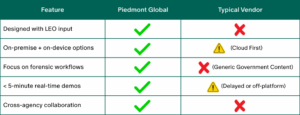
Here’s how we’re different from the competition:

Table showing Piedmont Global's capabilities versus other vendors

This isn’t about buzzwords. It’s about building language access tools that actually work for people in the field.

Where This Goes Next

We’re already setting up follow-up meetings from Techno East. Some leads are hot, some are exploratory, but all are tied together by a clear sense of urgency. No one wants to wait 5–10 business days for a translation when there’s a case on the line. And no one wants to guess at what a suspect said in a language they don’t speak.

That’s where we come in.

We’re helping teams:

  • Reduce evidence processing time
  • Improve accuracy in multilingual investigations
  • Stay compliant with chain-of-custody and data security requirements
  • Increase community trust through clearer communication

We’re already looking forward to next year’s Techno East in Myrtle Beach. We will be attending with deeper demos, more insights, and a strengthened commitment to solving real problems for law enforcement, not just checking a box.


Final Thought

This field is changing. Investigators aren’t just solving local crimes anymore; they’re navigating global data. And that data speaks every language.

Piedmont Global is here to help make sense of it.

Connect with me to learn more about our tailored solutions to navigate your global data.

The Voices in the Room: Why Language Access Matters

There’s clarity that only comes when you’re in the room.

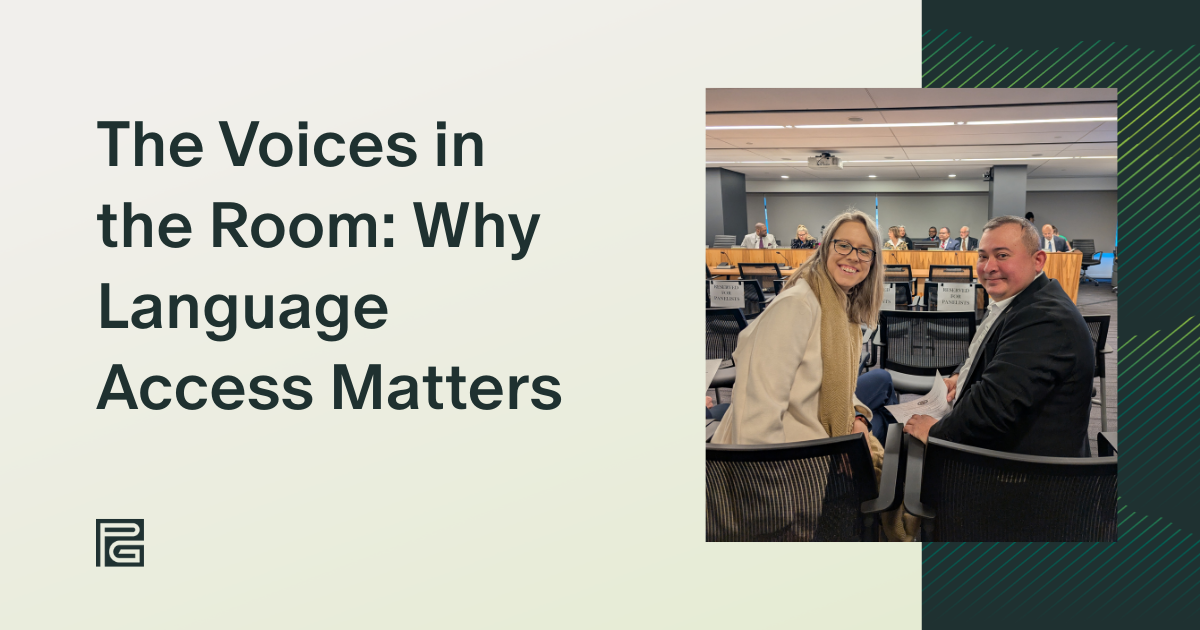
On March 25, we attended the U.S. Commission on Civil Rights (USCCR) briefing, Language Access for Individuals with Limited English Proficiency. We had read the agenda. We had seen the talking points. But nothing prepared us for the raw honesty of the testimony shared. For those who only watched the livestream, it is hard to convey how charged, human, and deeply personal the testimony felt in that room.

We didn’t testify—we were there to listen. As leaders in language operations and technology, we felt a responsibility to bear witness, reflect on what it means for our industry, and ask how we can do more.

As we sat listening, one thing was undeniably clear: Language access isn’t a nice-to-have or a bureaucratic box to check. It’s a public safety imperative. A moral obligation. And yes, a business issue.


A Personal Reflection: Clare

For me, it was deeply personal. I’m relatively new to the language access world—but I’m not new to what it feels like to be in a room where language is a barrier to belonging. As I sat, notebook in hand, memories came flooding back of the neighborhood I grew up in, where neighbors didn’t always share a language but shared everything else: meals, rides, childcare, laughter. I thought of my mom, who often stepped in to interpret for our neighbor, Aritza. She helped her navigate everything from coordinating with city maintenance workers to communicating with healthcare providers and law enforcement.

At the time, I saw it simply as neighborly support. But sitting in the hearing, I understood it differently. The burden of trying to make your world understandable without the right tools and support suddenly felt much heavier. Especially when I heard story after story of children interpreting for their parents in emergencies or translating complex forms at school. The emotional toll and the responsibility are too much for anyone, let alone a child.

As Ms. Tran reminded us during her testimony, “Interpreting is a specialized skill—one that requires training, accuracy, and cultural sensitivity. It’s not something you can ask someone to do just because they happen to speak the language.”


A Personal Reflection: Gilbert

From a basic accessibility lens, this is a failure to understand fundamental needs and requirements. If we’re not delivering the message clearly, consistently, and equitably, then we’re not solving the problem—we’re compounding it.

Poor design in communication isn’t just frustrating, it doesn’t just cost money; it’s dangerous. If you don’t build language access into civic interfaces from the start, you’re designing for failure. It’s not enough to simply translate a message. We have to deliver it in a way that is clear, unambiguous, in context, and accessible, whether that’s a posted evacuation plan, a courtroom proceeding, or a parent-teacher meeting. Language access isn’t a bolt-on feature. It has to be part of the blueprint. The consequences of mislabelling something are universally bad, and all languages and people deserve it; the collective costs are far outweighed by the modest investment in language access. It’s an investment in the community–we heard repeatedly that it’s not just about speaking their language, but in understanding their story. True access comes when communities shape the message, not just receive it.

It also struck me how often the children as interpreters came up—not just as witnesses to their parents’ struggle, but as participants, carrying burdens they should never have to bear. It’s a sign of quiet desperation when a child becomes a system’s last line of defense.


Stories of Barriers, Advocacy, and Solutions


When Translation Isn’t Enough: The Call for Meaningful Access

Mr. Lynip, a teacher and advocate in Richland School District in Columbia, South Carolina, spoke not just about tools or technology—but about the gap between communication and comprehension. And how students suffer when families are unheard.

He challenged the Commission to take seriously a term in its own mission statement: meaningful access.

“It’s not just a matter of having translated or interpreted materials. Parental voice has to be meaningful. It has to be loud enough for us to hear.”

He shared real stories of students:

  • A student delayed for over a year in receiving educational testing because the family couldn’t navigate the system.
  • A child who missed two weeks of school—not because of illness or truancy, but because her family didn’t know that having a scheduled vaccination appointment was enough to attend.
  • A young girl placed in fourth grade against her mother’s wishes—only to discover later that the child had missed the first two years of school entirely.

These weren’t translation problems. They were listening problems. Design problems. System problems.

However, Mr. Lynip also offered hope, pointing to local innovations like Healthy Learners, a program that eliminates healthcare access barriers by transporting students directly to appointments. He called for more intentional collaboration—across hospitals, schools, civic groups—to remove friction points and build systems where families are seen, heard, and served.


“She’s Only Nine Years Old”

Ms. Tran, an attorney at Community Legal Services of Philadelphia, shared her personal story and professional perspective.

As the child of Cambodian refugees, she often served as an interpreter for her parents in legal, medical, and emergency settings. One memory stood out:

“A police officer entered my family’s restaurant and asked my mother to interpret for a man outside. She explained she couldn’t leave the counter—she was the only one working. The officer pointed at me and said, ‘Well, what about her?’ My mother, in disbelief, replied, ‘No, she’s only nine years old.’”

Ms. Tran wasn’t forced to go outside that night—but she recalled many times she did interpret as a child, witnessing situations she never should have been part of.

“This experience is not atypical for children of people with limited English proficiency. It is still happening today.”

Professionally, Ms. Tran now leads language access advocacy work and represents individuals with disabilities navigating Social Security. She shared the ways in which inconsistent, unreliable interpretation services can derail an already difficult process—like the story of her client Kay, who was forced to testify in English due to audio issues with her Vietnamese interpreter. The hearing had already taken six months to schedule. Kay complied rather than risk another delay.

“The failure to provide reliable interpretation services resulted in wasted time and resources, and placed an undue burden on K—adding frustration and anxiety to an already stressful process.”

Ms. Tran’s message was clear: this is not a one-off. These are recurring systemic failures. Her recommendations emphasized the need for stronger legal protections, faster complaint resolution, and the kind of enforcement that makes civil rights real.


A Personal Mission, Made Professional

Ms. Muñoz, a compliance officer at DHR Health, didn’t just talk about policy—she talked about people. And she brought her whole self to the room.

“This is personal… My commitment to serving my community has been a lifelong hobby.”

Raised along the U.S.–Mexico border, Ms. Muñoz shared her journey—interpreting for families in her community, supporting students with disabilities, and now overseeing ADA and language access services for a healthcare system that serves nearly 2 million people.

She spoke not only about the emotional weight of language access, but about the practical infrastructure her team has put in place—bilingual staff, in-house interpreters, proficiency assessments, community education, and multi-tiered language support. Spanish-language services are built into their staffing model and budget planning.

“Language access is a fundamental part of delivering quality healthcare. Effective communication empowers patients to make informed decisions—improving both outcomes and overall well-being.”

Even in a region where Spanish is dominant, Ms. Muñoz emphasized the importance of preparing for less common languages and continually expanding access tools. Her testimony was a reminder that doing this work right takes intention, empathy, and investment. And when done right—it works.


“They Don’t Just Translate Words. They Save Lives.”

Ms. de la Iglesia, Director of Language and Accessibility Services at Mount Sinai Health System in New York City, has spent nearly two decades working at the intersection of language and care. But her testimony started with something more personal:

“As an immigrant to this country 25 years ago—without language—I experienced firsthand what it is and how it feels.”

At Mount Sinai, her team supports patients speaking over 800 languages. Her integrated, multi-modal approach includes in-person interpreters, phone and video services, embedded technology, and written translations.

“Interpreters are critical. They don’t just translate words. They save lives.”

She spoke of interpreters facilitating surgeries, transplants, and end-of-life conversations. Despite the ongoing challenges—especially for rare languages and patients with disabilities—her message was clear:

“This work speaks to our shared humanity—and our belief that every person deserves to be heard, in their own language, in their own moment.”


Designing for Dignity: Native Language Access

Ms. Allison Neswood, Senior Staff Attorney at the Native American Rights Fund and citizen of the Navajo Nation, reminded us that language access is not one-size-fits-all.
Many Native languages are unwritten, have multiple dialects, or lack direct translations for complex concepts. That demands more than forms—it demands partnership.

“When my community members need to speak about something personal or important, they shift back into Navajo.”

She urged the Commission to build systems that reflect cultural understanding, designed in collaboration with Native communities—not just for accuracy, but for dignity. Her testimony reinforced something we’ve heard across many communities:

“Language access isn’t just a service—it’s a signal of respect.”


The Business Case: Often Overlooked

Lack of language access doesn’t just harm individuals. It breaks systems. 

It increases risk. It drives up costs. It slows emergency response. It adds friction to every interaction.

At the briefing, Dr. Bill Rivers, a linguist and national leader in language access policy, laid out the real-world operational gaps that persist—especially at the local level. While legal protections are in place, implementation is inconsistent. Schools, healthcare systems, and municipal agencies are often overwhelmed, under-resourced, and facing a patchwork of languages spoken by small populations. 

“This isn’t just about refraining from discrimination—Language access is much more like provision of access under the Americans with Disabilities Act. It requires proactive action. We have to do something. That means extending resources, investing in infrastructure, and doing the hard work of designing for access.”

That “something” means building access into the design of our systems—not bolting it on as an afterthought. It means recognizing that miscommunication isn’t just inefficient—it can create risk, delays, and breakdowns in service delivery.

The industry has the capacity to meet the need—350+ languages, 24/7, often in under two minutes. But systems must be in place to take advantage of it. Without that infrastructure, even the best language providers can’t close the gap.

The reality is that when language isn’t a given, communication must be intentional.

That’s the work we do every day—creating access on purpose. And in a moment like this, when responsibility for language access is increasingly shifting to state and local levels, our role becomes even more vital.

We’re not just enabling compliance. We’re helping systems work—efficiently, equitably, and safely.


The Call Forward

We didn’t just walk away with notes. We brought the stories back to our teams, to our clients, and to our company roadmap.

We’re working with school districts, hospitals, and public agencies to build solutions that don’t just comply—they connect.

We’re building systems that reduce risk, improve trust, and reach people in the language they understand.

We’re not waiting on a perfect policy. We’re moving with clarity and urgency.

Because this work doesn’t belong to one party, one agency, or one industry. It belongs to all of us.

We’ll be listening. And we’ll keep building what’s next.

The U.S. Commission on Civil Rights briefing highlighted the real-world impact of language barriers across education, healthcare, and public services. For educators, these challenges are especially pressing. If you’re an educator located in the DMV area, join us at our second annual Language Access Symposium to explore solutions, share experiences, and collaborate on building more inclusive schools where every student and family is heard. Among others, you’ll hear from Mark Byrne, Jason Velasco, and Bill Rivers on the future of language access in K-12 education.

Language Training for International Diplomacy and Business

Language and Cultural Competence—Essential Elements for Effective Communication

“If you talk to a man in a language he understands, that goes to his head. If you talk to him in his own language, that goes to his heart.”


The Business of Language

The languages that we learn are more than just means of communication. Using only words, diplomats can start a war or end a hostage negotiation. Business leaders can create their vision of the world and persuade their counterparts across the boardroom table to invest in it. The Diplo Foundation, a non-profit foundation established by the governments of Malta and Switzerland, writes that this understanding of language as action, known as the Speech Act Theory, “is significant for diplomacy, since it confirms that diplomatic interventions and communications are not just a means to an end, but may be ends in themselves.”2

The same lessons must be applied in the increasingly interconnected world of international business, where language skills have proven to be just as important. Fundamentally, diplomats and business leaders “act on the world through language. It is therefore important to understand what exactly they are doing by means of the language they use.”3


Lack of Bilingualism in the US

Unfortunately in the US, when language training is mentioned, most people think back to everything that they have forgotten from their high school Spanish class. While experts estimate that approximately half of the human race is bilingual, only 20% of the American population is able to converse in two or more languages. In an online live panel discussion with The Guardian, Bill Rivers, Executive Director for the US Joint National Committee for Languages, accurately summarized the unique relationship that the US has with foreign languages: “We’ve a cultural tendency to look for quick solutions.”4

Despite today’s globalized society, there are still many factors that contribute to the lack of bilingualism here in the US, Relying too heavily on outdated foreign language workbooks, for instance, or on neural machine translation software can land you in hot water if you’re not careful. Effective, responsible language learning requires a program administered by language professionals who ensure you learn appropriate language skills coupled with poignant cultural references. If we refuse to change our monolingual attitude and fail to invest in professional language training, we will be left behind. We can no longer afford to employ these quick solutions — the stakes are just too high.


The Push for Language Training in the US — Lessons from our Past

On February 14th, 1979, Adolph “Spike” Dubs, the American Ambassador to Afghanistan was kidnapped in Kabul. He was held hostage in room 117 of the Kabul Hotel where he was ultimately killed in a 40-second shootout between the hostage-takers and the Afghan police who were acting under the direction of the Soviet embassy. As author Paul Simon wrote in his book, The Tongue-Tied American: Confronting the Foreign Language Crisis : “Before the tragic slaying, so the Washington Star reports: ‘[U.S.] Embassy officials had a brief chance to seize the initiative because they reached the hotel before Afghan police. But no one in the American party spoke fluent Dari or Pashto, the two most widely used Afghan languages, or fluent Russian.’”5

The primary function of diplomacy is communication between nations. According to the US Department of State (DOS), foreign service employees “represent the American people, advocate U.S. interests to the rest of the world and are America’s first line of defense in a complex and often dangerous world.”6 As such, language training should be seen as the most essential part of international diplomacy and international business.  “Diplomats engage in negotiations, persuasion, presentation, and communication, all of which necessitate language skills for the effective conduct of diplomatic work.”7 How can one advocate for the nation’s interests or negotiate for a preferred outcome without the basic ability to communicate across language and culture? The challenges of the 21st century require multilateral cooperation on multiple fronts — from climate change and environmental crises, to global pandemics and shocks to our interconnected economies. Without a multilingual approach, we will continue to talk past others, we will continue to fail, and will remain doomed to repeat the past.


US DOS Perspective: The Role of Language in Diplomacy

The US DOS’ perspective on the role of language in diplomacy has been evolving since the turn of the century. Dr. Gail McGinn, Senior Language Authority at the Department of Defense “recently noted the need to dramatically increase the number of personnel proficient in key languages such as Arabic, Farsi and Chinese to meet the expanding requirements for language and understanding of foreign cultures.”8 Additionally, Ruth A. Whiteside, the former director of the Foreign Service Institute, wrote in a 2008 article titled American Diplomacy and the Foreign Language Challenge:9


Language Training and Cultural Competence

Language training is more than simply learning the right words to say. It is about how we connect to others who come from a different part of the world. Language training for international diplomacy and business must take into account the cultural context of the language. In order for diplomatic training to be effective, former British diplomat Charles Crawford asserts: “Diplomats ought to know a little about the top 20 writers, poets, sports people, books, pop songs, legends, famous history moments, swearwords, jokes etc in any country they are going to.”10 This cultural competency ensures that, as British Foreign Secretary William Hague put it, diplomats and business leaders will be able to “get under the skin of a country and really understand its people.”11

In psycholinguistics, the Sapir-Whorf Hypothesis posits that the language spoken by an individual plays an important role in shaping her thoughts and actions. A significant part of learning a language involves changing the way our minds work, expanding them to include new perspectives and a new understanding of the world. If they are not careful, organizations might invest in language training that does not necessarily take the cultural context into account. It is only through intensive language training and cultural immersion that one can begin to understand the way that others think, and it is only through that understanding that we can truly break down barriers.

The following reflection of an American interpreter during his ACTFL-certified training for the Peace Corps demonstrates the need for cultural competence in language training:

During our 10-week intensive language training in Panamá, we covered cultural ideas like locus of control in collectivist vs. individualist cultures. In the latter, people believe that the individual is ultimately in charge of their own destiny, while in the former, the commonly held belief is that most things are outside of our control. I understood this concept intellectually, but there are some things that have to be experienced firsthand to be fully understood. In the afternoon, I would visit the house of one of my community counterparts, Marcelino Alabarca. We would drink coffee and engage for hours in small talk. Each day, I would attempt to schedule a time the following morning to work on his coffee farm. “Si Diós quiere,” he would respond (translated as “God willing”). After hearing this for several days without any follow through, I became frustrated. So, taking matters into my own hands, I came down to Marcelino’s house the next morning, ready to work. Marcelino sighed, “You want to go to the farm? Alright, let’s go.” “Great! I’m finally making progress!”, I thought to myself. However, when we arrived at the river, Marcelino looked at me knowingly. It had rained the previous night and the river had swollen its banks. The turbid water rushed rapidly over the stepping stones leading to the other side. There was no way to cross safely. “Si Diós quiere,” he chuckled. I learned my lesson that morning as we returned to Marcelino’s house for another cup of coffee.*

Language Service Providers (LSPs) that offer language training have an intimate understanding of the world of diplomacy for governments and international business communication. For this reason, they play a vital role in language training for diplomacy. Piedmont Global is a Strategic Globalization Organization that understands the importance of cultural competency and the critical need for specialized language training for international business.


Piedmont Global — Language Preparation for Diplomats and International Business Leaders

Piedmont Global has the experience and understanding necessary to adequately prepare diplomats and international business leaders for the challenges of our interconnected world. We have a longstanding partnership with the Defense Language Institute (DLI), the Department of Defense’s premier school for culturally-based foreign language training. We also have a longstanding partnership with the US DOS’ Foreign Service Institute (FSI), in which we train embassy staff before they are sent overseas. But our work is by no means limited to the public sector. We have extensive experience with numerous multinational corporations designing and implementing orientation and language immersion programs for new employees.

Piedmont Global offers language training in several signed languages as well as in more than 200 spoken languages, including Arabic, Chinese, Farsi, Dari, Hindi, Urdu and others deemed to be of critical-need by the US DOS. Additionally, Piedmont Global has followed the US DOS’ lead by “expand[ing] and enhanc[ing] language and area training to more advanced levels including focused targeted in-language media training and other job-specific modules designed to meet the needs of the 21st century foreign affairs professional.”12 This extensive experience has enabled us to rise to the top of elite language training programs in the US, offering a growing and robust language training program both on-site in Arlington, Virginia and online throughout the country.


Piedmont Global and ACTFL

As an active member of the American Council for the Teaching of Foreign Languages (ACTFL), we fully support the council’s advocacy for legislation that earmarks funding for the expansion of public school foreign language programs. It is vital that our children begin learning new languages at a young age if they are to achieve fluency. ACTFL proficiency guidelines remain the gold standard for understanding language fluency. Speakers at the Distinguished level demonstrate the ability to “reflect on a wide range of global issues and highly abstract concepts in a culturally appropriate manner. Distinguished-level speakers can use persuasive and hypothetical discourse for representational purposes, allowing them to advocate a point of view that is not necessarily their own… often using cultural and historical references to allow them to say less and mean more.”13 It is important to note that, as Matthew Rycroft, CEO of the U.K.’s Foreign and Commonwealth Office, pointed out, “however good diplomats are at languages, they will never be as proficient as native speakers.”14 This is a basic fact of language learning — no matter how hard you try, you can never fully get rid of your accent.

Overall, it is more important for diplomats and business leaders to have functional language skills rather than complete fluency. Speakers at the Advanced level of the ACTFL proficiency scale “engage in conversation in a clearly participatory manner in order to communicate information on autobiographical topics, as well as topics of community, national, or international interest… These speakers can also deal with a social situation with an unexpected complication.”15 Unexpected complications are commonplace in diplomatic and business settings, and the ability to stay flexible under pressure is vital. International counterparts will appreciate the effort being made to address them in their native language. Reaching across the language barrier shows a basic respect for our common humanity — refusing to make the attempt, however, reinforces cultural stereotypes about the Anglophone superiority complex, limiting and quite possibly damaging international relations.

In business as well as in diplomacy, multilateral solutions require a multilingual commitment. Invest in language training with Piedmont Global and rise to meet the challenges of an interconnected world.

Reach out to learn more about our language training solutions.


References

1 de Galbert, Pierre. “My Favorite Nelson Mandela (Mis)Quote.” Scholar.harvard.edu, 18 Feb. 2019, scholar.harvard.edu/pierredegalbert/node/632263

2, 3, 7 “Language and Diplomacy.” Language and Diplomacy | DiploFoundation, 2020, www.diplomacy.edu/language

4, 10, 14 Codrea-Rado, Anna. “Languages, Diplomacy and National Security: Five Key Issues.” The Guardian, Guardian News and Media, 5 Dec. 2013, www.theguardian.com/education/2013/dec/05/languages-for-diplomacy-key-points

5 Kuner, Christopher B. “Linguistic Equality in International Law: Miscommunication in the Gulf Crisis.” View of Linguistic Equality in International Law: Miscommunication in the Gulf Crisis, 1991, journals.iupui.edu/index.php/iiclr/article/view/17377/17505

6 “Who We Are – Careers.” U.S. Department of State, U.S. Department of State, 14 Feb. 2020, careers.state.gov/learn/who-we-are/

8, 9, 12 Whiteside, Ruth A. “American Diplomacy and the Foreign Language Challenge.” Council of American Ambassadors, 2008, www.americanambassadors.org/publications/ambassadors-review/fall-2008/american-diplomacy-and-the-foreign-language-challenge

13, 15 “ACTFL Proficiency Guidelines 2012”  American Council for the Teaching of Foreign Languages, 2012, www.actfl.org/resources/actfl-proficiency-guidelines-2012

The Importance of Translation in the Public Sector

With more than 6500 languages spoken in 195 countries throughout the world, each represents a population with its own unique customs, laws, and political wants. This, coupled with the fact that there are 350+ languages spoken everyday in the United States; means it’s never been more important to be able to conduct public sector translations from the community safety announcements we’ve been seeing from governors and officials across the country during the COVID-19 pandemic to important and often sensitive diplomatic translations to the highest standard possible.

The work of public sector translators is crucial to ensuring smooth international relations, the availability of clear communication both between governments and to all citizens affected by the outcome of decisions.


The History of Diplomatic Translations

The work of government and diplomatic translations has been around for centuries.

The advancement of human civilization on a global scale would never have been possible without effective diplomatic translations. The oldest recorded international relations between Egypt’s Pharaoh Ramses II and King of the Hittites Hattusili III were performed through Acadian, the diplomatic language of choice at the time. Since then, shifting political powers have led to changing lingua francas, from Aramean, to Greek, to Latin during the Roman Empire and then French during the beginning of the 20th Century.

Today, English is said to be the language of business in the 21st Century.

However, interestingly, there is no longer an accepted lingua franca for government and diplomatic relations, instead, we rely on numerous methods to ensure efficient and exact communication. These range from the use of an agreed third language for communications between two countries, each country communicates in its own native language for translation by the receiver, or each country communicates in the language of the intended recipient country. Whatever method is used, the requirement for flawless translation remains, and the stakes, arguably, never greater.


Diplomatic Translations: Mistakes with Grave Consequences

The 1840 Treaty of Waitangi in New Zealand is an example of what can happen when diplomatic translation fails. According to the Maori version of the treaty, their people were gaining a new legal system and governance from the British to help with social and criminal issues arising from the increase of convicts, sailors and tradesmen wandering through their lands. This version of the treaty allowed the Maori people to retain their sovereignty and right to rule themselves.

However, in the English version of the treaty, the Maori people were effectively giving up their own sovereignty to “cede to Her Majesty the Queen of England absolutely and without reservation all the rights and powers of Sovereignty.” This mistranslation had grave consequences and is still being sorted out today.

Similarly, during the Cold War a misunderstanding between Russia and the United States could have turned deadly when a Russian announcement that they would live to see (Capitalism) the US buried, which in itself isn’t exactly friendly, but this was mistranslated into ‘We will bury you’ and was thus understandably taken to be a direct threat by the American government at the time.


Translators with Great Responsibility

To work as a diplomatic translator, a linguist will be held to a much higher standard of translation perfection than those working in less critical sectors. None of us want our government officials miscommunicating with each other, this could have disastrous consequences for not only the parties involved but entire country populations. Likewise, if government translators made a mistake when translating important public safety information for US residents, the consequences can spell the difference between life and death.

Government translators not only need to be excellent linguists with great command of language, but they also need to be very familiar with government protocols and regulations within both the source and target languages and countries. Their solid understanding and experience of often complex governmental procedures, allows them to translate accurately each and every time.

Needless to say, government linguists must also have an incredibly strong work ethic and be able to work with absolute confidentiality and to exacting ethical standards, with what can be extremely sensitive information with far reaching implications. So, the next time you see a press briefing discussing diplomatic affairs or hear a public service announcement in a language other than your mother tongue, remember, it’s these public sector translations that keep the world, as we know it, turning.

At Piedmont Global, with more than ten years providing government translation services, we have extensive experience with all aspects of public sector translations from official diplomatic correspondence, intelligence collection and analysis, on-site interpreting for international conferences and legal proceedings and many more. Get in touch to learn more.

Government Document Translation – What Is It and How Is It Done?

With the world getting smaller day by day, it’s no wonder that government document translation is becoming even more important. And, it’s not just internal communication between foreign nations – citizens who may not necessarily be proficient in the country’s language rely on the government for all different kinds of information. So, how is it all handled and how can LSPs like ourselves help?


Government Document Translation Requires Expertise

Not just anyone can translate for the government. Depending on which agency you’re translating for, there may be certain requirements and regulations. For example, some translators are required to have a security clearance, whereas others may need a different kind of expertise, such as military/defense, economics, or open-source intelligence. It is important that your translation provider understands all of these varying requirements so they can pick the right kind of team for your project.


You’ll Need A Wide Array of Languages

With government document translation, you’re going to need a wide array of languages. You can’t just rely on languages like Spanish to get you by. You might need indigenous languages,  such as Quechua and Guarani, or Middle and Far Eastern languages like Khmer or Farsi. Trying to find professional, qualified resources for some of these languages can be tough, but they can be sourced by reputable and experienced firms.


What Types of Services are Needed?

From translating government health materials to dealing with court issues, there are so many different needs for government document translation services. Immigration is an area that has a huge need for multilingual documentation services, where translators are under a great deal of pressure. One mistranslation could be the difference between someone being denied their visa/asylum, which is why quality is so vital. Then you’ve got the likes of business law, international diplomacy, and everything else related to international development.


Why Piedmont Global?

While there are many different agencies out there who specialize in government document translation services, Piedmont Global is able to offer a wide array of services in all major world languages, including many of the extremely low-density languages mentioned above. Moreover, while we specialize in document translation, we can help with interpreting, language analysts, and even language training classes, meaning we’re truly your “one-stop-shop” for all things language-related. Get in touch with our team to learn more.