A Turning Point for Language Access
Something happened in Washington this year that the language services industry has been working toward for a long time.
The Language Access for All Act of 2026 has been introduced in Congress. If enacted, it would, for the first time in federal law, require agencies to develop and publish language access plans, establish technical standards for multilingual communications, and create accountability mechanisms to identify and reduce barriers to access. This is not a proposed regulatory guideline or a departmental policy memo. It is legislation with specific obligations and a framework for enforcement.
The implications reach far beyond federal agencies. Every organization that operates under federal funding requirements, Title VI of the Civil Rights Act, or Section 1557 of the Affordable Care Act has long had language access obligations. What this bill signals is that those obligations are moving toward a more formal, documented, and accountable structure. Organizations that have spent years treating language access plans as optional are running out of runway.
For those already doing this work, the legislation is validation. For those who have been waiting, it is a deadline.
With the Language Access for All Act, we see real Congressional action to codify language access as a right, and to ensure that federal agencies provide it and do it well. Companies like Piedmont Global have extensive experience providing language access at the front lines, and that experience will be incredibly valuable to agencies working on language access plans and policies. Bill Rivers | WP Rivers & Associates
The ALC and the Road to This Moment
Legislation of this scope does not arrive fully formed. The Language Access for All Act of 2026 reflects years of deliberate advocacy by the Association of Language Companies (ALC), led in significant part by Bill Rivers and the ALC Advocacy Committee. Through sustained engagement with congressional staff, direct policy input, and coordination with coalition partners, ALC worked to ensure that the language services industry’s perspective shaped the bill’s language, scope, and priorities.
The result reflects what ALC has long championed:
- Preserving federal language access requirements across agencies.
- Promoting professional standards for translation and interpretation.
- Supporting the responsible integration of AI and language technologies.
- Protecting a qualified, U.S.-based language services workforce.
As ALC President Josh Pennise wrote to members following the bill’s introduction, “Our members see every day how multilingual services connect people to health care, disaster assistance, housing, education, and economic opportunity. This legislation protects those connections and strengthens the systems that make them possible.”
For Piedmont Global, this advocacy effort is not abstract. The work we do every day, in courtrooms, clinics, and organizations serving diverse communities, is exactly what this legislation is designed to protect and, if enacted, formalize. We are proud to partner with and amplify the work ALC has driven on behalf of the industry.
If enacted, the Language Access for All Act will boost our industry by elevating language access as a right, requiring federal agencies to develop language access policies and plans, as well as standards for language access – all of which will lead to more business for companies providing language access, and for the linguists with whom they work. Real language access means comprehensive plans covering spoken and written language access, training for all levels of the organizations responsible for providing language access, and real accountability to consumers who need it. Bill Rivers | WP Rivers & Associates
Two Worlds, One Mandate
The Language Access for All Act can feel abstract until you see what it means on the ground. To bring it to life, we want to share two examples from our own consulting work, led by Piedmont Global VP of Product, Saba Dovlatabadi, MBA, MSc (Fin) , that illustrate what language access planning looks like in practice and what is at stake for organizations that delay.
A State Court System
A state court system serving a geographically dispersed population came to Piedmont Global, facing what we would describe as a structural access crisis. With more than 76,500 limited English proficiency proceedings estimated annually across its 15-county system, the court was operating without a coherent language access plan, without a credentialing framework capable of keeping pace with demand, and without a strategy to address the gap.
The system relied on a bifurcated credentialing structure that provided a formal certification pathway for Spanish-language interpreters but left all other languages, including Arabic, Mandarin, Vietnamese, and Russian, dependent on case-by-case approval with no structured certification pathway. The consequence was a compounding bottleneck. A shrinking pool of qualified interpreters, no structured mechanism to grow it, and rural counties facing acute shortages with no viable remote alternative. An examination process that was producing only a fraction of the qualified interpreters the system needed. A credentialing pipeline, in short, that was collapsing under its own structural weight.
Piedmont Global developed a three-lever compliance strategy: anchoring the court’s language access obligations within the Title VI enforcement framework, building a credentialed interpreter bench through targeted recruiting for non-Spanish languages, and positioning credentialed video remote interpretation as a defensible alternative to generic VRI vendors. The work positioned the court for compliance readiness at the exact moment federal standards may formalize that requirement.
A Community Health Center in New England
A community health center in New England was operating under a condition we call multilingual saturation. Serving a population that is 26.7% foreign-born, with significant and growing refugee communities from Haiti, the Democratic Republic of Congo, Afghanistan, and Somalia, the health center was experiencing nonlinear demand growth that its existing interpretation infrastructure could not absorb.
Piedmont Global’s language plan assessment surfaced six structural breakpoints:
- Persistent interpreter supply gaps across languages.
- Navigation and communication friction across the care continuum that was creating missed appointments and care discontinuity.
- Workflow inconsistency across departments in how interpretation was requested, documented, and delivered.
- Compliance exposure under both Title VI and Section 1557 of the Affordable Care Act.
- Over 22,000 annual social determinants of health requests involving complex multilingual interpretation needs.
- Rapidly accelerating demand for emerging languages including Dari and Arabic, outpacing the organization’s ability to recruit qualified interpreters.
The strategic redesign framework Piedmont Global developed addressed each fracture point with standardized interpretation workflows, a defensible compliance architecture, cross-cultural patient engagement strategies, and a multilingual navigation redesign across the patient journey from intake through discharge and follow-up.
It also introduced something that goes beyond interpretation infrastructure: a staffing solution. Through our IMG Staffing Services, we connect community health centers with international medical graduates who are natively fluent in the clinic’s highest-demand languages. Piedmont Global manages sourcing, credential alignment, H1B and visa sponsorship support, and relocation, creating a seamless pathway to bilingual clinical talent that is embedded in the care team rather than called in from the outside.
For a health center operating under the kind of demand pressure described here, this model significantly reduces reliance on third-party language services while driving measurable improvements in patient experience and outcomes. Together, these interventions represent precisely the kind of structured, documented, and accountable approach to language access that the proposed legislation would formalize as a federal standard.
The Intelligence Layer: Introducing CensIQ
What separates a language access plan that looks strong on paper from one that actually functions is intelligence. The ability to understand a population, its languages, its density, its demand trajectory, and its complexity, before designing for it.
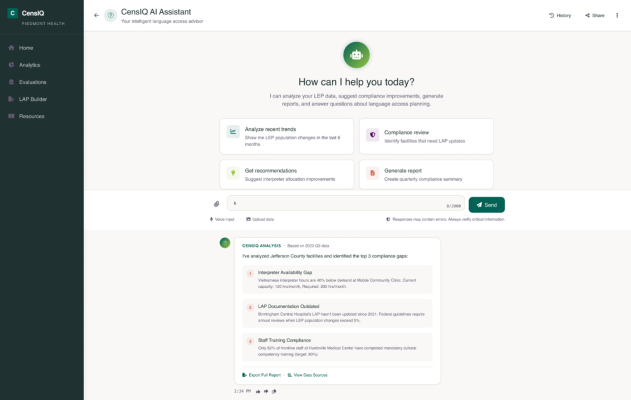
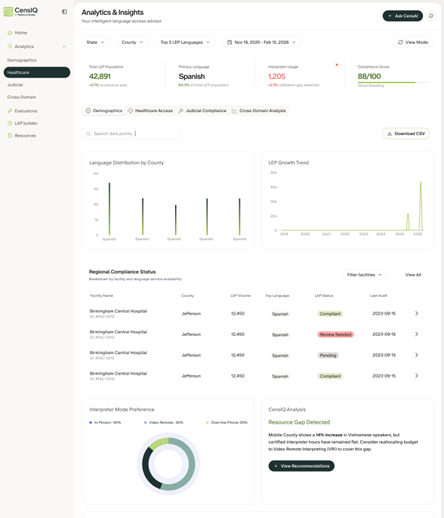
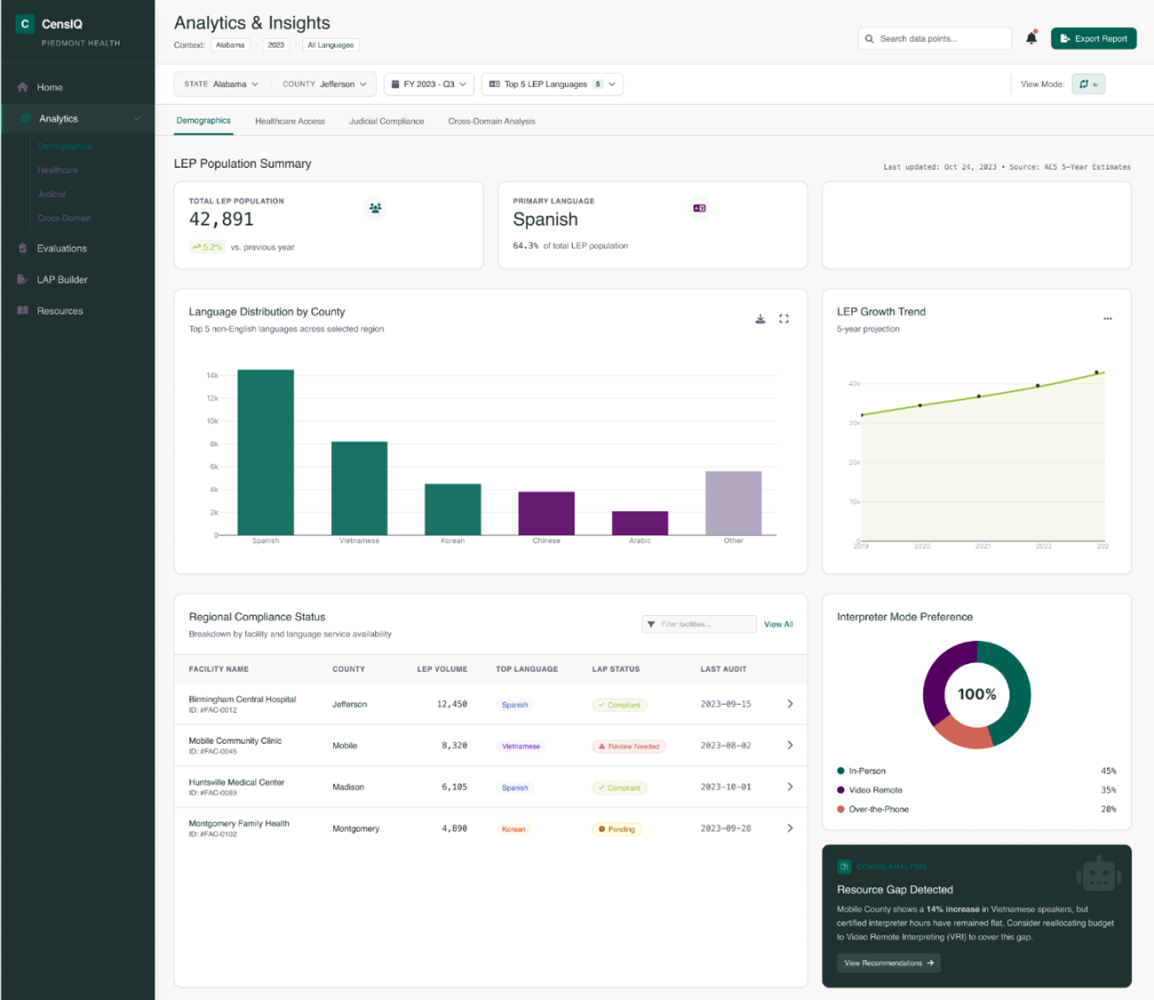
Piedmont Global built CensIQ to solve exactly that problem. CensIQ is our proprietary population intelligence platform, currently deployed as a consulting tool to inform the language access planning work we do with clients. It surfaces the demographic data, LEP density mapping, language demand projections, and modality analysis that allow us to design access strategies that are precise rather than generic.
In the court system engagement, CensIQ informed which language benches required immediate recruiting focus and which rural regions were at highest risk for access failure. In the health center engagement, it translated raw census and patient population data into a forward demand projection that shaped interpreter workforce planning and modality recommendations.
CensIQ is currently available as part of Piedmont Global’s LAP consulting engagements. We are building toward a client-facing platform and will have more to share on that later this year. To see it in action, join us at our April 30 LinkedIn Live for a live demonstration.
The Piedmont Global Approach
Federal legislation defines the floor. What an organization builds above it determines whether language access becomes a compliance checkbox or a genuine operational capability.
At Piedmont Global, we approach language access planning as a strategic function, not a document exercise. That means combining population intelligence through CensIQ, consulting depth built on years of work in healthcare, courts, and other regulated industries, and language services delivery, including interpretation, translation, and credentialed remote access. When those capabilities work together, a language access plan does not just satisfy a regulatory requirement. It functions as core infrastructure.
The Language Access for All Act of 2026, if enacted, would require federal agencies to have a documented plan. But the organizations that will be best positioned, in healthcare, in the justice system, in social services, education, and across any sector serving linguistically diverse populations, are those that build one before the mandate arrives. A language access plan developed under regulatory pressure, against a hard deadline, is rarely as strong as one built with time, data, and strategy behind it.
The organizations we have seen navigate this well share a common trait: they treat language access not as a task that falls to compliance, but as a capability that belongs to operations, clinical leadership, and strategy together. They ask the harder questions. Not just “do we have a plan?” but “does our plan reflect who our population actually is, where demand is heading, and how our workflows will need to adapt?” Those are the questions CensIQ is built to answer, and the questions our LAP consulting is designed to address.
Join Us: LinkedIn Live, April 30 at 11 a.m. ET
We are hosting our April LinkedIn Live event on Thursday, April 30 at 11 a.m. Eastern, and we want you there.
We will be discussing the Language Access for All Act of 2026, what LAP readiness looks like in practice for regulated industries, and walking through a live demonstration of CensIQ. Joining the conversation will be Piedmont Global’s Mary Grothe and Saba Dovlatabadi, along with Bill Rivers, of WP Rivers & Associates.
Whether you lead compliance, operations, HR, clinical services, or patient experience in a regulated industry, this conversation is for you. If language access has been on your to-do list, this is the month to move it to the top.
