Language Barriers in Manufacturing: Why Leaders Are Investing in Language Solutions

Manufacturing today is more global, quicker, and more complicated. In this setting, clear communication isn’t an operational edge — it’s a prerequisite to safety, efficacy, and profitability. The majority of manufacturers, however, confront one continual and mostly underestimated obstacle: linguistic diversity among their workers and along their supply chains.

This article deals with how language barriers impact manufacturing companies, the dangers they pose, and the actions visionary leaders are taking to safeguard their workers, de-bottleneck operations, and ensure sustainable growth.


How Language Barriers Affect Manufacturing Operations

In business, the workforce is often made up of employees of different linguistic backgrounds — particularly where labor is in short supply or where migrant labor is employed. In addition, supply chains span continents, and there are vendors and suppliers who may not share your native language.

Wherever there are language gaps at any point during this process, the whole operation is susceptible to:

  • Misconceptions by employees regarding procedures, safety procedures, or use of equipment
  • Delays resulting from miscommunication with suppliers or logistics partners
  • Compliance risks of regulatory failure
  • Poor staff morale and retention because of feelings of exclusion or confusion


The Top 3 Risks of Language Barriers in Manufacturing


1. Safety Risks: Language Gaps Endanger Workers

Safety is the foundation of every production environment. When instructions, safety procedures, or hazard communication cannot be understood because of a language problem, the potential for accidents grows exponentially.

Main safety hazards are:

  • Misreading of machine operational instructions
  • Inability to comprehend emergency protocols
  • Inability to identify hazard signs or labels
  • Challenges in reporting close calls or incidents

According to the U.S. Bureau of Labor Statistics, language barriers in the workplace are associated with increased rates of injuries and fatalities. Language barriers were found to be a contributory cause of nearly 25% of industrial accidents among immigrant construction and factory workers.


2. Efficiency Risks: Miscommunication Disrupts Operations

Manufacturing depends on synchronization and accuracy.  Ineffective communication between workers or supply chain partners produces:

  • Missed production deadlines
  • Errors in product assembly or packaging
  • Supplier Coordination Failures
  • Material Delivery Delays

Language barriers hinder daily commerce, sap productivity, and spoil relationships throughout the supply chain.


3. Financial Risks: Language Barriers Hurt the Bottom Line

When efficiency and safety are compromised, so is your bottom line. The bottom-line costs of language disparity in manufacturing can be:

  • Injury Costs: Medical cost, workers’ compensation claims, and increased insurance premiums
  • Production Downtime: Losses due to accidents or errors
  • Supply Chain Penalties: Failure to meet delivery timescales or inaccurate orders
  • Regulatory Fines: Noncompliance with safety standards due to misunderstood protocols

For firms that operate in low-margin businesses, these types of costs can disproportionately affect profitability.


Solutions: How Manufacturers Are Overcoming Language Barriers

Progressive factory executives no longer consider language access a nice-to-have. It’s now a strategic necessity. Let’s discuss three of the ways they are overcoming this obstacle:


1. Workforce Language Training

Providing language instruction (or exposure to translated instructional content) enables workers to acquire the skills necessary to become effective workplace communicators.

  • eLearning Localization: Companies are now localizing safety training, standard operating procedures, and onboarding modules into the native languages of employees. This provides understanding and engagement.
  • On-site or distance language training: Focused English-as-a-second-language (ESL) or work-specific language training enables workers to gain confidence while improving safety and productivity.


2. Content Translation: Signage, Manuals, and Beyond

Manufacturing operations encompass an enormous range of written content — from equipment manuals and SOPs to safety signs and plant signage.

  • Technical manual translation ensures workers can operate machinery safely and efficiently.
  • Plant signage localization means that hazard warnings, directions, and emergency exits are understandable to all.
  • Translation of employee handbooks establishes expectations with clarity and assists in fostering an inclusive culture.


3. Interpretation for Real-Time Communication

Multilingual supplier chains or vendors usually require assistance with site visits, audits, or meetings.

  • Phone and video interpretation services allow teams to communicate clearly in the moment, averting costly misunderstandings.
  • On-demand interpretation aids HR discussions, safety orientations, and emergencies in which clear understanding matters most.


The Piedmont Global Approach: Helping Manufacturing Leaders Scale Language Access

At Piedmont Global, we recognize the business imperatives that manufacturing leaders confront. Our solutions are crafted to:

  • Minimize risks: From warning signs to compliance documents, our services keep you and your employees safe.
  • Increase efficiency: Localized training and correct interpretation avoid delays and rework.
  • Protect profitability: Reduce expensive mistakes, downtime, and ship on schedule with certainty.

We work alongside you as your strategic language partner, delivering comprehensive and personalized language solutions to help you connect with your audience—across any language or region.


Take the Next Step To More Efficient, Safer Operations

Language issues in manufacturing are more than a communications issue — they’re an operational risk. However, with the right partner, those issues can be transformed into competitive advantages.

Explore our comprehensive language access guide to learn more.

Download our eBook on building inclusive manufacturing operations.

Get in touch to start a conversation about scaling language solutions for your team.

Why This Is IT’s Moment: Inside Piedmont Global’s Vision for Leading Through Change

When over 4,000 technology leaders gather in Las Vegas for Info-Tech LIVE 2025, you expect bold ideas. What you might not expect is validation that the strategy your team is building under pressure is the one the industry is now racing to adopt.

For us at Piedmont Global, Info-Tech LIVE wasn’t just a conference. It was confirmation that resilience, cultural fluency, and adaptive tech aren’t just differentiators. They’re requirements.


The Theme: Transform IT. Transform Everything.

This year’s rallying cry was more than marketing. It was a call to action. Technology is no longer a backend function; it’s the connective tissue of how organizations operate, scale, and build trust in the face of global uncertainty.

The message was clear: This is IT’s moment.

At Piedmont Global, we serve mission-driven institutions where communication, precision, and people are everything. We don’t have the luxury of lagging behind trends. We build for what’s next, because the communities we serve can’t afford for us not to.


Exponential IT: Designing for Change

One of the strongest insights from the summit was the concept of Exponential IT: a shift away from rigid roadmaps toward systems that adapt in real time.

As Info-Tech’s CEO put it: “Legacy roadmaps won’t survive exponential change.”

The data backs it up. As the World Uncertainty Index climbs 481% in just six months (now 40% higher than its COVID-era peak), our systems must evolve at the same pace.

At Piedmont Global, we’ve already embraced this mindset. We’ve moved away from static infrastructure toward modular, scalable solutions. Whether it’s adjusting to new compliance frameworks, global service delivery needs, or shifting client priorities – we design to pivot, not patch.

This isn’t just smarter architecture. It’s how we create continuity in environments where reliability isn’t optional.


From Assistive to Agentic AI

Everyone’s talking about AI, but the conversation is changing.

This year, the focus shifted from assistive tools (like chatbots) to agentic AI systems that can act, learn, and make decisions with autonomy.

But this isn’t about replacing people. It’s about reducing the friction that slows them down. The question isn’t whether AI can act, it’s how well it understands context when it does.

That’s why we’re focused on embedding AI across our operations with intention:

  • AI-native workflows in interpreter scheduling and client services
  • Context-aware decision systems that reduce manual lift
  • Ethical governance frameworks that protect human oversight

When AI enhances (not replaces) human clarity, everyone wins.


Culture: Not an Add-On, but a System Requirement

The best tech fails if it can’t account for people. At Piedmont Global, we know firsthand that cultural intelligence is a functional requirement, not a bonus feature.

We don’t localize after we build. We build to localize.

This shows up in how we test user interfaces, structure onboarding, and train support teams in global environments.

This isn’t just empathy – it’s risk mitigation. Systems that understand users are less likely to break in the field.


Interpreting Data into Strategy

Data without action is just noise. One theme echoed across the conference: strategic intelligence means turning insight into behavior.

We’re revamping our internal dashboards and feedback loops to enable better decisions, faster. Whether it’s improving turnaround times or proactively identifying service gaps, we’re asking: Does this data help someone act with confidence?

That’s how trust is built, decision by decision, insight by insight.


Security That Protects People First

Cybersecurity isn’t just about locking down assets. It’s about designing systems your team can use without burnout.

One statistic resonated: 73% of security professionals report reduced stress after deploying AI-powered tools.

We’re investing in automation not just for speed, but for sustainability. From early threat detection to intelligent triage, our goal is to keep security proactive, not reactive. All without overwhelming the people who keep our systems safe.


Leadership at Every Layer

At Info-Tech LIVE, leadership wasn’t framed as a role, it was framed as a capability. The expectation? CIOs and CISOs aren’t just technologists, but translators, visionaries, and culture-shapers.

That message resonated deeply.

We’re embedding leadership development across every IT layer, from the help desk to architecture – because the challenges we face require more than technical fixes. They require people who can motivate, communicate, and adapt under pressure.

Talent is no longer a pipeline issue. It’s a system design issue.


A Strategy Validated, Not Rewritten

Info-Tech LIVE didn’t change our direction. It affirmed it.

We’re not waiting for perfect conditions. We’re building systems that thrive under real-world complexity. That means infrastructure that scales, technology that understands its users, and teams that lead with intention.

Our mission at Piedmont Global is inherently human. And that means our tech must be too.
What Happens Next?

This isn’t just a moment for IT. It’s a mandate.

We are:

  • Scaling agentic AI for operational impact
  • Redefining how IT communicates value across the organization
  • Evolving our leadership pipeline for resilience
  • Building systems that adapt as fast as the world changes

At the intersection of communication and technology, we aren’t reacting to change, we’re architecting what comes next.

The future isn’t waiting. Neither are we.

Ready to transform how your team navigates complexity?
Let’s build it, together.

Breaking the Language Barrier in Forensics: A Perspective from Techno East

Last month, I had the chance to represent Piedmont Global at Techno Security East alongside our VP of Technology, Gil Segura. When we showed up, I expected the usual: booths, badges, and maybe a few new contacts. What I didn’t expect was to leave with a crystal-clear confirmation of something we’ve been sensing for months: that forensic and law enforcement agencies are hitting a wall when it comes to multilingual data.

And no one’s really helping them fix it.

Over three days, we met with dozens of local, state, and federal law enforcement professionals. What we heard was consistent: language is becoming a bigger and bigger barrier in digital investigations. Whether it is evidence extracted from phones, audio from body cams, or interviews conducted in the field, the multilingual footprint is growing. And most agencies don’t have a plan to handle it.

That’s where our work comes in.


A Clear Gap in the Market

Despite the enormous role language plays in modern investigations, most vendors haven’t caught up. The usual suspects (I won’t name them here, but you know who they are) tend to focus on volume-based interpreting or general translation. Their government offerings are often copy-pasted from healthcare or corporate templates, not built for the complexities of forensic workflows.

What we’re doing at Piedmont Global is different.

We’re not adapting existing products for government. We’re building new solutions, designed in partnership with the very people using them: law enforcement officers, investigators, forensic analysts. That co-design approach shows up in everything from our deployment models (on-prem, on-device, no cloud required) to the way we deliver training and support.

Examples of Forensic Linguistics in Action:

  • Investigative Linguistics
    Analyzing threatening text messages or social media posts in foreign languages to identify the author and prevent future harm. Every word counts in an investigation, and linguistic accuracy is at the heart of an investigation.
  • Author Identification
    Analyzing the writing style of a ransom note in a foreign language to identify the author and their background. Language identification is vital, but the ability to identify age, gender, and other key characteristics is a true game changer.
  • Analyzing Witness Testimony
    Analyzing the language used by witnesses who speak different languages to ensure accurate and fair representation of their statements. This evidence can come in a variety of formats: (Video, Audio, Digital Content, Documents, etc.)


What We Heard at Techno East

Several clear patterns emerged from our conversations:

  • Cloud Fatigue
    Almost everyone we spoke to said the same thing: they don’t trust the cloud. Whether it’s about data sensitivity, chain of custody, or just institutional policy, cloud-based tools often get blocked before they even get piloted. Our ability to deploy secure, localized solutions was a major differentiator.
  • Demo-First Decision-Making
    This audience doesn’t want a pitch, they want to see the tool work. On-the-spot demos of our platform generated more interest in five minutes than a PDF ever could. The ability to surface multilingual evidence instantly hit home.
  • An Underserved Niche
    Everyone was dealing with language issues. No one had a vendor they trusted to solve them. The most common question we heard? “Why hasn’t anyone built something for this?”
  • The Forensics-Language Loop
    One particularly compelling insight came from a few cybercrime teams: they want to use anonymized language data to help train models for early detection, but privacy regulations make that nearly impossible. That opens the door to future R&D partnerships focused on encrypted language data training.


The Piedmont Global Advantage: Built With, Not For

At Piedmont Global, we don’t just support law enforcement — we partner with them. Some of our most exciting product features were shaped through feedback from officers, analysts, and forensic technologists. That’s not something you can bolt on after the fact.

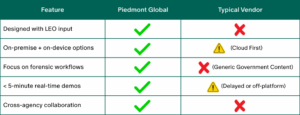
Here’s how we’re different from the competition:

Table showing Piedmont Global's capabilities versus other vendors

This isn’t about buzzwords. It’s about building language access tools that actually work for people in the field.

Where This Goes Next

We’re already setting up follow-up meetings from Techno East. Some leads are hot, some are exploratory, but all are tied together by a clear sense of urgency. No one wants to wait 5–10 business days for a translation when there’s a case on the line. And no one wants to guess at what a suspect said in a language they don’t speak.

That’s where we come in.

We’re helping teams:

  • Reduce evidence processing time
  • Improve accuracy in multilingual investigations
  • Stay compliant with chain-of-custody and data security requirements
  • Increase community trust through clearer communication

We’re already looking forward to next year’s Techno East in Myrtle Beach. We will be attending with deeper demos, more insights, and a strengthened commitment to solving real problems for law enforcement, not just checking a box.


Final Thought

This field is changing. Investigators aren’t just solving local crimes anymore; they’re navigating global data. And that data speaks every language.

Piedmont Global is here to help make sense of it.

Connect with me to learn more about our tailored solutions to navigate your global data.