Why Human-in-the-Loop AI Is the New Standard for Localization

AI has transformed localization more in the past two years than in the previous twenty. What once took days can now take minutes. What required extensive workflows now launches in a single click. Teams are moving faster, content volumes are exploding, and leaders are rightfully asking the big question: 

When is AI enough, and when does a human need to step in? 

Across every regulated industry we serve — healthcare, legal, insurance, manufacturing — executives are looking for clarity. Not hype. Not fear. A framework. Something that helps them balance speed with safety, efficiency with compliance, automation with accountability. 

That’s where Human-in-the-Loop (HITL) comes in: a governance-driven approach where AI accelerates the work, and humans secure the outcome. 

It’s quickly becoming the localization standard, and the standard we’re perfecting as your partner in Strategic Globalization. 


Why Organizations Are Moving Toward HITL 

Early conversations around AI in localization were dominated by replacement narratives. 

“AI will eliminate translators.”
“AI will automate entire workflows.”
“AI will make localization instant and free.” 

Today, the organizations we advise are asking a different and more strategic question: 

“How do we integrate AI responsibly, with guardrails that protect quality, cultural accuracy, and compliance?” 
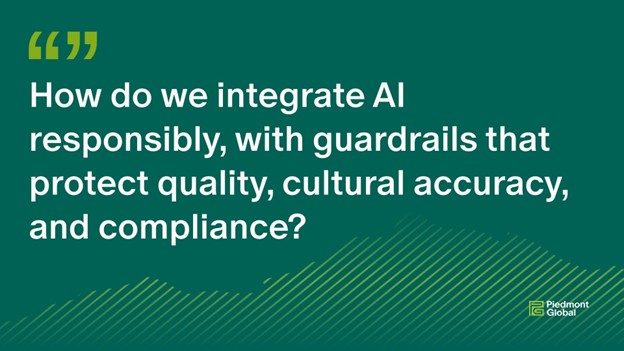
Graphis that reads How do we integrate AI responsibly, with guardrails that protect quality, cultural accuracy, and compliance?

Enterprises aren’t rejecting AI. They’re operationalizing it. They’re formalizing HITL frameworks because the risks of LLM-only localization models are too significant to ignore: 

  • Undetected hallucinations 
  • Cultural misinterpretations 
  • Missing legal terminology 
  • Inconsistent tone or style 
  • Data privacy concerns 
  • Regulatory exposure

In industries where a single mistranslation can lead to patient harm, legal liability, safety failures, or financial risk, fully autonomous AI simply isn’t an option. HITL is safer, more scalable, and ultimately more cost-efficient. 


The “Right Touch” Model: Calibrating Human Involvement by Risk Level 

One of Piedmont Global’s principles around AI is simple: 

Not all content needs the same level of human involvement, but all content needs the right level of human involvement. 

We help organizations evaluate content through a Right Touch Framework across four dimensions:


1. Content Risk 

Is the content informational, instructional, legal, or safety-critical?


2. Audience Risk 

Could misunderstandings impact patient health, financial decisions, legal outcomes, or public safety?


3. Cultural Risk 

Does the content require cultural nuance, lived experience, or contextual understanding?


4. Compliance Requirements 

Is certified translation required? Does the content support regulated workflows? 

From here, we calibrate human involvement.
Some content is AI-first, human-verified.
Some is human-edited AI.
Some is human-led, AI-assisted.
And some remains human-only. 

This is the operational clarity leaders are asking for, and the foundation of future-ready language programs. 


Where AI Fails and Why Humans Still Matter 

LLMs are extraordinary pattern-recognizers. But culture is not a pattern; it’s context, identity, lived experience, and interpretation. 

AI struggles with: 

  • Humor and idioms 
  • Taboo language 
  • Sensitive topics 
  • Emotionally charged content 
  • Region-specific norms 
  • Social values and beliefs 
  • Industry-specific cultural expectations 
  • And more 

Humans don’t just translate words. They interpret meaning. 

That’s why we integrate cultural subject matter experts (SMEs) as quality governors inside AI systems, training models to reflect real-world nuance. It’s why we rely on human oversight to catch errors AI can’t see. And it’s why, ultimately, HITL is an upgrade and not a compromise. 


Post-Editing Maturity: How Teams Evolve with AI 

Most global organizations are somewhere on a post-editing maturity path:


1. AI Curiosity 

Teams experiment in pockets with generative AI, but usage is inconsistent.


2. AI Adoption 

Machine translation and post-editing enter the workflow, often without governance.


3. AI Alignment 

Teams create formal guidelines for post-editing, quality, risk, and review.


4. AI Embedding 

Enterprises develop custom HITL workflows, quality frameworks, and escalation paths.


5. AI Optimization 

Data, cultural insights, and human feedback loops train models to improve over time. 

Wherever you sit on this path, one principle remains the same:  

AI requires professional human oversight to achieve enterprise-grade accuracy. 


HITL in Regulated Industries: Where It Matters Most 

Healthcare 

  • Clinical accuracy 
  • Patient safety 
  • Informed consent 
  • Certified medical translations 
  • Multilingual patient communication 

Legal 

  • Legal terminology 
  • Case evidence 
  • Contracts & compliance 
  • Certified translations for court 

Insurance 

  • Policy accuracy 
  • Claim adjudication 
  • Regulatory alignment 
  • Customer rights & responsibilities 

Manufacturing & Government 

  • Safety documentation 
  • Technical manuals 
  • Recall notices 
  • Public communication 

In these sectors, quality is not a preference. It’s a legal requirement. HITL ensures organizations meet those obligations without sacrificing speed. 


How AI Is Reshaping Localization Teams 

Modern localization teams look different than they did even a year ago. 

Leaders are restructuring around: 

  • AI quality managers 
  • Culturally fluent SMEs 
  • AI-assisted project managers 
  • Data governance and compliance leads 
  • Tech + human hybrid workflows 
  • New escalation paths and review loops 

The future isn’t “AI vs. human.” The future is AI + human, integrated into a system where each strengthens the other. 

Graphic that reads The future isn't AI vs Human. The future is AI + human, integrated into a system where each strengthens the other.

The Future Standard: Human-in-the-Loop AI 

HITL is no longer a trend. It’s a strategic imperative for organizations that operate globally, responsibly, and at scale. 

It delivers: 

  • Faster workflows 
  • Higher accuracy 
  • Better cultural alignment 
  • Stronger governance 
  • Reduced risk 
  • Increased confidence 
  • Clearer compliance paths 
  • Improved customer experiences 

Organizations need clarity, calibration, and a partner who understands both the possibilities of AI and the realities of global communication. 

That’s why Piedmont Global exists. To help you lead globally, fluently, and confidently. 

If you’re evaluating how to integrate AI into your global workflows, we can help you design a Human-in-the-Loop model that accelerates your operations while protecting what matters most.
Explore Piedmont Global’s custom solutions → 

Why Organizations Value Asian Translation Services from a Native Speaker

The globalization of commerce has seen countries like China rise in recent years to become some of the most powerful economies in the world. Manufacturing, for example, has shifted East in a big way.

The rise of the middle class in these countries has created new markets for Western businesses and seized opportunities for organizations to enter joint ventures and other collaborative relationships with Asian companies.

The following examines the value of Asian language translation services and the importance of working with native speakers.


The Benefits of Asian Language Translation Services

There are several reasons why organizations value translation services. We’ve listed a few of the most important benefits below:


Over 200 Languages

Some companies choose to work with an individual freelancer who is a native speaker of the language they need. However, this can be risky because you’re putting all your eggs in one basket.

It is unlikely that a single person will be a native speaker of all the languages you might need. This is where working with a company that specializes in Asian language translation can be beneficial.

At Piedmont Global, we have a team of native speaker experts and can offer over 200 languages. We can help you source materials in Taiwan while helping you navigate the complexities of doing business in Japan.


Reliability

The first and most apparent benefit is reliability. When working with translations, it’s crucial to trust the person or organization you’re working with.

There are many moving parts in any translation project. Things can easily go up in smoke if the people you’re working with don’t have a strong understanding of the source language. Likewise, if the translator you’re working with doesn’t have a strong understanding of the target audience, they might not be able to properly convey the message you’re trying to communicate.


Increased Accuracy in Translations

Native speakers have a better understanding of the subtleties and nuances of their home languages. This increased understanding leads to improved accuracy in translations.

This is important because the meaning of sentences or paragraphs can easily get lost in translation. When you’re dealing with something as crucial as business communications, you can’t afford to have any inaccuracies in your translations.

As a bonus, increased accuracy can also lead to stronger relationships with your Asian business partners.


Localization

A better understanding of regional dialects is another benefit of working with a native speaker. In many countries, there can be a significant difference in the way people speak in different regions. Linguistically, some countries are considered to have many languages with a common writing system.

In the same vein, you want to respect the different cultures you’re working with and use the appropriate language when addressing them. For example, extended eye contact in the west might be seen as a sign of respect, but in some cultures in Asia, it might be interpreted as disrespectful.


Industries That Rely on Asian Translation Services

Many industries rely on Asian language translation services. Working with Piedmont Global offers numerous benefits to many different industries including education, healthcare, legal services, and more.


Manufacturing

The globalization of the manufacturing industry has led to an increased need for accurate and timely translations of technical documents. Manufacturers frequently generate complex technical documents that include manufacturing terminology, scientific information, and technical descriptions. Additionally, translations of such technical documents generate text that exceeds specified character limits. At Piedmont Global, we have a team of experienced translators familiar with the specific jargon and terminology used in the manufacturing industry. We can accommodate your specifications without compromising quality.

From MSDS/SDSs to marketing materials, our team understands the importance of accuracy in tone, meaning, and technical details. You can be confident that the translated text will convey your message effectively.  Learn more about our translation services for manufacturing.


Education

One industry that relies heavily on translation and interpretation services is education. Communication is part of daily life for students, parents, educators, and school staff. When language is a barrier, schools are unable to reach their primary goal of helping students succeed. Learn more about language access in schools.

Additionally, there has been an increase in the number of US, Canadian and European teachers moving abroad to teach English in Asia. However, these teachers often don’t have any training in the local language, which can make it difficult to communicate with their students properly. Here’s where language services come in.

We can help these teachers by providing them with translations of the key phrases and concepts they need to teach their classes. We can also help them to better understand their students by translating student work and essays. Learn more about our language services for education.


Healthcare

Another area that has come to rely heavily on translation services is the healthcare industry. There are valid reasons for this. First, there has been an increase in medical tourists going to Asia for treatment. These medical tourists often don’t speak the local language. Hospitals and clinics need to be able to communicate with them in their native language.

Another reason why the healthcare industry has come to rely on translation services is the rise of telemedicine. With telemedicine, doctors and patients can consult from different parts of the world. However, this consultation can only be effective if there is a good understanding between the doctor and the patient. Learn more about our medical and healthcare language services.


Legal

The legal industry is another field that has come to rely on Asian language translation services. That’s because there is a growing need for legal documents to be translated into Asian languages, from business contracts to artistic licenses. Immigrants who have been charged with a crime also need to understand the legal documents they are being asked to sign.


Other Industries

These are just a few industries that now rely on Asian language translation services. As you can see, there is a growing need for these services in many different fields. Governmentmedia, and the nonprofit sector are also among the many industries that have come to need these services.

We’ve also seen a growing demand for these services in the financial sector. In recent years, there has been an increase in fintech startups in Asia. These startups often need help translating their products and services into the local language.


Getting Started with Piedmont Global’s Asian Language Translation Services

Now that you know more about the benefits of working with a native speaker, you may be wondering how to get started.

If you’re looking for a reliable and experienced company to provide you with these services, we can help. From translation to interpreting and language training training, we’re here to support all of your language needs.

The first step is to request a quote and let us know what languages you need. We will then match you with one of our expert translators. Contact us today to get started.

The Importance of Terminology in Legal Translations

With our world becoming more connected each day, business transactions and even legal proceedings are now regularly considered cross border affairs. However, this globalization doesn’t change the highly specific rules and regulations that need to be adhered to within each unique legal jurisdiction. That’s where legal translators come in. Whether we realize it or not, we interact with legal translations on a daily basis. From translated terms & conditions for services or apps we use on our smartphones, to international banking and even online shopping. These translations are vital to the smooth operation of international trade and cross border travel that we, in this digital age, often take for granted.

Legal translation is an integral part of society, ensuring a smooth transition between legal systems. Translating marketing content from one language into another requires insight into how the target market thinks and feels, and how to resonate with them on a personal level. This creativity is matched in legal translations with a demand for accuracy so high that some translators must first be court-approved and can be called to testify to the accuracy of their translations of important legal documents. This is a highly-specialized niche with expertly trained and experienced translators (and interpreters).


How is Legal Translation Different from General Translation?

Legal translation is the translation of documents from one language to another that are used in a legal context. It often means translating legal documents from one legal system for use in a completely different one. Legal structures can vary widely between regions, let alone countries and sometimes even continents. The pressure is truly on to produce 100% accurate results that are fit for purpose, the first time. It’s vital that only qualified, experienced professionals work on these types of documents. After all, the resulting translated texts will be used as an aid in the making of legally binding decisions. They can have a significant real life impact. The consequences of failure are so severe that mistranslation of a legal document could spell disaster for a case, induce huge financial losses, or even come at a human cost.


Types of Legal Translations

  • Legal translators deal with a wide variety of legal documents; beginning with the more straightforward educational certificates such as degrees, identification documents like passports, birth, marriage and death certificates, but also including things like work permits, divorce decrees, etc.
  • Next, are more complex court-related documentation for use in international court cases. Businesses of all sizes regularly require the translation of their important documentation when entering new regional markets or entering into cross border trade deals with foreign businesses. These types of translations can include trade contracts, shareholder books, or even company registration information for trade licenses and rely on an in depth understanding of international trade law.
  • Finally, legal translators are often called upon to translate documents for criminal and civil proceedings being transferred from one country’s legal jurisdiction to another, or even cases involving Limited English Proficient (LEP) individuals in the United States who, by law, are afforded language access services. From important witness statements to court records, arrest warrants to evidence files and more; these documents must be translated to be appropriate for use within the new legal structure in which they will be used, without compromising their meaning in any way. There is far less room for interpretation in the area of legal translation than in any other.


Legal Terminology

No one would be surprised to learn that legal documents tend to be laden with legal jargon and specialized terminology, difficult to understand and often convoluted in the way they are written. This is done in an attempt to avoid any possible misunderstandings or create unintentional loop holes with the use of vague language. Learning to proficiently comprehend and write legal documents requires a great deal of training and experience. Likewise, the job of a legal translator demands not only fluency in each language, but also a comprehensive understanding of the legal processes in multiple regions.


No Two Legal Systems are the Same

The art of translating across language barriers and legal systems is one that bears significant risk. Legal documents themselves can seem impossible to decipher to an untrained eye. The legal translator must similarly ensure that their translation adheres to the same standard of accuracy demanded in any legal documentation, while also compensating for any differences in the legal systems of the two texts.

For example, in the US, the tone of legal documentation is usually straight to the point, utilizing a very active tone of voice. In contrast, legal documents in the UK use a much more passive tone, relying on the content of the text to convey the appropriate importance of any given piece. Here, the difficult task of balancing these responsibilities becomes apparent, especially when translating from one language into another.

Legal systems can also vary in the actual laws applicable in a given context. Some laws may not exist or could differ a great deal between countries. This is referred to as ‘private international law’, or more commonly as a ‘conflict of laws’. To achieve accurate translations that are error free and make sense to those trained in a different legal system, legal translators must rely on their understanding of each system and the terminologies utilized in both.


Legal Terms can Cause Confusion

For example, the terms ‘trial’ and ‘hearing’ in the US and UK legal systems respectively can refer to the same stages during similar proceedings. While, in the US, every criminal prosecution has the option of a jury trial, the same is not true in the UK. In the UK, there are stages to the proceedings which include magistrate hearings over a full trial. In translating between these two legal systems, even with a shared language, seemingly straightforward terminology can cause confusion.


Using Logical Reasoning

In the translation of legal documents, it’s not just terminology that translators must contend with. With each translation, everyday expressions and colloquialisms in one language must be accurately translated into the target language while keeping in mind the appropriateness of the language used. An innocuous statement in the source language could be offensive in another. A translator must also be vigilant for mistakes in the source text, as undetected errors could cause unintentional miscommunications and ultimately have dire consequences.


Mistakes are Never Worth the Risk

Your company may be liable if there are mistakes. To make sure this doesn’t happen, it’s imperative to employ only the most experienced, certified legal translators. It requires years of training and experience to develop the skills and knowledge required to translate legal documents. For your peace of mind, all Piedmont Global legal translators are both highly-skilled native speaking linguists, with the legal expertise necessary to translate your documents with the utmost accuracy. Get in touch with our team to learn more.