
Rethinking Learning: Insights from ATD 2025 and the Future of Talent Development

If there was one clear takeaway from this year’s ATD 2025 Conference, it’s this: the learning function is no longer a “nice to have.” It is the foundation of workforce transformation.

At Piedmont Global, we’re not waiting for the future—we’re building it. That mindset shaped my experience attending ATD, where learning and development (L&D) professionals, HR leaders, and technologists converged to discuss what comes next. The resounding theme? To navigate tomorrow’s work, learning must evolve beyond compliance checklists and mandatory courses. It must become immersive, personalized, strategic—and central to business outcomes.


Learning as a Strategic Lever for Change

In a world where only 26% of the skills needed in 2030 are present in today’s workforce, the traditional HR toolkit is no longer enough. Performance reviews and retroactive assessments can’t close the readiness gap. What can? Forward-thinking learning strategies that develop both competence and confidence in real time.

That’s why we’re reimagining our own approach to learning and development at PGLS. It’s not just about content—it’s about context, culture, and capability. As we design for a smarter, more adaptive workforce, our L&D program must cultivate behaviors and decision-making aligned to our values and mission. Learning is how we shape—not just support—organizational transformation.


The Build, Buy, Borrow Imperative

One of the more sobering insights from ATD: by 2030, the global workforce will be short over 85 million people with the skills needed to drive innovation and growth. Addressing this isn’t a matter of hiring faster. It requires a strategic reframe around talent—what we call the “build, buy, borrow” approach.

  • Build refers to growing capabilities internally through tailored training and coaching.
  • Buy means identifying and recruiting external talent for emerging needs.
  • Borrow acknowledges the value of strategic contractors and partners who can help you move faster without long-term overhead.

To make this model work, you need skill-level data—down to the task level, not just the job title. This is where AI and quantum labor analysis come into play. By understanding the “have, need, and want” of your workforce, HR and L&D leaders can target learning where it will move the needle, not just fill a seat.


Immersive Learning and Human Skills

One of the most exciting trends at ATD was the rise of immersive learning—using virtual reality and simulations to replicate high-stakes environments and train faster, better, and with more retention. Case studies from healthcare, defense, and corporate leadership showed that VR and simulation-based learning drastically improve retention, engagement, and speed-to-competency. According to a PwC study cited at the conference, VR learners trained four times faster than those in traditional classrooms. From leadership readiness to clinical training, the ability to “learn by doing” is driving measurable performance gains.

But speed isn’t the only metric. Quality matters. Which brings us to the growing importance of soft skills—what many now call “human skills.” Emotional intelligence. Cultural awareness. Communication. Leadership presence. Adaptability. These are no longer “soft” skills. They are business-critical and increasingly valued above technical know-how. Why? Because the landscape changes too quickly for tools and processes to be static. What endures is our ability to navigate uncertainty—and that’s where human-centered, culturally fluent learning comes in.

These skills are harder to teach—which is why experiential learning is so powerful. It allows people to practice in context, make decisions in safe environments, and build the confidence they need to thrive.


From Order-Takers to Value Creators

Too often, L&D teams are seen as service providers—executors of one-off trainings or check-the-box compliance. That’s not the model of the future. Learning professionals must become value creators, helping to align skill-building to organizational strategy, performance goals, and workforce transformation.

ATD reinforced the importance of strategic workforce planning. That means connecting L&D not just to HR, but to finance, operations, and executive leadership. It also means understanding which roles are critical—not just to today’s workflows, but to tomorrow’s growth.

This evolution requires better tools, yes—but also a mindset shift. Data has to drive decisions. And learning has to be owned not just by HR, but by every manager and leader in the organization.


Human-Centered Design and Listening at Scale

Another insight I’m bringing back from ATD is the value of human-centered design in L&D. Whether you’re building a course or a full-scale learning experience, the learner’s perspective has to be at the core. Tools like Qualtrics are helping organizations listen to employees at every stage of their journey—capturing sentiment, tracking engagement, and refining learning in real time.

The Kirkpatrick model was also emphasized as a way to measure learning effectiveness not just by test scores or attendance, but by behavior change, business impact, and ongoing engagement. When learning becomes an experience—not an event—it drives results.

This is something we’re actively applying at Piedmont Global. In 2025, we’re rolling out a new management development program focused on coaching, conversation, and community. It includes dedicated time each month for managers to develop themselves and their teams—and aligns professional development directly with performance and compensation. We’re building the future of leadership, one conversation at a time.


Why Language and Cultural Fluency Matter

As much as the ATD conference focused on tech and talent, one topic was notably underrepresented: language and culture. And yet, these are foundational to effective learning—especially in diverse, global, or multilingual workforces.

At Piedmont Global, we’ve seen firsthand how a lack of linguistic or cultural access creates friction—misunderstood expectations, uneven training results, and disengagement. That’s why we embed language and cultural fluency into every learning program we design or deliver.

eLearning isn’t effective if it’s not accessible. Immersive training won’t resonate if it’s not localized. And strategic workforce planning won’t succeed if teams don’t feel included in the journey.

That’s where we come in. As a Strategic Globalization Partner, we help organizations ensure their learning content is clear, relevant, and resonant—no matter the language, location, or audience.


Looking Ahead

My time at ATD left me more energized than ever. The world of work is changing fast, but so are the tools, strategies, and insights we can use to get ahead. We’re committed to putting learning at the heart of our workforce strategy—not just to train, but to transform.

We’re embracing new technologies like VR and AI, but we’re doing so with a human-first lens. We’re coaching our managers to lead with empathy and intentionality. And we’re building programs that reflect who our employees are—not just what we want them to know.

Because learning isn’t just how we grow skills. It’s how we grow people.


Ready to deliver impactful learning across cultures and languages?

At Piedmont Global, we partner with organizations to design and deliver culturally fluent, multilingual eLearning programs that accelerate understanding and performance across borders. Whether you need localization, interpretation, or multilingual content strategy, our team is here to support you.

Connect with our team!

eLearning Localization: Engaging Multilingual Learners in 7 Industries

The world is increasingly connected in commerce and trade, thanks to the internet. The global pandemic of 2019 highlighted the need for a connected global workforce. The tools developed during this time also facilitated remote meetings, work, and training. Trainers no longer needed to fly to remote offices, and employees didn’t need to spend a week in a conference room for training. COVID-19 banned travel, and like a social experiment, we learned that remote work is possible. Almost.

To adapt to technological and economic changes, distributed organizations need a robust learning strategy to develop talent and enhance performance in the new remote eLearning environment. Like Zoom meetings, eLearning existed before COVID. It lived in global organizations with remote satellite offices, often in different countries and cultures. Managing eLearning in one language is challenging, let alone in five or a dozen languages.

When it comes to multilingual learners, many organizations initiate eLearning projects without a clear global vision and strategy, often relying on outdated content that is delivered in a ‘broadcast’ manner. This approach fails to transfer knowledge to multilingual learners from diverse cultural backgrounds. Other teams sometimes lack the tools, resources, and skilled professionals to design, deliver, and manage eLearning programs—and then struggle to do this at scale.

A poorly or partially produced video will backfire without considering local attitudes. Without localization, eLearning content may be misinterpreted, misunderstood, or lost entirely in the target culture. So, which industries can benefit from localizing their eLearning content? Here are seven inter-related examples. Not every solution will fit all teams, but exploring different approaches is worthwhile.


1. Global Corporations With a Multilingual Workforce

Gallup report found that organizations that make strategic investments in employee development experience 11% greater profitability and are 2x as likely to retain their employees. However, creating a high-development culture requires more than just adding a few learning programs to the roster.

As a company grows internationally and workforces diversify, Learning and Development (L&D) professionals encounter communication differences when sharing core messaging and critical training modules. It becomes vital for eLearning courses to be made local to accommodate diverse employee demographics.

Localization ensures that training can be delivered in multiple languages at scale and guarantees that all teams, domestic or abroad, can improve through localized content in their native language. This ensures that training materials are culturally relevant, linguistically accurate, and aligned with local regulations and practices. A global talent development team must consider multilingual learners in different locations, not just one, and tailor the message to connect while still achieving the objectives and desired outcomes.


2. Educational Institutions with Multilingual Learners

According to the National Center for Education Statistics (NCES), public colleges enrolled approximately 7.5 million online students in 2022. Another 2.6 million remote learners attended private schools, including 1.8 million at nonprofit institutions and nearly 800,000 at for-profit schools. Not all of these students are local.

“If we really want to provide equal opportunities for all students, and we want underrepresented minority students to do well, we really need to pay attention to their experiences and their perspectives and give them the tools to do better.”

Universities, colleges, and schools offering online courses in learning management systems need to localize their content to accommodate international students or learners from various linguistic backgrounds. This enhances accessibility and improves learning outcomes for multilingual learners. It is also an obligation. While it may not be Title 9 or a specific mandate, there’s a need for feasibility and enabling students to learn effectively.

Making courses available to students anywhere—and translating them when there’s interest—is important. “Locale” refers to how particular words need to be in relation to the goal. For example, in one part of town, people might call it a “sandwich,” while in another part, they might call it a “hoagie” (a US English, mid-Atlantic linguistic divide). Does it matter? Sometimes it’s not relevant, but other times it can cause minor or major distractions. Most major errors are caught by a local review, there are ways to bring that upstream. Fixing and re-deploying a course after it’s already launched is a partially wasted effort.


3. Public-Sector Agencies Addressing Multilingual Constituents

Government departments or agencies involved in training initiatives, public awareness campaigns, or citizen education programs may require localization services to reach constituents in various regions or linguistic communities. Over 359 languages are spoken in the US, making it #9 globally out of 242 countries. This is far fewer than Papua New Guinea’s 840 languages but highlights our globalized nature. While we focus on the US in this example, each region has its unique challenges and opportunities.

For example, a public health campaign regarding vaccination must account for cultural beliefs about healthcare, local idioms, varying literacy levels, and language preferences for those with limited English proficiency (LEP) to achieve success. This is especially true for Black, Indigenous, and people of color (BIPOC) populations, who often harbor greater distrust and hesitancy toward vaccines. There are other policy implications that go beyond our topic—but the best solution is to embrace the diversity of the cultural divide and allow that differences will appear. If you pay attention, there is something to learn about the diverse populations that make up the patchwork of communities and can drive better engagement and response.

Localization ensures that important information is not only understood but also embraced by the community. This can lead to greater mission success with the desired outcomes of a program, whether it’s increased public knowledge, changed behaviors, or improved access to services.


4. Healthcare Providers Serving Multilingual Populations

Healthcare organizations frequently develop eLearning modules for staff training, patient education, or medical certification programs. Localizing these materials is crucial to ensure that terminology, procedures, and healthcare guidelines are accurately conveyed across different languages and cultural contexts.

For instance, consider patient education. The term “hospice,” commonly translated into Spanish as “hospicio,” often carries the negative connotation of institutionalizing a loved one. This concept is unfamiliar in Latin America, where most families care for their loved ones at home.

“Latinos often think they’re giving up on their [loved one’s] medical care, and that’s not the case. It’s bringing a holistic, compassionate form of health care focused on dignity and the patient’s wishes.”

Suzanne Sanchez, Community Liaison at Hospice of the Valley, says that while they have bilingual staff serving Spanish-speaking patients, they “don’t focus on the word, but on the feeling.” Similarly, localization goes beyond word-for-word translation to account for such cultural nuances. In all patient interactions with cultural or language barriers, there are opportunities to improve access and quality of care by providing more culturally-aware context. Better outcomes result from adapting to the patient, rather than expecting the patient to adapt to something unfamiliar.


5. Technology Companies Engaging Multilingual Learners

Approximately 16% of the world’s population speaking English, but surprisingly 52% of websites are written in English. Software companies, IT firms, and tech startups that develop eLearning software tutorials to reach global users or product training materials to engage multilingual learners often require localization services.

According to a recent study by DeepL, 75% of respondents agree that localized content significantly increases customer engagement. It also improves user experience and promotes wider adoption. People are more inclined to engage with content that resonates with their linguistic and cultural background, leading to increased user satisfaction and product success. Product teams regularly consider user personas, use cases, and the best outcomes from using a product. The language aspect shouldn’t be an afterthought if you want to capture the remaining 80% of the global market.


6. Manufacturing and Industry with Multilingual Workers

Companies in manufacturing, engineering, or industrial sectors often create eLearning courses for employee training on safety, standard operating procedures, or compliance. Did you know that, Hispanic and Latino workers are expected to comprise 78% of new workers by 2030, yet they face a 32% higher risk of fatal work injuries?

Localization ensures that safety and training resources are effectively communicated to workers across diverse linguistic backgrounds. Without multilingual and localized content, it is impossible to hold every employee to the same safety, productivity, and quality standards. Additionally, other worker populations, such as overseas subsidiaries or partners, regularly need to understand concepts that enable higher performance. While some organizations manage with bootstrapped solutions, a comprehensive strategy can significantly improve efficiency and operational excellence for multilingual learners.


7. Nonprofit Organizations Engaging Multilingual Communities

NGOs, charities, and humanitarian organizations involved in capacity-building initiatives, community development projects, or advocacy may require localized eLearning content to engage with stakeholders in different regions or language groups. Localization helps reflect local customs, values, and norms, making the content relatable and respectful to the target audience. Incorporating locally relevant images, symbols, and voices in multimedia content also boosts engagement and retention among the audience.

For example, UNICEF localizes educational materials for children in different countries, ensuring they are culturally and linguistically appropriate. The Amref Health Africa in the US uses localized eLearning content to train health workers across Africa. Their materials are tailored to the specific health needs and cultural contexts of the regions they serve. A smart strategy for localization can also stretch the effectiveness of budgets so that more impact can be achieved with less wasted effort.


Localize Your eLearning Content with Piedmont Global

Starting an eLearning localization project involves careful consideration of various factors, from advanced project management to international regulations. Piedmont Global is the preferred language partner for organizations of all sizes. Our renowned localization services, coupled with our team’s expertise, a global network of specialists, and tailored end-to-end solutions, ensure comprehensive support at every stage of the localization process. We can help craft a strategy, introduce new tools and processes, and optimize your global-to-local communication pipeline. eLearning can be complicated but getting solutions to reach multilingual learners doesn’t have to be.

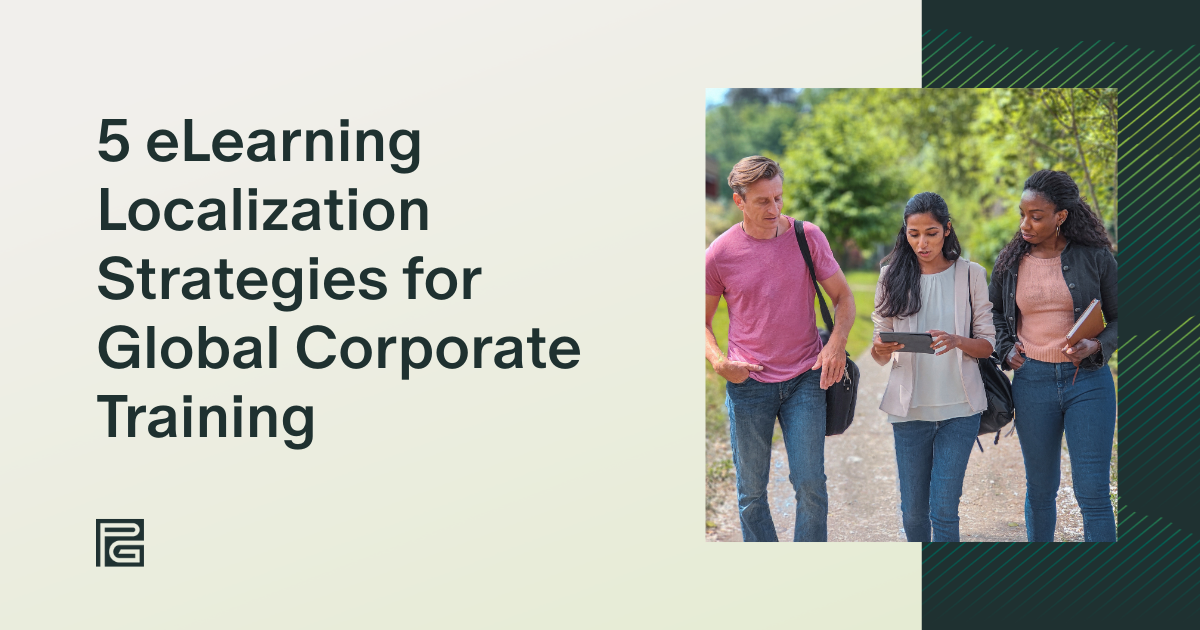
5 eLearning Localization Strategies for Global Corporate Training

Rapid Growth of the Corporate eLearning Market

Did you know that in certain large organizations, up to 60% of training costs are due to travel? But the age of the traveling trainer is fading, replaced by digital self-learning as training delivery becomes more accessible across borders.

The pandemic, rise of remote work, and normalization of video calls have significantly transformed corporate training. The global corporate eLearning market is projected to reach $50 billion by 2026, growing at an annual rate of 15% from 2020 to 2026.

eLearning teams with increasingly global responsibilities must bridge language and cultural barriers. Yet, in many cases, localization strategies for global eLearning content often overlook the vast intercultural differences between headquarters and satellite offices. To speak effectively to local audiences, it is vital to transform eLearning content into a version that resonates with native speakers, rather than produce an imitation of the original.


What is Localization in Corporate eLearning?

Creating successful eLearning content for international audiences requires more than just translation. Localization is essential. It involves adapting translations to fit the culture and context of a target market, ensuring that the content feels natural and native to its audience. A robust eLearning localization strategy considers the cause and purpose behind various content elements, such as narratives, images, ideas, and overarching concepts.


Localization Strategies and Best Practices for Corporate

To help you develop impactful eLearning content, we’re sharing five strategies and technical best practices to overcome common challenges for a successful and efficient launch.


1. Engage Global Stakeholders to Inform the eLearning Content Strategy

How do you identify and incorporate the content needs of global and multilingual audiences? After all, the best content feels tailor-made – not adapted from another source.

It is important to engage global stakeholders who represent your end-users, as their feedback can be invaluable to the design and language of the eLearning content.

Even simple interactions, like greetings between colleagues, can vary widely between cultures. Collaborating with stakeholders allows timely adjustments to minor yet significant changes that could become costly fixes later.

It is essential to source at least one stakeholder from each country to capture linguistic and cultural variations. Larger countries like China may require multiple stakeholders to account for regional differences.


2. Have an Effective Feedback Loop When Creating Source Content

As part of your eLearning localization strategy, it’s important to create a detailed content outline and have it reviewed by stakeholders. This not only includes text, but audio and visual resources as well. Incorporate their feedback to develop content variations tailored for each region.

It is essential to consider the broader context, storytelling mechanisms, and subtle visual details to achieve a natural manner of speaking and engage with the audience. Remember, the goal is to ensure the audience can focus on the content without being distracted by mistranslations or cultural faux pas.


3. Work with a Language Partner with eLearning Expertise

Localizing eLearning content is a multifaceted and complex process that goes far beyond a word-for-word translation. Where typical translation projects involve linguists and quality assurance, eLearning localization requires additional experts such as narrators, graphic designers, video editors, and specialists with sharp linguistic skills. The right language partner can offer you:

  • In-house expertise with eLearning project management.
  • Multimedia content localization expertise.
  • Voiceover support, talent selection, multimedia editing, and pronunciation guides.
  • Comprehensive quality assurance.
  • Effective communication on project needs, status, and troubleshooting, with seamless collaboration between linguists and multimedia producers.


4. Leverage AI Tools to Streamline eLearning Content Production

While AI technology is not a cure-all, it can accelerate certain aspects of the localization process without compromising quality, particularly for media-rich projects.

For example, when it comes to graphics and video localization, AI can refine low-resolution files to enhance their appearance or adapt elements to align with a region’s cultural norms. This may involve substituting local signs, eliminating background noise or music from videos, or adjusting logos to accommodate global variations.

Voiceovers can improve attention and retention, particularly when combating screen fatigue caused by lengthy content. However, sourcing in-country voiceover talent can be expensive and time-consuming. AI-driven voiceover technology provides a viable alternative, but it’s crucial to have a linguist oversee the process to ensure accuracy and maintain quality.

AI plays a vital role in streamlining eLearning content production, but it’s important not to overlook the human touch. Collaborating with linguists and specialists ensures the content resonates with multilingual audiences.


5. Measure the Success of Your eLearning Content

There are multiple ways to gauge the success of your eLearning program and gather social proof for future projects:

  • Survey global users. Craft questions that ask about their user experience, perception of quality, and level of engagement.
  • Pay attention to engagement metrics. Positive engagement outcomes such as downloads, minutes watched, or quiz scores directly reflect the effectiveness of your localization efforts.
  • Rely on your language partner. They can offer metrics beyond just linguistic quality to pinpoint success factors.


Localize Global eLearning Content with Piedmont Global

Localizing global eLearning content can be daunting. As the project expands and progresses, the scope of project management will also broaden. Managing thousands of files and vast amounts of data can easily get out of hand. However, a language partner with an eLearning focus can help streamline the process by employing a systematic approach to maintain control and momentum.

At Piedmont Global, we curate an eLearning development team that encompasses diverse expertise. Our team consists of multimedia specialists, linguists, AI specialists, and project managers who work collaboratively to produce refined and localized content. From inception to completion, these teams remain consistent, ensuring seamless continuity, high quality, and efficient cost management.

Ready to get started? Get in touch to start a discussion on how to position your eLearning localization endeavors for success!