How to Prepare for CMS Test Calls: Boost Language Access & Star Ratings

Are your customer service representatives ready to assist limited English proficient (LEP) callers properly? Each year, the Centers for Medicare & Medicaid Services (CMS) conducts test calls that directly influence your Star Rating and your bottom line. Preparation isn’t optional. It’s essential to maintain compliance, build member trust, and maximize incentive payments and your CMS Star Rating.


What Is CMS and Why Does It Matter

The Centers for Medicare & Medicaid Services (CMS) oversees Medicare and works with states to manage Medicaid, the Children’s Health Insurance Program (CHIP), and health insurance portability standards. For health plans, CMS is both a regulator and a gatekeeper, shaping how benefits are delivered and evaluated.


Understanding CMS Star Ratings

CMS rates Medicare plans on a 1–5 star scale to assess quality and help beneficiaries make informed choices. This star rating system was established by CMS to evaluate the quality of the plans and help seniors select the most suitable option. Even so, ratings influence more than reputation. They also play a crucial role in CMS’s decisions on whether plans can continue to bill Medicare for their services. In addition:

  • Plans with 4+ stars receive a 5% quality bonus from CMS.
  • In 2023, these bonuses totaled $12.8 billion for Medicare Advantage plans.
  • Yet, average ratings have declined in recent years, reflecting the lingering effects of COVID-19 and a new methodology for calculating ratings..

A higher rating means stronger member acquisition, retention, and financial performance.


How the CMS Accuracy and Accessibility Study Impacts You

Every fall, the CMS publishes its annual Accuracy and Accessibility Study, which measures performance in assisting limited English proficient (LEP) callers. The result of this annual study plays a big role in determining the star rating a plan receives. If your team struggles to connect callers with interpreters quickly or provides inaccurate information, then the consequences are immediate: lower ratings, reduced bonuses, and potential reputational risk. This is why it is crucial to partner with a Strategic Globalization Organization like Piedmont Global. We ensure your customer service representatives are equipped with the resources they need to assist your LEP patient population.


What Happens During a CMS Test Call

CMS measures performance by conducting test calls. Test calls are made by “secret shoppers” who are limited English proficient (LEP) individuals posing as patients or family members of patients seeking information about their insurance plan benefits and coverage. A typical test call follows strict benchmarks:

  • Step 1: The caller must reach a live representative within 10 minutes (including hold time).
  • Step 2: Once connected with an interpreter, the first of three survey questions must begin within 8 minutes.
  • Step 3: Each survey question must be answered within 7 minutes, using information pulled from CMS publications (like Medicare & You 2024) and plan-specific details.

These calls are conducted annually, from February through June. During the testing period (conducted annually from February through June), any inbound call could be a test call. As an insurance provider, it is crucial to prepare your customer service team for these calls and to make sure they have quick and easy access to the appropriate resources.


CMS Test Call Assessment Criteria

The test calls conducted by CMS evaluate a number of criteria, including: 

  • Ease of navigating automated phone systems
  • Speed of reaching a live representative
  • Accuracy and completeness of answers provided
  • Availability and accuracy of interpreters in key languages: Spanish, Mandarin, Cantonese, French, Vietnamese, and Tagalog

For LEP callers, interpreter connection and communication quality are often the deciding factors.


Preparing Your Customer Service Team

Your customer service team needs to be prepared when the next test call season comes around. They need to know what metrics CMS evaluates, and more importantly, they need to know how to quickly access the appropriate resources to support LEP members effectively. Key steps include:

  • Staff Awareness: Ensure representatives are aware of the CMS test call season to plan and staff accordingly.
  • Assessment Familiarity: Educate your team on the CMS assessment criteria and the weight they carry in Star Ratings.
  • Interpreter Access: Train representatives on how to quickly connect with professional phone or video interpreters.
  • Simulation Practice: Run mock test calls so your team can practice how to interact with a professional interpreter under realistic conditions and conduct test calls of your own.

With preparation, your staff won’t just pass CMS evaluations; they’ll provide a consistently higher level of service for every member, year-round.


Final Thought: Preparation Shapes Performance

CMS test calls are not simply a compliance hurdle; they are a reflection of how well you serve your diverse member population. Plans that prioritize language access earn stronger ratings, higher incentive payments, and greater member satisfaction.

Why Technology Alone Won’t Solve Global Communication

For decades, organizations have leaned into automation, translation engines, and plug-and-play platforms to manage the complexity of global operations.

And while technology has made leaps—especially with the rise of generative AI—it’s not a silver bullet.

The truth? Without strategy, human intelligence, and cultural context, technology alone can fall short.

At Piedmont Global, we believe in something different. We believe in integrated intelligence, where humans and technology work together to enable seamless, strategic communication across borders and systems.

Here’s why that matters now more than ever.


The Problem: Technology Without Strategy Creates Global Communication Gaps

In global communication, speed without context can be dangerous.

  • A machine-translated safety manual might be “accurate” linguistically, but miss culturally appropriate terminology that resonates with workers.
  • An AI-powered chatbot might respond instantly, but lacks the nuance needed to de-escalate a sensitive customer issue in another language.
  • A global training module might work technically, but fail to connect due to localized learning styles or regional compliance frameworks.


In each case, the issue isn’t the tech itself—it’s the lack of strategic, cultural, and operational fluency around it.


The Solution: Strategic Integration of Tech + Human Expertise

The future isn’t humans vs. AI. It’s humans with AI, working in sync, by design. At Piedmont Global, we use a three-part model to ensure your solutions don’t just work—they work everywhere:

1. Custom Technology Stacks

We help you build tailored systems that integrate translation memory, AI-powered chat, eLearning localization, and multilingual CMS platforms—but only where they fit your infrastructure and workflow.

2. Cultural and Operational Intelligence

Our specialists infuse cultural context and business logic into your tech, so your communications reflect both your brand and your audiences’ expectations.

3. Embedded Human Oversight

From linguists to localization engineers to program managers, our human experts fine-tune, guide, and adapt your content at every stage—so it lands clearly, confidently, and compliantly.


What “Human + Tech” Looks Like in Practice

Let’s say a healthcare organization wants to translate appointment reminders into 12 languages.

A tech-only solution could auto-translate SMS messages—but that doesn’t account for tone, cultural preferences (e.g. formal vs. informal greetings), or message length limits in different alphabets.

We help the organization:

  • Choose the right combination of machine translation and human review
  • Create culturally appropriate templates
  • Ensure accessibility for Deaf and Hard-of-Hearing populations
  • Monitor engagement metrics and iterate for impact


The result? Scalable, human-centric communication that builds trust and improves outcomes.


Tech is a Tool. Strategy is the Differentiator.

Investing in technology is smart—but only when it’s grounded in the right systems, people, and purpose.

If you want to scale intelligently and lead confidently, you need more than automation. You need the expertise and insight to turn that automation into alignment.

That’s where Piedmont Global comes in.


Strategic Globalization Starts with the Right Stack

We don’t just help you deploy tools. We help you build capabilities—combining smart tech, cultural fluency, and embedded partnership.

Because real transformation doesn’t happen at the surface level. It happens when everything works together—intelligently, humanely, and globally.

Let’s build it.

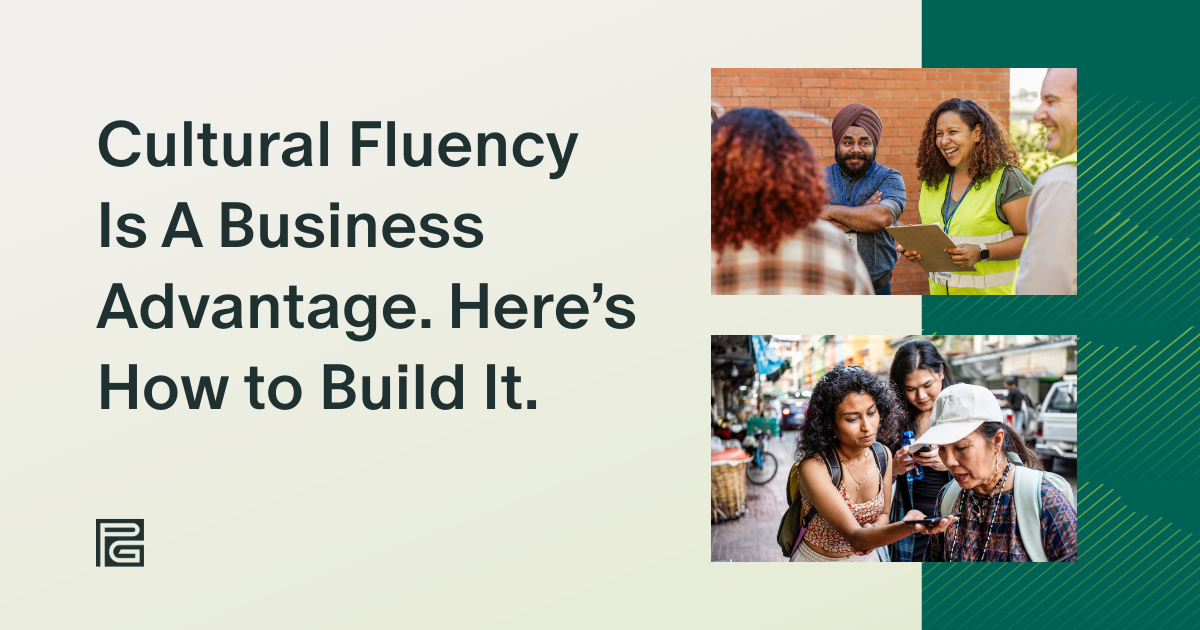
Cultural Fluency Is A Business Advantage. Here’s How to Build It.

In a world where goods move fast, people move faster, and expectations move fastest, cultural fluency is no longer a “nice to have.” It’s a competitive edge.Regardless of whether you’re working with diverse populations locally or expanding globally, your capacity to work with cultural fluency has a direct influence on business results. It influences how your enterprise is viewed, how your message is understood, and how successfully your mission is executed.So, what exactly is cultural fluency? And how do you acquire it?
Let’s break it down.

What is Cultural Fluency?

Cultural fluency is being able to comprehend, communicate, and function effectively across cultures.

That includes:

  • Language skills, verbal and written
  • Cultural context, values, norms, and sensitivities
  • Systemic awareness, such as legal systems, organizational policies, and community standards

At Piedmont Global, we see cultural fluency as something more than just communication. It’s alignment. Intention. It’s shaping your systems and strategies with cultural insight baked in, so nothing is lost in translation and every interaction earns trust.

Why Cultural Fluency Drives Business Results

Here’s the truth: the more global and diverse your audiences are, the less one-size-fits-all solutions will suffice. Organizations that value cultural fluency acquire three significant benefits:

      1. Fewer Mistakes
        Culturally literate teams anticipate risks before they arise. They avoid messaging that is off-putting. They prevent compliance gaps that happen when context is ignored. Whether in a product launch or government service rollout, cultural insight minimizes friction and misalignment.
      2. Quicker Market Entry
        When you’re familiar with a market’s language, systems, and expectations, you can act more confidently—and faster. Cultural fluency speeds up localization, content adaptation, team onboarding, and public engagement.
      3. Deeper Trust
        Whether you’re a doctor communicating with a patient or a manufacturer collaborating with global suppliers, cultural fluency builds trust. It shows that you care about getting it right, and that you care about making people feel heard, seen, and understood.

How to Build Cultural Fluency: Three Necessary Lever

At Piedmont Global, we help organizations in developing cultural fluency through three intertwined components:

      1. Expert People
        Linguists. Strategists. Analysts. All collaborating with in-depth knowledge of local subtlety, policy ramifications, and real-world dynamics. Cultural fluency isn’t “speaking the language”—it’s knowing what’s most important in a particular context, and why.
      2. Smart Systems
        Bespoke technology stacks get cultural intelligence where you need it most—across platforms, workflows, and communications. Whether that’s an AI-powered training module or multilingual customer service flows, we enable you to scale understanding, not just services.
      3. Strategic Insight
        Market studies, compliance audits, audience analysis—we turn sophisticated data into strategic guidance so your operations aren’t just informed by culture, they’re built for it.

What Cultural Fluency Looks Like in Practice

Here’s a picture of what this looks like in the real world:

      • A health system introduces multilingual appointment reminders that are tailored to the cultural norms of patients, reducing no-shows and rescheduled appointments.
      • A federal agency reshapes its online content to mirror the life experiences and [translate:vernaculars of its Spanish-speaking members], establishing trust and boosting engagement.
      • A multinational manufacturer translates safety training videos into local languages, avoiding misunderstandings that previously led to expensive delays and hazards on the production floor.

In every instance, cultural fluency not only prevented an issue—it turned the situation into a source of performance, clarity, and growth.

Ready to Lead with Cultural Fluency?

Cultural fluency is a capability–and like any capability, it must grow with your business. The more embedded it is across your people, platforms, and processes, the more powerful and successful you become in a world that’s increasingly complex.

When you pair cultural fluency with strategic insight and custom tech, you unlock something even more powerful: Strategic Globalization. And that’s where we come in.

At Piedmont Global, we help businesses make a shift from translation to transformation by developing globalization strategies rooted in cultural intelligence.

Whether you are expanding into new markets or reimagining the way you appear in your existing ones, let us develop the systems and intelligence that enable you to lead—globally, fluently, and confidently.

The Invisible Work Behind Visible Impact: Why Outcomes Start Before the Moment They’re Measured

Success rarely happens at the moment you see it.

It happens in everything that came before.

The decision gets made in the room, but was shaped by the quality of context leading up to it. The patient recovers in the hospital, but healing begins with the feeling of being understood. The emergency is resolved, but the real work was in the systems, trust, and training that made the proper response possible.

That’s the kind of work I’ve always been drawn to: the work that lives behind the scenes but changes everything.

At Piedmont Global, we talk about this as “creating the conditions around the moment.” Because when you operate across cultures, across communities, or continents, the moment itself is only the surface. Beneath it are layers of preparation, design, intent, and alignment. And when those layers are strong, the outcomes tend to follow.


Real outcomes are shaped before the moment of action.

We see it every day with our clients. Whether you’re in healthcare, government, education, or any other industry, the pressures you face are real: demographic shifts, global volatility, evolving expectations, competing priorities. Businesses are navigating complex realities where precision and humanity coexist. These are not static systems. The organizations that succeed are those that’ve invested in more than just tools; they’ve invested in readiness.

And the most forward-looking leaders? They are already working upstream.

What does that look like in practice?

It’s not about translating words; it’s about designing systems that create understanding.

It’s not just about interpreting one call; it’s about ensuring every interaction is delivered with clarity and care.

It’s not about fixing problems in real time; it’s about reducing the need for triage in the first place.


In other words, it’s about making cross-cultural operations easier, smarter, and more human.

Too often, organizations support global operations reactively – issues are addressed as they arise, translation happens on the fly, and individuals are left to bridge cultural gaps in real time. But the real opportunity lies further upstream: in designing systems that anticipate complexity before it appears.

Upstream work matters because surface-level solutions can only go so far. When systems are built to be culturally fluent from the start, they reduce confusion, friction, and costly rework. This proactive approach turns global complexity into an operational advantage.

Central to this is Cultural Intelligence (CQ) – the capability to work effectively across cultures. It encompasses four core components: motivation, knowledge, strategy, and action. High-CQ organizations adapt communication, collaboration, and decision-making with intention and agility. The impact is measurable: greater innovation, stronger engagement, and higher customer satisfaction across regions.


This is where Strategic Globalization comes in.

It’s not just about expanding into new markets but embedding cultural intelligence into every layer of your operations. That can look like:

  • Building internal cultural intelligence hubs to share knowledge
  • Training global teams in culturally adaptive communication
  • Partnering with local consultants during go-to-market planning
  • Designing governance models that reflect regional norms


I’ve come to believe that ease is a signal of integrity. If you’ve done the work—the strategic alignment, the systems thinking, the people investment—the moment won’t feel like a scramble. It will feel like a natural next step.


That’s where we focus our energy at Piedmont Global.

Not by reacting to chaos, but by helping our clients build something durable and adaptive. We call it Strategic Globalization, not as jargon, but as a serious commitment to solving the messy, meaningful challenges of operating across cultures, whether expanding into new global markets or serving multicultural communities at home.

We help organizations create the conditions for connection, clarity, and impact. That might mean redesigning internal processes to reduce friction and improve response time. It may mean helping leadership teams align around a shared sense of purpose before embarking on a significant transformation. It could also mean training teams in cultural fluency so they can build trust across borders before the first meeting even starts.

None of this is visible at first glance. It rarely appears on a project timeline or dashboard. But it’s the invisible infrastructure behind every moment that matters – the ounce of prevention that spares you the pound of cure. Because when organizations misstep early, the costs multiply downstream. At best, things are “good enough.” At worst, they’re misaligned, delayed, or ineffective. We don’t wait for that.


At Piedmont Global, we create environments where understanding is built-in, not bolted on.

We help healthcare teams reduce clinical errors—not just by following protocols, but by understanding each patient’s cultural context.

We support governments in designing public services that feel intuitive and inclusive, because the systems behind them anticipate needs before they’re voiced.

And we empower school districts to move beyond reactive translation, building proactive systems where every student feels connected and supported from day one.

As one client recently shared after a successful expansion: “We transitioned to Piedmont Global after years with a previous vendor. They made the transition extremely easy and seamless. Before we even launched fully, they translated our website, app, webinars, and live sessions into 12+ languages, all tied to a major contract win. Throughout the process, they were responsive, adaptive, and highly strategic. They didn’t just execute, they anticipated what we’d need before we needed it.


So if you’re aiming for impact, don’t just ask what needs to happen in the moment. Ask what needs to happen before the moment.

Because how you prepare determines how you perform.

This requires a mindset shift:

  • From transactional to relational.
  • From words to systems.
  • From surface inclusion to structural belonging.


We’ve studied the gaps. We’ve felt the friction. We’ve built something better. Not louder, but deeper.

And we’ll keep building the invisible infrastructure, so that when your moment comes, everything around it is already working in your favor.

The Partnership Shift: How Strategic Globalization Transforms Operations

In a world where complexity is rising and connection is constant, cross-cultural leadership requires more than translation or technology. It takes a partner.

For years, organizations have outsourced interpretation, localization, or training to fill specific gaps. But in today’s operating environment, those gaps are wider, deeper and harder to navigate. That’s why forward-looking teams are seeking more than service providers and transactional vendors. They’re seeking strategic partners that can embed, evolve, and scale with them.

At Piedmont Global, we believe meaningful connection starts with strategic alignment—not transactional tasks. Here’s what it means to be a Strategic Globalization Partner—and why it matters now more than ever.


From Provider to Partner: What’s the Difference?

Service providers complete tasks. Strategic partners accelerate outcomes.

A vendor may translate a document. A partner will ask: What is this content meant to accomplish, and how do we design it to work across audiences, systems, and languages?

A vendor may provide an interpreter. A partner will ask: Who is in the room, what’s at stake in this conversation, and how do we ensure everyone is truly heard and understood—across languages and cultures?

Here’s how true strategic partners show up:

  • They understand your business strategy and align to your vision
  • They help you navigate cultural, regulatory, and operational complexity
  • They build systems and capabilities that adapt as you scale
  • They build long-term value, not just short-term project deliverables

The key difference is this: vendors solve isolated problems; partners design systems that reduce friction, increase impact, and grow with you. Vendors execute. Partners embed. And that difference is everything.


Why Strategic Globalization

Globalization isn’t new. But maintaining clarity, cohesion, and compliance across diverse audiences, markets and geographies is harder than ever.

So how we approach it must change.

Consider this:

  • Your workforce may span five continents, a dozen languages, and multiple time zones.
  • Your customer base expects personalized, seamless experiences—regardless of language, culture, or region.
  • Your compliance risks, operational systems, and community relationships are all influenced by cultural context.

And yet, many organizations still rely on siloed solutions to manage cross-cultural complexity.

That’s where Strategic Globalization comes in. It’s an integrated approach that blends:

  • Cultural Fluency: Deep knowledge and nuanced understanding of language, culture, and context
  • Custom Technology: Agile platforms and AI-enhanced workflows that adapt to your systems
  • Strategic Insight: Market intelligence, risk mitigation, and tailored growth planning

This integrated model fuels connected, scalable growth—ensuring organizations aren’t just seen and heard but trusted and understood across every audience and environment.


The Piedmont Global Approach

As a Strategic Globalization Partner, we don’t show up with a playbook and leave.

We integrate with your teams and systems. We align to your mission. We evolve with you.

Whether you’re:

  • A healthcare leader working to improve patient outcomes across language barriers,
  • A government agency trying to reach every resident with clarity,
  • Or an education provider building inclusive learning systems,

We help you build the capabilities—not just content—you need to lead across cultures.

It’s not about being everywhere. It’s about showing up the right way. With the right systems. The right context. And the right partner.


Why It Matters Now

Every organization is under pressure to do more—with fewer silos, fewer vendors, and fewer missteps. But good intentions don’t bridge cultural gaps. Systems do. Strategy does. So does alignment, agility, and cultural intelligence.

That’s what Strategic Globalization delivers.

And it’s why Piedmont Global exists: to make cross-cultural operations easier, smarter, and more human—for every team, every system, and every community.

Ready to Rethink What Partnership Can Look Like?

If your organization is evolving and growing, your support model should evolve with it. Strategic Globalization isn’t a trend. It’s a capability. And we’re here to help you build it.

Why It’s Time to Rethink Global Growth: From Translation to Transformation

In today’s hyper-connected, fast-paced world, companies aren’t just growing geographically — they’re working with diverse populations, integrating across systems, and navigating increasing cultural and operational complexity. For decades, translation and localization services were considered the default solution for global communication. But the stakes are rising, speed is accelerating, and traditional approaches are no longer enough. 

At Piedmont Global, we believe it’s time for something more. 

It’s time to move from translation to transformation. 


The global reality has changed — has your strategy?

There was a time when translating a website or brochure was sufficient to “go global.” Today, organizations face a fundamentally different landscape. Whether you work in healthcare, government, or education, your audiences are no longer defined by geography — and neither are your teams, vendors, or stakeholders. 

Language is only one layer of what it means to operate across cultures. Cultural expectations, regulatory requirements, evolving tech infrastructures, and operational workflows all converge. Growth now depends on a more holistic fluency: not only in language, but in strategy, systems, and human connection. 


The weakness of translation-only models, and why professional translation agencies must evolve

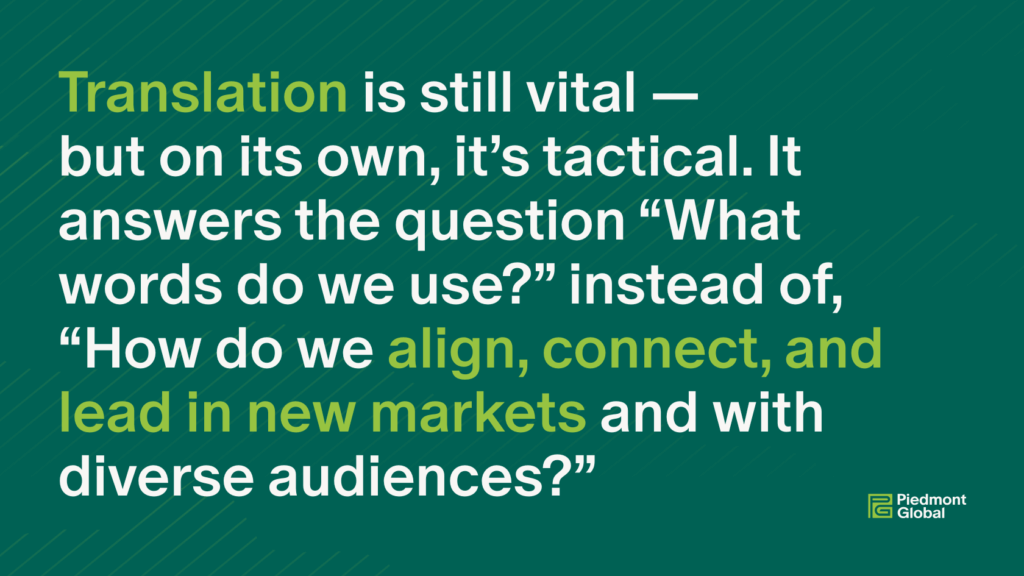
Translation is still vital — but on its own, it’s tactical. It answers the question “What words do we use?” instead of, “How do we align, connect, and lead in new markets and with diverse audiences?”

Transform global growth with strategic translation and localization services built for enterprises, cultural fluency, and multilingual content operations.

When translation is commodified as a transactional service, even when delivered by a traditional professional translation agency or language service provider, organizations often experience: 

  • Disjointed customer experiences across languages
  • Delayed market entry from a lack of enterprise localization at scale
  • Overlooked compliance or cultural nuance
  • Fragmented communication across multilingual teams
  • Limited ROI from global marketing, training, and CX programs 

Translation solves for communication. Strategic Globalization solves for coordination, connection, and impact. 


What is Strategic Globalization?

 Strategic Globalization is a new category — and a new way forward for organizations operating across borders, systems, and cultures. 

More than a one-size-fits-all solution, it’s a comprehensive methodology combining cultural fluency, human expertise, custom technology, and actionable strategy. It’s built to support every phase of global expansion, from entering new markets to sustaining global content operations with clarity and confidence. 

It means: 

  • Embedding expertise — from interpreters and localization experts to consultants and cultural advisors — directly into your workflows
  • Integrating global readiness into customer experience, compliance, multilingual support, and service delivery systems
  • Designing programs and processes that work across cultures and contexts
  • Infusing cultural intelligence into marketing, HR, supply chain, and technology operations
  • Aligning strategy, people, and technology to drive growth and equitable outcome

This is a model built for organizations that require more than managed language services. They need integrated, future-ready infrastructure.


From vendor to partner: A new kind of global support

At Piedmont Global, we don’t parachute in with a playbook and disappear. We embed. We learn your systems, understand your audiences, and evolve with you. This embedded partnership model — powering translation and localization services within broader transformation — creates real advantages: 

  • Faster go-to-market execution without language lag
  • Seamless team alignment across departments and borders
  • Improved customer experiences in every language, for every individual
  • Reduced operational and compliance risk
  • Built-for-you capabilities that scale through enterprise localization at scale and multilingual operations 

Our clients don’t just need content translated. They need durable global systems, and we build them. 


Why now?

This is the tipping point for global content operations, and the stakes have never been higher. 

Organizations are being tasked with doing more across more languages, cultures, and channels, and with greater precision and speed than ever before. 

Because employee and customer populations are more diverse than ever. Expectations are rising. Equity matters. 

Because quick fixes and transactional models won’t prepare you for the future. 

And because the organizations that rethink global growth today are the ones that will lead tomorrow. 


What’s next

We’ve launched our new brand identity with exceptional reception, and we’re excited to share how we’re redefining what it means to be a global partner. As we move into the new year, we’ll continue to explore the building blocks of Strategic Globalization — and how Piedmont Global is delivering smarter, more human, more scalable solutions for a changing world.


Ready to move from translation to transformation? 

Connect with our team →  

Language Barriers in Manufacturing: Why Leaders Are Investing in Language Solutions

Manufacturing today is more global, quicker, and more complicated. In this setting, clear communication isn’t an operational edge — it’s a prerequisite to safety, efficacy, and profitability. The majority of manufacturers, however, confront one continual and mostly underestimated obstacle: linguistic diversity among their workers and along their supply chains.

This article deals with how language barriers impact manufacturing companies, the dangers they pose, and the actions visionary leaders are taking to safeguard their workers, de-bottleneck operations, and ensure sustainable growth.


How Language Barriers Affect Manufacturing Operations

In business, the workforce is often made up of employees of different linguistic backgrounds — particularly where labor is in short supply or where migrant labor is employed. In addition, supply chains span continents, and there are vendors and suppliers who may not share your native language.

Wherever there are language gaps at any point during this process, the whole operation is susceptible to:

  • Misconceptions by employees regarding procedures, safety procedures, or use of equipment
  • Delays resulting from miscommunication with suppliers or logistics partners
  • Compliance risks of regulatory failure
  • Poor staff morale and retention because of feelings of exclusion or confusion


The Top 3 Risks of Language Barriers in Manufacturing


1. Safety Risks: Language Gaps Endanger Workers

Safety is the foundation of every production environment. When instructions, safety procedures, or hazard communication cannot be understood because of a language problem, the potential for accidents grows exponentially.

Main safety hazards are:

  • Misreading of machine operational instructions
  • Inability to comprehend emergency protocols
  • Inability to identify hazard signs or labels
  • Challenges in reporting close calls or incidents

According to the U.S. Bureau of Labor Statistics, language barriers in the workplace are associated with increased rates of injuries and fatalities. Language barriers were found to be a contributory cause of nearly 25% of industrial accidents among immigrant construction and factory workers.


2. Efficiency Risks: Miscommunication Disrupts Operations

Manufacturing depends on synchronization and accuracy.  Ineffective communication between workers or supply chain partners produces:

  • Missed production deadlines
  • Errors in product assembly or packaging
  • Supplier Coordination Failures
  • Material Delivery Delays

Language barriers hinder daily commerce, sap productivity, and spoil relationships throughout the supply chain.


3. Financial Risks: Language Barriers Hurt the Bottom Line

When efficiency and safety are compromised, so is your bottom line. The bottom-line costs of language disparity in manufacturing can be:

  • Injury Costs: Medical cost, workers’ compensation claims, and increased insurance premiums
  • Production Downtime: Losses due to accidents or errors
  • Supply Chain Penalties: Failure to meet delivery timescales or inaccurate orders
  • Regulatory Fines: Noncompliance with safety standards due to misunderstood protocols

For firms that operate in low-margin businesses, these types of costs can disproportionately affect profitability.


Solutions: How Manufacturers Are Overcoming Language Barriers

Progressive factory executives no longer consider language access a nice-to-have. It’s now a strategic necessity. Let’s discuss three of the ways they are overcoming this obstacle:


1. Workforce Language Training

Providing language instruction (or exposure to translated instructional content) enables workers to acquire the skills necessary to become effective workplace communicators.

  • eLearning Localization: Companies are now localizing safety training, standard operating procedures, and onboarding modules into the native languages of employees. This provides understanding and engagement.
  • On-site or distance language training: Focused English-as-a-second-language (ESL) or work-specific language training enables workers to gain confidence while improving safety and productivity.


2. Content Translation: Signage, Manuals, and Beyond

Manufacturing operations encompass an enormous range of written content — from equipment manuals and SOPs to safety signs and plant signage.

  • Technical manual translation ensures workers can operate machinery safely and efficiently.
  • Plant signage localization means that hazard warnings, directions, and emergency exits are understandable to all.
  • Translation of employee handbooks establishes expectations with clarity and assists in fostering an inclusive culture.


3. Interpretation for Real-Time Communication

Multilingual supplier chains or vendors usually require assistance with site visits, audits, or meetings.

  • Phone and video interpretation services allow teams to communicate clearly in the moment, averting costly misunderstandings.
  • On-demand interpretation aids HR discussions, safety orientations, and emergencies in which clear understanding matters most.


The Piedmont Global Approach: Helping Manufacturing Leaders Scale Language Access

At Piedmont Global, we recognize the business imperatives that manufacturing leaders confront. Our solutions are crafted to:

  • Minimize risks: From warning signs to compliance documents, our services keep you and your employees safe.
  • Increase efficiency: Localized training and correct interpretation avoid delays and rework.
  • Protect profitability: Reduce expensive mistakes, downtime, and ship on schedule with certainty.

We work alongside you as your strategic language partner, delivering comprehensive and personalized language solutions to help you connect with your audience—across any language or region.


Take the Next Step To More Efficient, Safer Operations

Language issues in manufacturing are more than a communications issue — they’re an operational risk. However, with the right partner, those issues can be transformed into competitive advantages.

Explore our comprehensive language access guide to learn more.

Download our eBook on building inclusive manufacturing operations.

Get in touch to start a conversation about scaling language solutions for your team.

Why This Is IT’s Moment: Inside Piedmont Global’s Vision for Leading Through Change

When over 4,000 technology leaders gather in Las Vegas for Info-Tech LIVE 2025, you expect bold ideas. What you might not expect is validation that the strategy your team is building under pressure is the one the industry is now racing to adopt.

For us at Piedmont Global, Info-Tech LIVE wasn’t just a conference. It was confirmation that resilience, cultural fluency, and adaptive tech aren’t just differentiators. They’re requirements.


The Theme: Transform IT. Transform Everything.

This year’s rallying cry was more than marketing. It was a call to action. Technology is no longer a backend function; it’s the connective tissue of how organizations operate, scale, and build trust in the face of global uncertainty.

The message was clear: This is IT’s moment.

At Piedmont Global, we serve mission-driven institutions where communication, precision, and people are everything. We don’t have the luxury of lagging behind trends. We build for what’s next, because the communities we serve can’t afford for us not to.


Exponential IT: Designing for Change

One of the strongest insights from the summit was the concept of Exponential IT: a shift away from rigid roadmaps toward systems that adapt in real time.

As Info-Tech’s CEO put it: “Legacy roadmaps won’t survive exponential change.”

The data backs it up. As the World Uncertainty Index climbs 481% in just six months (now 40% higher than its COVID-era peak), our systems must evolve at the same pace.

At Piedmont Global, we’ve already embraced this mindset. We’ve moved away from static infrastructure toward modular, scalable solutions. Whether it’s adjusting to new compliance frameworks, global service delivery needs, or shifting client priorities – we design to pivot, not patch.

This isn’t just smarter architecture. It’s how we create continuity in environments where reliability isn’t optional.


From Assistive to Agentic AI

Everyone’s talking about AI, but the conversation is changing.

This year, the focus shifted from assistive tools (like chatbots) to agentic AI systems that can act, learn, and make decisions with autonomy.

But this isn’t about replacing people. It’s about reducing the friction that slows them down. The question isn’t whether AI can act, it’s how well it understands context when it does.

That’s why we’re focused on embedding AI across our operations with intention:

  • AI-native workflows in interpreter scheduling and client services
  • Context-aware decision systems that reduce manual lift
  • Ethical governance frameworks that protect human oversight

When AI enhances (not replaces) human clarity, everyone wins.


Culture: Not an Add-On, but a System Requirement

The best tech fails if it can’t account for people. At Piedmont Global, we know firsthand that cultural intelligence is a functional requirement, not a bonus feature.

We don’t localize after we build. We build to localize.

This shows up in how we test user interfaces, structure onboarding, and train support teams in global environments.

This isn’t just empathy – it’s risk mitigation. Systems that understand users are less likely to break in the field.


Interpreting Data into Strategy

Data without action is just noise. One theme echoed across the conference: strategic intelligence means turning insight into behavior.

We’re revamping our internal dashboards and feedback loops to enable better decisions, faster. Whether it’s improving turnaround times or proactively identifying service gaps, we’re asking: Does this data help someone act with confidence?

That’s how trust is built, decision by decision, insight by insight.


Security That Protects People First

Cybersecurity isn’t just about locking down assets. It’s about designing systems your team can use without burnout.

One statistic resonated: 73% of security professionals report reduced stress after deploying AI-powered tools.

We’re investing in automation not just for speed, but for sustainability. From early threat detection to intelligent triage, our goal is to keep security proactive, not reactive. All without overwhelming the people who keep our systems safe.


Leadership at Every Layer

At Info-Tech LIVE, leadership wasn’t framed as a role, it was framed as a capability. The expectation? CIOs and CISOs aren’t just technologists, but translators, visionaries, and culture-shapers.

That message resonated deeply.

We’re embedding leadership development across every IT layer, from the help desk to architecture – because the challenges we face require more than technical fixes. They require people who can motivate, communicate, and adapt under pressure.

Talent is no longer a pipeline issue. It’s a system design issue.


A Strategy Validated, Not Rewritten

Info-Tech LIVE didn’t change our direction. It affirmed it.

We’re not waiting for perfect conditions. We’re building systems that thrive under real-world complexity. That means infrastructure that scales, technology that understands its users, and teams that lead with intention.

Our mission at Piedmont Global is inherently human. And that means our tech must be too.
What Happens Next?

This isn’t just a moment for IT. It’s a mandate.

We are:

  • Scaling agentic AI for operational impact
  • Redefining how IT communicates value across the organization
  • Evolving our leadership pipeline for resilience
  • Building systems that adapt as fast as the world changes

At the intersection of communication and technology, we aren’t reacting to change, we’re architecting what comes next.

The future isn’t waiting. Neither are we.

Ready to transform how your team navigates complexity?
Let’s build it, together.

Breaking the Language Barrier in Forensics: A Perspective from Techno East

Last month, I had the chance to represent Piedmont Global at Techno Security East alongside our VP of Technology, Gil Segura. When we showed up, I expected the usual: booths, badges, and maybe a few new contacts. What I didn’t expect was to leave with a crystal-clear confirmation of something we’ve been sensing for months: that forensic and law enforcement agencies are hitting a wall when it comes to multilingual data.

And no one’s really helping them fix it.

Over three days, we met with dozens of local, state, and federal law enforcement professionals. What we heard was consistent: language is becoming a bigger and bigger barrier in digital investigations. Whether it is evidence extracted from phones, audio from body cams, or interviews conducted in the field, the multilingual footprint is growing. And most agencies don’t have a plan to handle it.

That’s where our work comes in.


A Clear Gap in the Market

Despite the enormous role language plays in modern investigations, most vendors haven’t caught up. The usual suspects (I won’t name them here, but you know who they are) tend to focus on volume-based interpreting or general translation. Their government offerings are often copy-pasted from healthcare or corporate templates, not built for the complexities of forensic workflows.

What we’re doing at Piedmont Global is different.

We’re not adapting existing products for government. We’re building new solutions, designed in partnership with the very people using them: law enforcement officers, investigators, forensic analysts. That co-design approach shows up in everything from our deployment models (on-prem, on-device, no cloud required) to the way we deliver training and support.

Examples of Forensic Linguistics in Action:

  • Investigative Linguistics
    Analyzing threatening text messages or social media posts in foreign languages to identify the author and prevent future harm. Every word counts in an investigation, and linguistic accuracy is at the heart of an investigation.
  • Author Identification
    Analyzing the writing style of a ransom note in a foreign language to identify the author and their background. Language identification is vital, but the ability to identify age, gender, and other key characteristics is a true game changer.
  • Analyzing Witness Testimony
    Analyzing the language used by witnesses who speak different languages to ensure accurate and fair representation of their statements. This evidence can come in a variety of formats: (Video, Audio, Digital Content, Documents, etc.)


What We Heard at Techno East

Several clear patterns emerged from our conversations:

  • Cloud Fatigue
    Almost everyone we spoke to said the same thing: they don’t trust the cloud. Whether it’s about data sensitivity, chain of custody, or just institutional policy, cloud-based tools often get blocked before they even get piloted. Our ability to deploy secure, localized solutions was a major differentiator.
  • Demo-First Decision-Making
    This audience doesn’t want a pitch, they want to see the tool work. On-the-spot demos of our platform generated more interest in five minutes than a PDF ever could. The ability to surface multilingual evidence instantly hit home.
  • An Underserved Niche
    Everyone was dealing with language issues. No one had a vendor they trusted to solve them. The most common question we heard? “Why hasn’t anyone built something for this?”
  • The Forensics-Language Loop
    One particularly compelling insight came from a few cybercrime teams: they want to use anonymized language data to help train models for early detection, but privacy regulations make that nearly impossible. That opens the door to future R&D partnerships focused on encrypted language data training.


The Piedmont Global Advantage: Built With, Not For

At Piedmont Global, we don’t just support law enforcement — we partner with them. Some of our most exciting product features were shaped through feedback from officers, analysts, and forensic technologists. That’s not something you can bolt on after the fact.

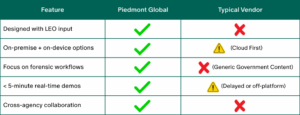
Here’s how we’re different from the competition:

Table showing Piedmont Global's capabilities versus other vendors

This isn’t about buzzwords. It’s about building language access tools that actually work for people in the field.

Where This Goes Next

We’re already setting up follow-up meetings from Techno East. Some leads are hot, some are exploratory, but all are tied together by a clear sense of urgency. No one wants to wait 5–10 business days for a translation when there’s a case on the line. And no one wants to guess at what a suspect said in a language they don’t speak.

That’s where we come in.

We’re helping teams:

  • Reduce evidence processing time
  • Improve accuracy in multilingual investigations
  • Stay compliant with chain-of-custody and data security requirements
  • Increase community trust through clearer communication

We’re already looking forward to next year’s Techno East in Myrtle Beach. We will be attending with deeper demos, more insights, and a strengthened commitment to solving real problems for law enforcement, not just checking a box.


Final Thought

This field is changing. Investigators aren’t just solving local crimes anymore; they’re navigating global data. And that data speaks every language.

Piedmont Global is here to help make sense of it.

Connect with me to learn more about our tailored solutions to navigate your global data.

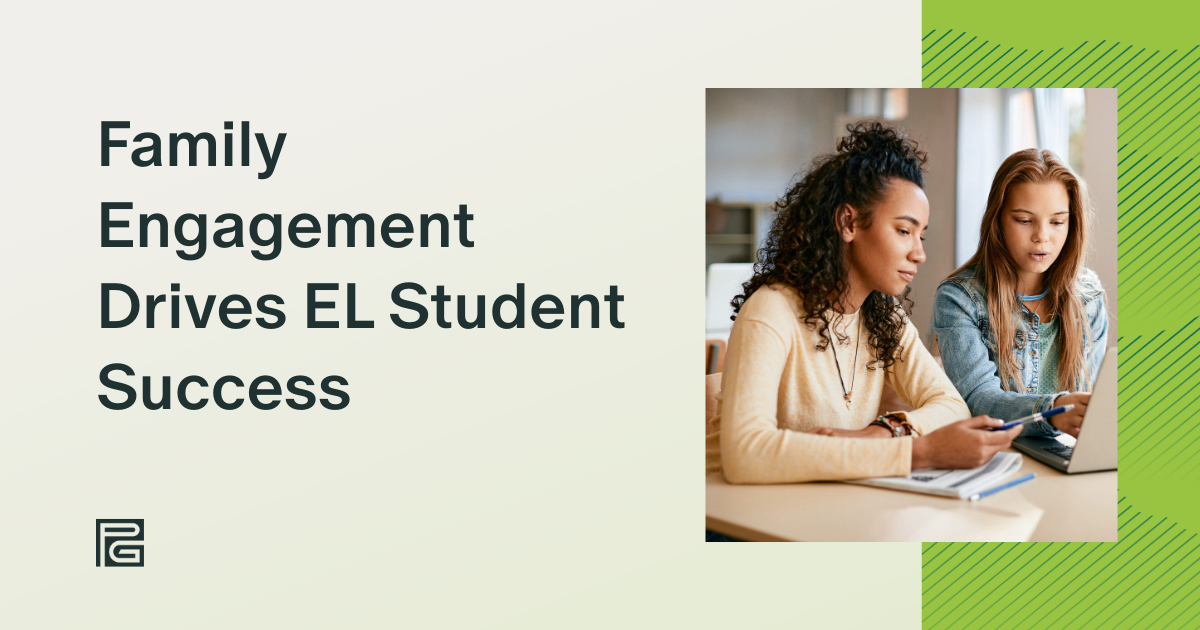
Family Engagement Drives EL Student Success: How Language Access Makes a Difference

More than 50 years of research from the U.S. Department of Education shows the irreplaceable impact of family engagement on student achievement. From higher grades and test scores to increased teacher morale and graduation rates, K-12 schools benefit from investments in family engagement.

Considering that English-learner (EL) students traditionally lag behind their peers’ academic performance, family engagement offers a bridge to better outcomes. However, most EL students have parents or caregivers who do not speak English fluently. Building and sustaining these relationships requires a strategic approach to generate measurable results.

Whether you are noticing an increase in EL students in your district or are considering how to improve outcomes for your existing EL students, family engagement must play a central role. While bridging the gap between languages and cultures can be daunting, a comprehensive K-12 language access plan identifies the necessary structure and resources to engage effectively with multilingual families.

Do you need help advocating for an increase in language access planning and resources in your district? We’ve rounded up the most common language access-related challenges facing K-12 schools today and paired them with solutions that are time-tested and supported by data. 


Challenge: Addressing Language Barriers between Teachers and Multilingual Parents/Caregivers

The majority of EL students come from households where English isn’t the primary language. Without meaningful language support, it’s much harder for schools to engage families in discussions about their child’s progress. This leaves EL students vulnerable to the adverse effects of minimal familial support, which will not help them catch up with their native English-speaking peers, who benefit from academic support at home. Also, when announcements and events are released only in English, multilingual families are excluded from socially integrating into the school community.

No matter what language is spoken at home, most parents are interested in tracking their students’ academic progress and working with teachers to support learning outcomes. Parents know their children are more likely to show better attendance, grades, and social development if they’re involved. The challenge facing K-12 schools is tackling the language and cultural barriers between them.


Solution: Factor Family Engagement into Your Interpreting and Translation Budget

To improve engagement, consider how and where schools communicate with families. Which conversations, resources, and events can lead to the greatest impact?  

Parent meetings are among the most important, high-touch opportunities to address student academic needs, so this should be one of your top priorities. If employing an on-site linguist is not an option, virtual remote interpretation is a cost-effective alternative that allows for greater flexibility and language variance. Creating a system for submitting interpreter requests in advance can help bring down costs further.

Next, official materials, such as handbooks, codes of conduct, and other essential information, should be made available in the languages spoken at home by families. Considering some of these resources are often perennial, with minor year-over-year updates, this investment can be of value for years to come.


Challenge: Ensuring EL Students with Special Needs Are Accommodated

EL students with special needs deserve additional attention to help ensure they receive adequate accommodations at school and support at home. Parents may lack the financial resources to help their children thrive inside and outside the classroom. Transparent communication with them is imperative and can significantly improve the students’ quality of life.

Special education often uses complex terms that can be hard to understand—especially for families who speak a language other than English. Multilingual parents of Deaf or hard-of-hearing students may feel excluded and overwhelmed when navigating the system.


Solution: Language Access Planning for Students with IEP and 504 Plans

In these cases, the IEP and 504 coordinators and language access coordinators need to team up. Language access planning must be inclusive of students with disabilities or special needs. Strategically considering this student population will allow educators, paraeducators, and coordinators to provide the appropriate accommodations and make informed decisions around budgets.

Since sensitive conversations, such as 504 and IEP planning sessions, chart a definitive path forward for EL students, parental involvement in the decision-making process is critical. Interpreters must be provided for these conversations to comply with Title VI non-discrimination requirements, whether for spoken language or ASL interpreting. Beyond compliance, interpreters provide much-needed precision and assurance when the stakes are high, enhancing trust in parent-teacher relationships. 


Challenge: Facing the Budget Conversation

If you’re tasked with family engagement and language access and simultaneously concerned about how to advocate for your budget, you’re not alone. It may sound simple, but framing the ask correctly is important. The administration’s job is to allocate spending to efforts that will be compliant, efficient, and beneficial to students. Your job is to help them understand why language access needs to be a priority line item. 


Solution: Align Your Ask with Data

As an advocate for EL students and families, you can help the administration see how family engagement enriches students’ academic experiences and builds trust with the community. 

The best approach to the budget conversation is to lead with data. Connect the dots between language access and family engagement, which they may (or may not) already know supports better student outcomes, test scores, teacher retention, and other key metrics.

Also, conclude with data. Demonstrate how your investment will lead to measurable outcomes aligning with your district’s priorities. Overall, budget decision-makers should walk away from your conversation understanding that in more ways than one, getting multilingual families more involved is a win for everyone. 


Challenge: Inconsistent Implementation of Existing Language Access Resources

Are you noticing inconsistencies across how different faculty members deploy language access resources? This is yet another common challenge. Between the long-term teachers with routines that are not easily disrupted, newer staff members still learning the ropes, or others who remain skeptical, uneven implementation of language access could allow EL students and families to slip through the cracks. This is especially disheartening after working hard to obtain budget and resources. 


Solution: Schoolwide K-12 Language Access Planning and Training

When training faculty on how and when to deploy language access, give them a purpose to hold onto—and focus their attention on the positive impacts. Sometimes, folks need a “why” answer before embracing change. This might seem simple, but it goes a long way toward turning skeptics into champions of language access. 

Partner with the expert PGLS team for K-12 language access planning and implementation. Learn more here and get in touch.