Newsletter Series: Why Strategic Global Operations Is Reshaping How Organizations Scale

This article was originally published as part of Piedmont Global Pulse, our LinkedIn newsletter where we share timely insights and  industry trends. To stay ahead of the conversation and receive future editions directly in your LinkedIn feed, be sure to subscribe to Piedmont Global Pulse.


Why Strategic Global Operations Is Reshaping How Organizations Scale

Listen in as Mary Grothe, Chief Revenue Officer at Piedmont Global, shares her insights on January 22’s newsletter.


For the last several years, organizations have been solving global challenges one request at a time. And “global” no longer means what it used to.

For some organizations, globalization shows up across borders — serving international customers, managing multilingual operations, or scaling teams across regions.

For others, globalization is happening inside their four walls.

Different environments. Same pressure.

A translation request here. An accessibility accommodation there. A staffing gap. A compliance concern. Another vendor added to the mix.

On the surface, things appear to be “working.” Underneath, leaders feel the friction.

Costs are rising. Risk is harder to see. Outcomes are harder to measure. And teams are stuck reacting instead of operating strategically.

If you’ve ever thought, “We’re not a global company — so why does this feel so complex?” You’re asking the right question.

Because today, global operations aren’t defined by geography. They’re defined by people, systems, access, and execution — and nearly every organization is navigating that reality, whether they realize it or not.


The problem isn’t language. It’s fragmentation.

Most organizations don’t have a translation problem. They don’t have an accessibility problem. They don’t have a staffing problem.

They have an operational clarity problem.

Language, accessibility, content, staffing, compliance, and data all live in different silos — owned by different teams, managed by different vendors, measured in different ways.

The result?

  • Disconnected decision-making
  • Inconsistent experiences for employees and customers
  • Higher compliance risk
  • Slower execution
  • And leadership teams are forced into constant tradeoffs

What leaders are feeling today isn’t inefficiency — it’s structural misalignment. And the market has finally reached a tipping point where that misalignment can’t be ignored.


Why Strategic Global Operations had to exist

Strategic Global Operations (SGO) was not created as a framework or a rebrand. It emerged because organizations changed faster than the industry supporting them.

Global operations no longer happen “over there.” They happen inside organizations — every day.

In hospitals and clinics, in classrooms and universities, in manufacturing plants, in call centers, and across public agencies and institutions.

Language access, cultural fluency, accessibility, content, and staffing are no longer edge cases. They are core operating requirements.

SGO exists to unify what has been fragmented. It connects:

  • Strategy and execution
  • Systems and people
  • Compliance and experience
  • Cost control and outcomes

Not by adding more layers — but by designing operations intentionally, from the start.


The market forced a new model

For years, organizations were forced to stitch together solutions:

  • One vendor for translation
  • Another for accessibility
  • Another for staffing
  • Another for content
  • Another for data

Each solved a narrow problem. None solved the whole. Leaders were left managing the gaps.

SGO is our response to what the market demanded but never received: A single operating model that treats global execution as a strategic function — not a collection of tasks.

This is not about doing more. It’s about finally doing things in the right order.


Introducing the Elite 8: a unified operating system

At the core of Strategic Global Operations is what we call the Elite 8 — eight interconnected solution areas designed to work as a system, not standalone services. They include:

Each addresses a critical operational need. Together, they eliminate fragmentation.

This is not a menu of offerings. It’s an operating system for scale — designed to reduce risk, improve outcomes, and bring clarity to complex environments.

Over the coming months, we’ll explore each of these areas in depth — why they exist, the problems they solve, and how they apply across each specific industry use case.


What this means for leaders

For executives and operators, SGO changes the conversation. It means:

  • Fewer vendors and clearer accountability
  • Better visibility into cost, performance, and risk
  • Consistent experiences for employees, patients, students, and customers
  • Operations that can scale without breaking
  • AI and predictive data to get ahead of critical decision-making

Whether you lead in healthcare, education, manufacturing, contact centers, or the public sector, the challenge is the same:

How do we operate globally, compliantly, and human-centered — without creating chaos?

SGO is the answer to that question.


What’s coming in 2026

This newsletter marks the beginning of a deliberate, monthly deep dive into Strategic Global Operations. Here’s what’s ahead:

  • February: LangOps + Content — where execution breaks down
  • March: Data Services — turning complexity into intelligence
  • April: Consulting — designing systems that actually scale
  • May: Accessibility — building access by design (National Accessibility Month)
  • June: OSINT — turning global signals into strategic foresight
  • July: Staffing — The right people, in the right roles

Each month, we’ll focus on one core pillar — grounded in real market signals, real operational challenges, and real outcomes.


Stay connected

If this resonates, follow:

→ Our newsletter for monthly insights

→ Our LinkedIn for research-driven thought leadership

→ Our Instagram for a behind-the-scenes look at who we are and how we work

Strategic Global Operations isn’t a trend. It’s the next evolution of how organizations operate and compete.

And at Piedmont Global, we’re proud to be building it — intentionally, transparently, and in partnership with the organizations shaping the future.

Breaking the Language Barrier in Forensics: A Perspective from Techno East

Last month, I had the chance to represent Piedmont Global at Techno Security East alongside our VP of Technology, Gil Segura. When we showed up, I expected the usual: booths, badges, and maybe a few new contacts. What I didn’t expect was to leave with a crystal-clear confirmation of something we’ve been sensing for months: that forensic and law enforcement agencies are hitting a wall when it comes to multilingual data.

And no one’s really helping them fix it.

Over three days, we met with dozens of local, state, and federal law enforcement professionals. What we heard was consistent: language is becoming a bigger and bigger barrier in digital investigations. Whether it is evidence extracted from phones, audio from body cams, or interviews conducted in the field, the multilingual footprint is growing. And most agencies don’t have a plan to handle it.

That’s where our work comes in.


A Clear Gap in the Market

Despite the enormous role language plays in modern investigations, most vendors haven’t caught up. The usual suspects (I won’t name them here, but you know who they are) tend to focus on volume-based interpreting or general translation. Their government offerings are often copy-pasted from healthcare or corporate templates, not built for the complexities of forensic workflows.

What we’re doing at Piedmont Global is different.

We’re not adapting existing products for government. We’re building new solutions, designed in partnership with the very people using them: law enforcement officers, investigators, forensic analysts. That co-design approach shows up in everything from our deployment models (on-prem, on-device, no cloud required) to the way we deliver training and support.

Examples of Forensic Linguistics in Action:

  • Investigative Linguistics
    Analyzing threatening text messages or social media posts in foreign languages to identify the author and prevent future harm. Every word counts in an investigation, and linguistic accuracy is at the heart of an investigation.
  • Author Identification
    Analyzing the writing style of a ransom note in a foreign language to identify the author and their background. Language identification is vital, but the ability to identify age, gender, and other key characteristics is a true game changer.
  • Analyzing Witness Testimony
    Analyzing the language used by witnesses who speak different languages to ensure accurate and fair representation of their statements. This evidence can come in a variety of formats: (Video, Audio, Digital Content, Documents, etc.)


What We Heard at Techno East

Several clear patterns emerged from our conversations:

  • Cloud Fatigue
    Almost everyone we spoke to said the same thing: they don’t trust the cloud. Whether it’s about data sensitivity, chain of custody, or just institutional policy, cloud-based tools often get blocked before they even get piloted. Our ability to deploy secure, localized solutions was a major differentiator.
  • Demo-First Decision-Making
    This audience doesn’t want a pitch, they want to see the tool work. On-the-spot demos of our platform generated more interest in five minutes than a PDF ever could. The ability to surface multilingual evidence instantly hit home.
  • An Underserved Niche
    Everyone was dealing with language issues. No one had a vendor they trusted to solve them. The most common question we heard? “Why hasn’t anyone built something for this?”
  • The Forensics-Language Loop
    One particularly compelling insight came from a few cybercrime teams: they want to use anonymized language data to help train models for early detection, but privacy regulations make that nearly impossible. That opens the door to future R&D partnerships focused on encrypted language data training.


The Piedmont Global Advantage: Built With, Not For

At Piedmont Global, we don’t just support law enforcement — we partner with them. Some of our most exciting product features were shaped through feedback from officers, analysts, and forensic technologists. That’s not something you can bolt on after the fact.

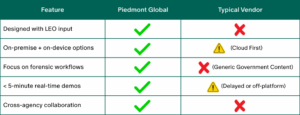
Here’s how we’re different from the competition:

Table showing Piedmont Global's capabilities versus other vendors

This isn’t about buzzwords. It’s about building language access tools that actually work for people in the field.

Where This Goes Next

We’re already setting up follow-up meetings from Techno East. Some leads are hot, some are exploratory, but all are tied together by a clear sense of urgency. No one wants to wait 5–10 business days for a translation when there’s a case on the line. And no one wants to guess at what a suspect said in a language they don’t speak.

That’s where we come in.

We’re helping teams:

  • Reduce evidence processing time
  • Improve accuracy in multilingual investigations
  • Stay compliant with chain-of-custody and data security requirements
  • Increase community trust through clearer communication

We’re already looking forward to next year’s Techno East in Myrtle Beach. We will be attending with deeper demos, more insights, and a strengthened commitment to solving real problems for law enforcement, not just checking a box.


Final Thought

This field is changing. Investigators aren’t just solving local crimes anymore; they’re navigating global data. And that data speaks every language.

Piedmont Global is here to help make sense of it.

Connect with me to learn more about our tailored solutions to navigate your global data.

8 Tips for Utilities to Choose the Right Language Services Provider

Utilities must balance safety, cost-effectiveness, and energy efficiency in their daily operations. Partnering with a Strategic Globalization Organization (SGO) who shares these values is crucial. This collaboration can develop a multilingual communications program that drives organizational growth, enhances service delivery, and allows utilities to embrace the latest energy trends with exceptional transparency.

Choosing the right partner and adopting a strategic approach to language access are key to meeting regulations and achieving business goals. Here are some tips for selecting the right provider:


1. Evaluate the Partner’s Background and Experience in the Utilities Sector

When selecting a language services provider, consider their industry expertise, knowledge of state and federal energy regulations, and commitment to environmentally-friendly initiatives. A provider well-versed in these areas ensures compliance, offers innovative solutions, and contributes to sustainability.

Piedmont Global has extensive experience providing language solutions to utility companies such as Washington GasDominion Energy, and Northern Virginia Electric Cooperative (NOVEC), as well as government agencies and other commercial clients. We also recognize and value sustainability in the sector.


2. Consider the Partner’s Ability to Accommodate the Languages Spoken in Your Territory

Inquire about the SGO’s cultural competence in working inclusively and sensitively with Limited English Proficiency (LEP) communities. This includes their experience in effective communication, understanding cultural nuances, and providing accessible language services.

Piedmont Global frequently hires linguists who are local to the communities we serve. As a full-service SGO, we offer diverse, customizable solutions in over 200 languages and dialects. Our experts are trained in the nuances of the utilities sector and are embedded in various service territories.


3. Review the SGO’s Quality Assurance (QA) and Quality Control (QC) Processes

These processes may involve everything from vetting and training staff to proofreading multilingual content and ensuring accuracy and timeliness. Effective management ensures that the provider delivers high-quality, culturally appropriate services that meet the diverse needs of LEP communities.

Piedmont Global operates with a robust ISO 9001:2015 Certified Quality Management System (QMS) that exceeds both ISO and ASTM International standards for the provision of language services. Our pool of 5,000+ language professionals are trained in this and continually honor these standards.


4. Assess the SGO’s Commitment to Data Security Since Not all Technologies are Created Equal

From translation requests to document management services, compliance, security, and efficiency are essential. This ensures that operations are streamlined, sensitive information is safeguarded, and services are delivered promptly and accurately.

Piedmont Global takes customer privacy and data security seriously. We proudly offer NIST 800-171-compliant network infrastructure, distribute non-disclosure agreements (NDAs) to all personnel, and facilitate annual security refresher trainings.


5. Evaluate the Partner’s Ability to Ensure Timely Communication During Critical Situations

Multilingual communications must be immediate (especially in emergency or extreme weather situations). For example, during a hurricane, providing real-time updates in multiple languages ensures that all residents, including those with limited English proficiency, receive crucial information to stay safe and take necessary precautions.

Piedmont Global can accommodate fast turnarounds and offer language services in real-time. We work as efficiently as possible – and leverage technology as needed – to serve clients.


6. Consider if the SGO Can Provide Cost-Effective Language Solutions

Multilingual communications must be cost-effective and deliver measurable ROI, even for smaller utilities with tighter operating budgets. Investing in efficient language services ensures broad reach in multilingual markets and justifies the investment through clear, quantifiable benefits such as improved customer satisfaction and operational efficiency.

Piedmont Global offers a high return on investment, with translation and interpretation work that can save lives – and reduce the need for emergency services – in the energy sector.


7. Assess if the SGO Understands the Specific Needs of the Energy Utilities Industry

Multilingual communications must be tailored to the energy utilities industry. This ensures that technical terms and industry-specific information are accurately conveyed, enabling all customers to understand their energy usage, billing, and available services regardless of their language proficiency.

Piedmont Global has a deep understanding of the sector’s evolution and core variances, from regional differences to the operational nuances of different utility providers.


8. Determine if the SGO Project Management Capabilities Ensure Customized and Accurate Communication

Multilingual communications must be clear, accurate, and personalized. This improves customer satisfaction, builds trust, and improves engagement, all while meeting regulatory requirements and fostering inclusivity.

Piedmont Global offers client-centric project management and delivery, with a dedicated project manager assigned to each energy utility client. This promotes a customized approach.


Ensure Language Access With Piedmont Global

Piedmont Global is a leading provider of translation, interpretation, and language training solutions in over 200 languages and regional varieties. In emergencies or extreme weather situations, multilingual communications must be immediate. Piedmont Global can accommodate fast turnarounds and provide real-time solutions. We work efficiently and leverage technology to serve clients effectively. Contact our team to explore how our language services, tools, resources, and expertise can help energy utilities achieve their language access goals.