PGLS Named a Top 50 Global LSP by CSA Research

Rising in the Ranks

We’re proud to share that PGLS has been recognized as one of the Top 50 Language Service Providers in the world—ranking #23 globally and #8 in North America in CSA Research’s 2025 Global Market Study. This recognition marks a significant leap from last year’s positions of #34 globally and #13 in the region.

For over two decades, CSA Research has conducted one of the industry’s most comprehensive studies on outsourced language services and technology, using a rigorous methodology to size the market and identify the top providers. Their findings reflect more than just revenue—they’re a measure of capability, trust, and impact in a competitive global landscape.

Growth Backed by Purpose

Our rise in the rankings is the result of sustained growth, driven by a simple commitment: helping mission-driven organizations connect across cultures with clarity and confidence. From day one, our work has been about more than translation—it’s been about making global communication more human, strategic, and impactful.

In 2024, that meant helping clients like Minnesota Community Care, Fairfax County VA, and GT Independence overcome complex language, cultural, and operational barriers to achieve their mission and goals. It meant investing in the right blend of technology, cultural intelligence, and embedded human expertise. And it meant showing up as true partners—not just vendors.

A Milestone on the Road to Transformation

This recognition comes at a pivotal time. On September 30, we will officially launch our new identity. This evolution reflects the reality of the work we do today—helping organizations go beyond transactional language services to achieve scalable, strategic, and culturally fluent growth. Our mission is clear: to help you expand intelligently, connect authentically, and lead confidently in every market you enter.

The Road Ahead

Being named a top global LSP is an honor and an important milestone in our larger journey to redefine what’s possible in global expansion. We’re grateful to our clients, partners, and team for making this achievement possible, and we can’t wait to share what’s next as we step into this new chapter.

PGLS is a leading provider of global language and business solutions dedicated to unlocking the full potential of communication – empowering our clients to achieve growth, enhance experiences, and transform information into actionable insights. Committed to innovation and excellence, PGLS offers a range of services designed to meet the evolving needs of our diverse clientele. From language and communication solutions to market intelligence, staff augmentation, and growth advisory, PGLS is redefining the landscape of global business and communication, empowering organizations to succeed in a dynamic world. .

Why It’s Time to Rethink Global Growth: From Translation to Transformation

In today’s hyper-connected, fast-paced world, companies aren’t just growing geographically — they’re working with diverse populations, integrating across systems, and navigating increasing cultural and operational complexity. For decades, translation and localization services were considered the default solution for global communication. But the stakes are rising, speed is accelerating, and traditional approaches are no longer enough. 

At Piedmont Global, we believe it’s time for something more. 

It’s time to move from translation to transformation. 


The global reality has changed — has your strategy?

There was a time when translating a website or brochure was sufficient to “go global.” Today, organizations face a fundamentally different landscape. Whether you work in healthcare, government, or education, your audiences are no longer defined by geography — and neither are your teams, vendors, or stakeholders. 

Language is only one layer of what it means to operate across cultures. Cultural expectations, regulatory requirements, evolving tech infrastructures, and operational workflows all converge. Growth now depends on a more holistic fluency: not only in language, but in strategy, systems, and human connection. 


The weakness of translation-only models, and why professional translation agencies must evolve

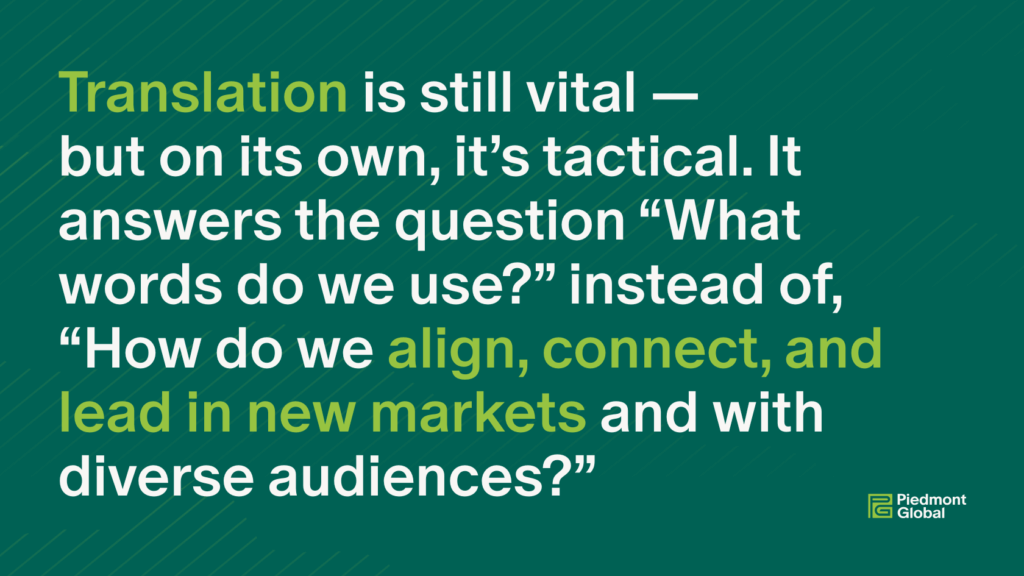
Translation is still vital — but on its own, it’s tactical. It answers the question “What words do we use?” instead of, “How do we align, connect, and lead in new markets and with diverse audiences?”

Transform global growth with strategic translation and localization services built for enterprises, cultural fluency, and multilingual content operations.

When translation is commodified as a transactional service, even when delivered by a traditional professional translation agency or language service provider, organizations often experience: 

  • Disjointed customer experiences across languages
  • Delayed market entry from a lack of enterprise localization at scale
  • Overlooked compliance or cultural nuance
  • Fragmented communication across multilingual teams
  • Limited ROI from global marketing, training, and CX programs 

Translation solves for communication. Strategic Globalization solves for coordination, connection, and impact. 


What is Strategic Globalization?

 Strategic Globalization is a new category — and a new way forward for organizations operating across borders, systems, and cultures. 

More than a one-size-fits-all solution, it’s a comprehensive methodology combining cultural fluency, human expertise, custom technology, and actionable strategy. It’s built to support every phase of global expansion, from entering new markets to sustaining global content operations with clarity and confidence. 

It means: 

  • Embedding expertise — from interpreters and localization experts to consultants and cultural advisors — directly into your workflows
  • Integrating global readiness into customer experience, compliance, multilingual support, and service delivery systems
  • Designing programs and processes that work across cultures and contexts
  • Infusing cultural intelligence into marketing, HR, supply chain, and technology operations
  • Aligning strategy, people, and technology to drive growth and equitable outcome

This is a model built for organizations that require more than managed language services. They need integrated, future-ready infrastructure.


From vendor to partner: A new kind of global support

At Piedmont Global, we don’t parachute in with a playbook and disappear. We embed. We learn your systems, understand your audiences, and evolve with you. This embedded partnership model — powering translation and localization services within broader transformation — creates real advantages: 

  • Faster go-to-market execution without language lag
  • Seamless team alignment across departments and borders
  • Improved customer experiences in every language, for every individual
  • Reduced operational and compliance risk
  • Built-for-you capabilities that scale through enterprise localization at scale and multilingual operations 

Our clients don’t just need content translated. They need durable global systems, and we build them. 


Why now?

This is the tipping point for global content operations, and the stakes have never been higher. 

Organizations are being tasked with doing more across more languages, cultures, and channels, and with greater precision and speed than ever before. 

Because employee and customer populations are more diverse than ever. Expectations are rising. Equity matters. 

Because quick fixes and transactional models won’t prepare you for the future. 

And because the organizations that rethink global growth today are the ones that will lead tomorrow. 


What’s next

We’ve launched our new brand identity with exceptional reception, and we’re excited to share how we’re redefining what it means to be a global partner. As we move into the new year, we’ll continue to explore the building blocks of Strategic Globalization — and how Piedmont Global is delivering smarter, more human, more scalable solutions for a changing world.


Ready to move from translation to transformation? 

Connect with our team →