The Making of Piedmont Global and the Rise of the Strategic Globalization Organization
Rebrands usually start with a problem. The logo is dated, the colors are off, or someone wants a “fresh new look.”
That’s not our story.
We rebranded because the company evolved faster than the label could keep up. By the summer of 2024, we had clearly outgrown the LSP container.
We began as Piedmont Translations, evolved into Piedmont Global Language Solutions (PGLS), and built a strong reputation in the language industry. That name served us well for a long time. It told people what we did — language services — and who we did it for — global organizations.
But over the last 18–24 months, the work itself changed. We started:
- Doing advisory and consultative work
- Building and integrating technology
- Creating sector-specific solutions for healthcare, education, and the public sector
- Acting as an embedded partner inside our clients’ operations
We were helping organizations solve their cross-cultural operations challenges — while our name still said “language solutions.” It was accurate to our history, but not to our future.
So we made the logical decision: if the business has evolved, the brand has to evolve with it. And that’s how Piedmont Global came to be.
Brand as infrastructure, not cosmetics
This is something I say to my team all the time: a brand is not window dressing, it’s infrastructure.
A good brand is the thing that lets every part of the business answer, “What do we do, for whom, and why does it matter right now?”
It’s also what makes growth less chaotic. When you have a clear, well-anchored brand, you can launch new products, open new verticals, or add services without rewriting your story every time. It aligns sales, marketing, delivery, and even talent around one direction.
So we didn’t ask, “What’s trendy right now?” We asked, “What identity will scale with the company we’re becoming?”
Why our brand was ready for a refresh
There were three big drivers:
1. The work expanded beyond the label
Interpreting, translation, localization? Absolutely yes. That’s core, and for a lot of our buyers, that’s the front door.
But we now also support:
- tech-enabled delivery,
- sector-specific and regulatory-aware solutions,
- data and insight,
- and the consultative work that drives seamless experiences across cultures.
So while language is still our core competency, it’s no longer the only thing we do.
2. A name that once fit became a boundary
The people we work with today — health systems, school districts, public agencies, global companies — have problems like:
- “How do we make cross-cultural operations easier across 19 member districts?”
- “How do we protect patient experience while we modernize language access?”
- “How do we stop doing one-off translation tasks and move to something scalable?”
Those are reach problems. Systems problems. Consistency across languages and geographies problems.
“Language Solutions” tells part of that story, but not all of it.
3. A new category demanded a new frame
Around the same time, Mohamed started articulating the idea of a Strategic Globalization Organization (SGO) — a model for how enterprises can lead, operate, and adapt across cultures, in a world defined by interconnection and complexity.
This meant, in addition to rebranding, we pioneered an entirely new category of company. We went from an LSP to an SGO.
So yes, this was a rebrand—but it was also us saying: the category we’ve been working in no longer fully describes us.
Why “Piedmont” still fits — and “LS” didn’t
This part is personal. I met Mohamed first, and that’s why I joined the company.
He told me the story of how the company was founded in Virginia, in the Piedmont region, and then mentioned that Somalia (where his family is from) was an Italian colony until the 1960s. So you have this really specific cross-cultural thread: a founder with East African roots, an Italian linguistic influence in his background, and a company born in Virginia. All of that is about language, movement, and place. I love a good origin story, and what a story it was.
“Piedmont” anchors us to where we started. “Global” reflects where we operate now.
That blend — local roots, global work — is also our clients’ reality. They’re serving people across languages and geographies and need a partner fluent in all of it. The name needed to reflect that reality more than it needed to list services.
And yes, we hired a naming agency, did the exploration, ran the process… and came right back home. We already had the right name. We just needed to remove the limiter.
Inside one of those early conversations, Mohamed literally picked up a marker and said, “What we’re doing now is slashing the LS,” and he slashed the LS on his office door. We took what people knew — PGLS — and removed the part that boxed us into “language services.” Not abandoning it, but widening it. That’s precisely what we had started doing for our customers, too: taking “this is translation” and opening it up to “this is how you operate globally.”
Endless Reach: our promise in practice
Every brand needs a backbone idea. Ours is “Endless Reach.”
We chose it because it speaks to both sides of the relationship:
- it reminds us how far we’re willing to go for our clients, and
it shows clients how far they can go with us when language and culture stop being barriers.
It also quietly nods to what many of our customers are trying to do — expand services, products, and impact across cultures and geographies without sacrificing quality.
And it shows up everywhere in our work.
When a health system needs to reach a patient far earlier in the journey — in the parking lot, in the portal, in the intake process — our teams design solutions that make every step understandable and accessible.
When a public agency is navigating 19 member districts with inconsistent workflows, we build the governance, technology integrations, and cultural fluency that allow information to travel further, faster, and more reliably.
When an enterprise is entering new markets, our blend of intelligence, human expertise, and custom solutions removes the bottlenecks that typically slow expansion — helping them connect with more people, in more places, with more precision.
You won’t see “Endless Reach” shouted on every page, but you’ll feel it in the way our products scale, the way our teams embed, and the way our solutions make global operations easier, smarter, and more human.
Rebranding the company while defining the category
Here’s the part that made this project a little more complicated (and a lot more interesting): we were doing two things at once.
Track 1: The essential elements of the rebrand
- What’s our logo and lockup?
- What’s our palette?
- What does our site need to say on day one?
- How do we tell the story of Piedmont (the climb, the structure, the system)?
Track 2: The category-design workstream
- What is a Strategic Globalization Organization?
- How is it different from an LSP?
- What capabilities have we actually built horizontally and vertically that justify that language?
- And how do we keep talking to today’s LSP buyer (the person who wants to know we can staff interpreters and integrate with Epic) without losing the higher-level story?
Our company was rebranding. At the same time, Mohamed was defining what a Strategic Globalization Organization is. We needed a brand that could hold both: the business we run today and the way we want the market to think about us tomorrow.
That’s why I keep saying: this wasn’t just a change in how we looked. We were making sure the brand could hold both the business we run today and the way we want the market to think about us tomorrow.
We didn’t abandon LSP buyers; we still talk about minutes, integrations, and compliance. We just stopped letting that be the ceiling.
Here’s how we now describe what we do, externally:
We help organizations communicate with intelligence, scale with intention, and operate with cultural fluency — leveraging human expertise and technology to unlock borderless growth.
That’s Strategic Globalization. And that’s what Piedmont Global is built to do.
The operating principles behind the brand system
We didn’t want this to feel like a startup rebrand that’s all color and no depth.
The three attributes we kept coming back to were:
- Collaborative — because so much of our work is embedded. We sit inside implementation teams, school districts, and health systems to help them drive adoption. A vendor can’t do that; a partner can.
- Mature — not old or rigid, but experienced. Our buyers need to know we’ve done this in high-stakes, highly regulated environments. We know the compliance piece. We’re not guessing.
- Systematic — because Strategic Globalization isn’t a poster, it’s infrastructure. If you want to score high on a Cross-Cultural Index, you need repeatability, governance, and measurement.
Those three words — collaborative, mature, systematic — shaped both the voice and the visuals. We deliberately did not pick “disruptive,” “innovative,” and all the usual suspects, because what our clients need most from us is confidence and clarity.
A visual identity shaped by place, purpose, and progression
1. We started with the origin
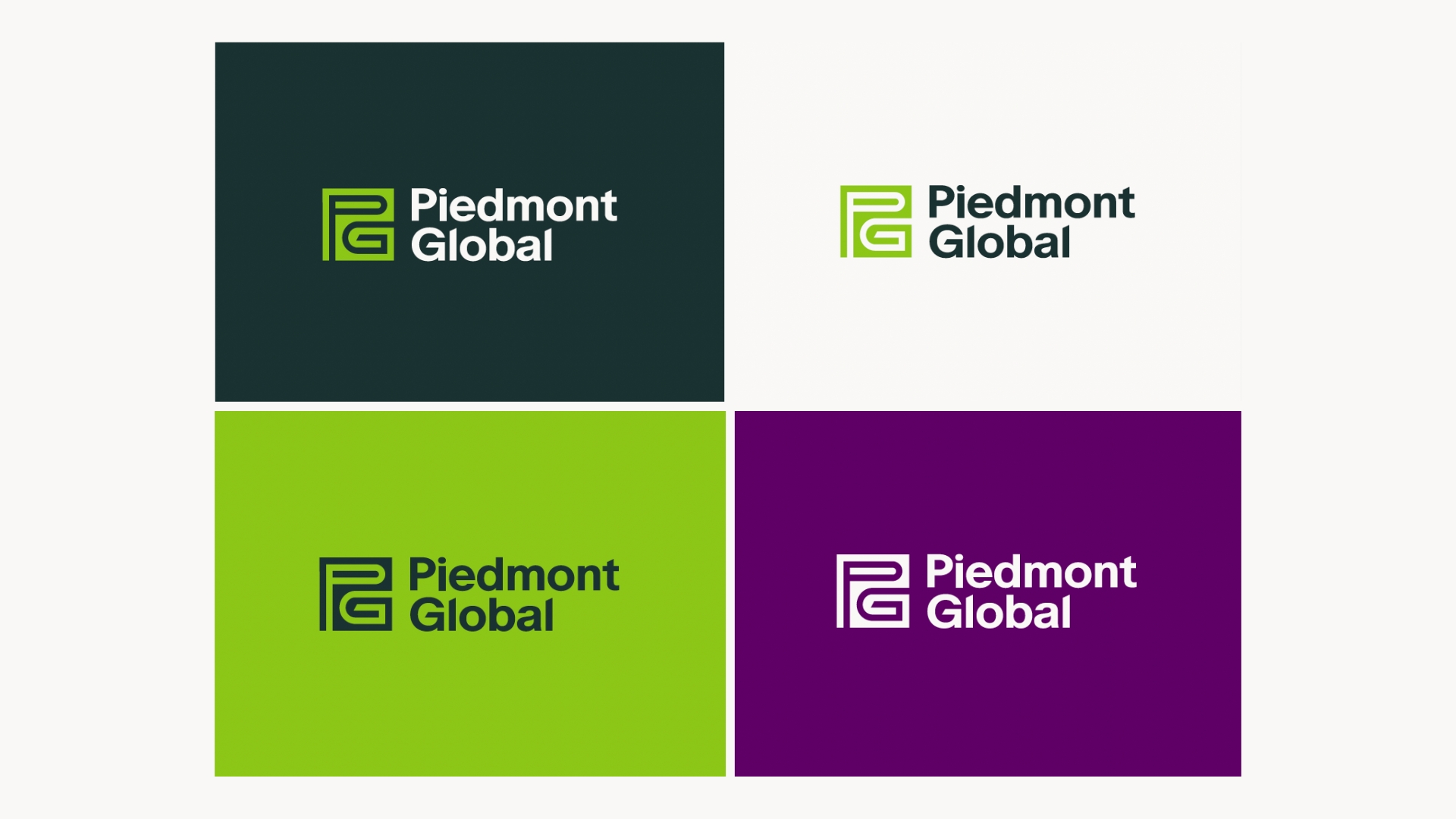
“Piedmont” literally means “foothill.” We liked that as a metaphor — a strong, grounded place from which you begin a climb. The logomark reflects that: it’s a monogram with embedded pathways that subtly show strategic routes upward, outward, and forward.
2. We chose a palette that speaks to growth
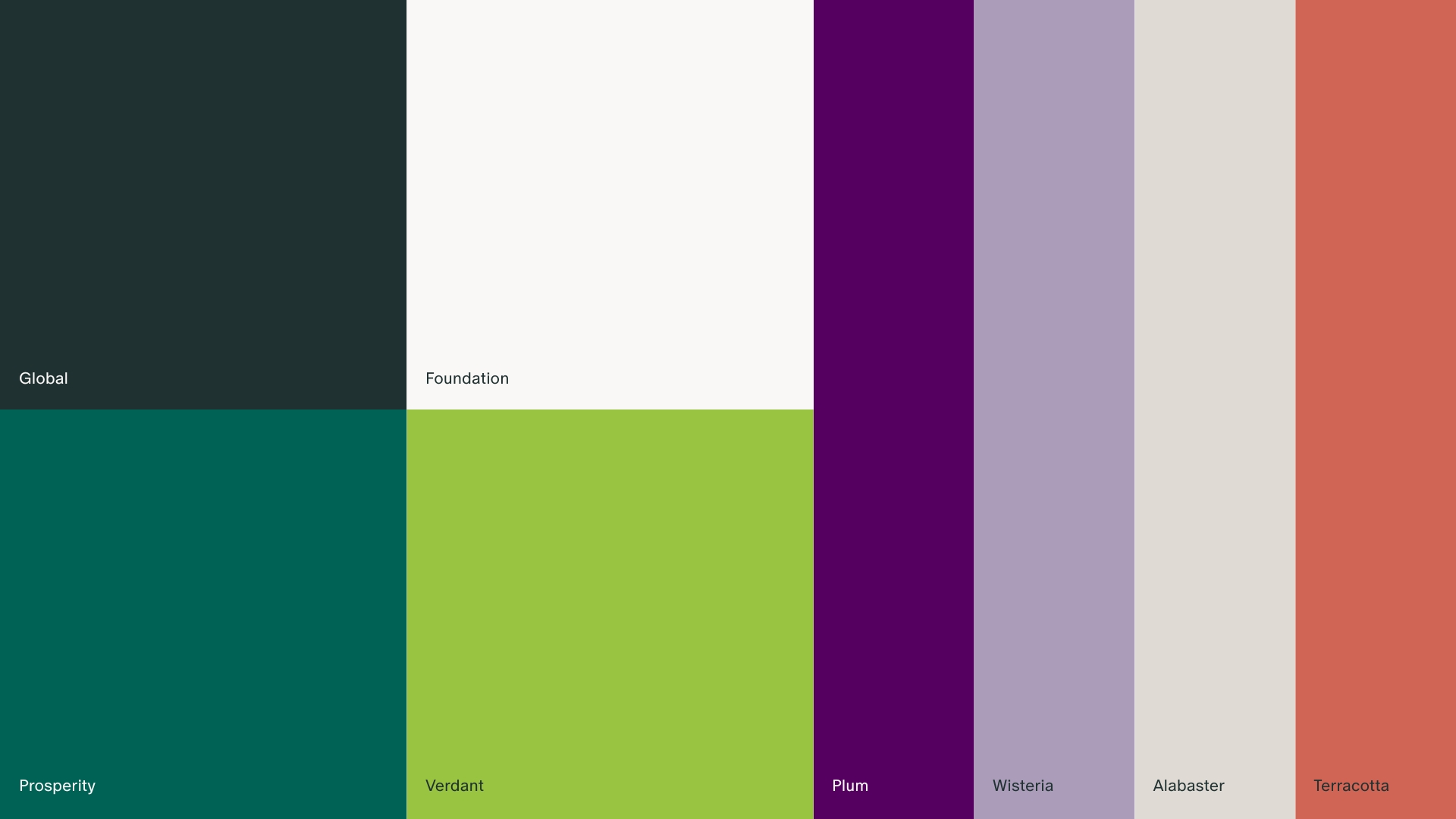
If you look at the names — Global, Verdant, Prosperity, Foundation — it’s all expansion language. It’s meant to feel global, modern, and still warm/human, not sterile.
3. We incorporated the mountainscape and progression graphics
That was intentional. We guide clients through a strategic climb — from “we translate” to “we operate cross-culturally.” The visuals needed to narrate that.

4. We broke away from typical consulting visuals
We could have done the safe navy-and-gray consultant look. Instead, we embraced the bold, entrepreneurial spirit that actually built Piedmont in the first place — the one that came from Mohamed’s vision.

The result is a system that’s:
- ownable
- extensible to products/verticals
- and recognizable as us, whether it’s on social, in a deck, or on a product screen.
A rebrand built the way we work
We did this the way we do most things — across time zones, with a distributed team, and with partners who were willing to get in the weeds with us.
We worked with Villain Branding and Focus Lab as embedded partners. We weren’t looking for a one-and-done handoff; we needed people who could help us translate a pretty ambitious internal vision into something clear, ownable, and scalable.
We hold our partners to the same standard we hold ourselves to. We want embedded problem-solvers in the trenches with us. This matters because part of our brand promise to clients is, “we’ll be in it with you.” So the rebrand itself had to be run that way:
- We spent 28 weeks in research, stakeholder interviews, and creative development
- We reviewed more than 100 internal and external materials
- And we left room for who we’re becoming, not just who we are right now
That mirrors the way we work with our own clients, so it felt right that the rebrand itself was run that way.
What’s different now
If you’re encountering Piedmont Global for the first time, here’s what should stand out:
- A bigger name – Piedmont Global. Not just languages. Global — cross-cultural operations, strategy, and access.
- A visual system built around movement and progression – foothills, climb, pathways, building blocks, because we’re helping organizations move from where they are to where they need to be.
- A more direct voice – less corporate filler, more “here’s the friction we saw, here’s what we built, here’s how it helps you.”
- A founder story that connects us – because Mohamed’s story is inspiring, and it’s why many of us joined this company.
- A place to watch – we’ll be talking more about the Cross-Cultural Index (first edition coming next year!), about how to assess your organization’s readiness, and about how Strategic Globalization shows up differently in healthcare vs. education vs. the public sector.
What this signals to the market
If you work with us now — or want to — here’s what the rebrand should tell you:
- We’re not leaving language behind. We’re elevating it into cultural fluency as a business capability.
- We can help you close the gap between intent and impact. Not just “say it in another language,” but “make sure the right people receive it, understand it, and can act on it.”
- We’re building for scale. The brand was designed to support products, data services, advisory, and what’s coming next.
- We’re serious about the category. Strategic Globalization isn’t a marketing phrase. It’s the way we’re organizing our work and our partnerships.
What the transformation meant to the people behind it
I can talk about strategy, category, and visual systems all day, but the part that convinced me we got this right was watching the team react to it. I love hearing what it unlocked for people on my team:
- It pulled people out of silos
“The rebrand gave us a chance to work more broadly across the company, break down silos, and rally around the same goal. That sense of teamwork and alignment was really inspiring.”
That was the throughline in a lot of the notes I got: this felt bigger than marketing. People in ops, client services, and creative all got to see how their piece fits into “Strategic Globalization.” That’s what a good brand does — it gives everyone the same north star.
- It made the work feel bigger than ‘services’
One person put it perfectly:
“When we stopped listing ‘services’ and started mapping our core capabilities — cultural fluency, strategic insight, and custom solutions — and how they embed inside a client’s world… that was a powerful shift.”
That’s exactly what we were trying to do. Move the story from outputs to outcomes. From “we translate” to “we help you run cross-cultural operations.” For the content folks, that unlocked a ton — suddenly you can tell clearer, more impactful stories.
- It signaled growth and impact, not just ‘new look’
“To me, this brand represents growth and greater impact. With more capabilities, we can serve more people, solve bigger challenges, and make cross-cultural operations easier… While the new look is really cool, it’s about expanding who we are and what we can deliver.”
That’s the nuance I always want to protect. Yes, the system is beautiful. But if it doesn’t help us reach more people and solve harder problems, it’s just decoration. The team saw that, immediately.
- It was a courageous moment
Another teammate said:
“Focus, and courage. We’re boldly naming what we actually do — Strategic Globalization — and giving leaders a model that scales. We shaped a brand built to lead, not to chase trends.”
That’s exactly right. We could have stayed safely in “LSP,” but we didn’t. We named the thing we’re actually building.
- There were real ‘aha’ moments
My favorites:
“The day we did the brand voice workshop — it instantly made writing copy easier, and the output felt more confident and human.”
“Finalizing the social templates — I literally sighed in relief because the graphics finally matched the energy of the brand we’ve been tirelessly building.”
“It took reading the Strategic Globalization content for the webpage for it to really click. Knowing it’s a living definition was the aha. It’s not one thing — it evolves, and we evolve with it.”
- And yes, there were fun, very human moments
“Definitely the video shoot at HQ. It was energizing to be part of the creative process in person… we’re often heads down in our own departments, so it was a powerful reminder of how much potential we have when we come together.”
- Becoming a butterfly
One teammate said the new brand felt like “we’ve been a caterpillar and we’re becoming the butterfly we were always meant to be.” Is it a little whimsical? Sure. Is it accurate? Also yes. There was nothing wrong with where we came from, but it wasn’t our end state. Piedmont Global is the version that can fly.
Building a brand that grows ahead of us
I’ll end with this: rebrands should have a bit of stretch in them.
We were very intentional about closing the gap between who we are and who we say we are — but we also left space for who we’re becoming. That’s what healthy brands do. They name the next chapter in a way that allows the organization to grow into it.
Piedmont Global is that next chapter for us.
If you’re a health system trying to reach every patient, a district serving multilingual families, or an enterprise trying to operate across borders without breaking the experience, this is the work we’re doing now.
And now our brand says so.