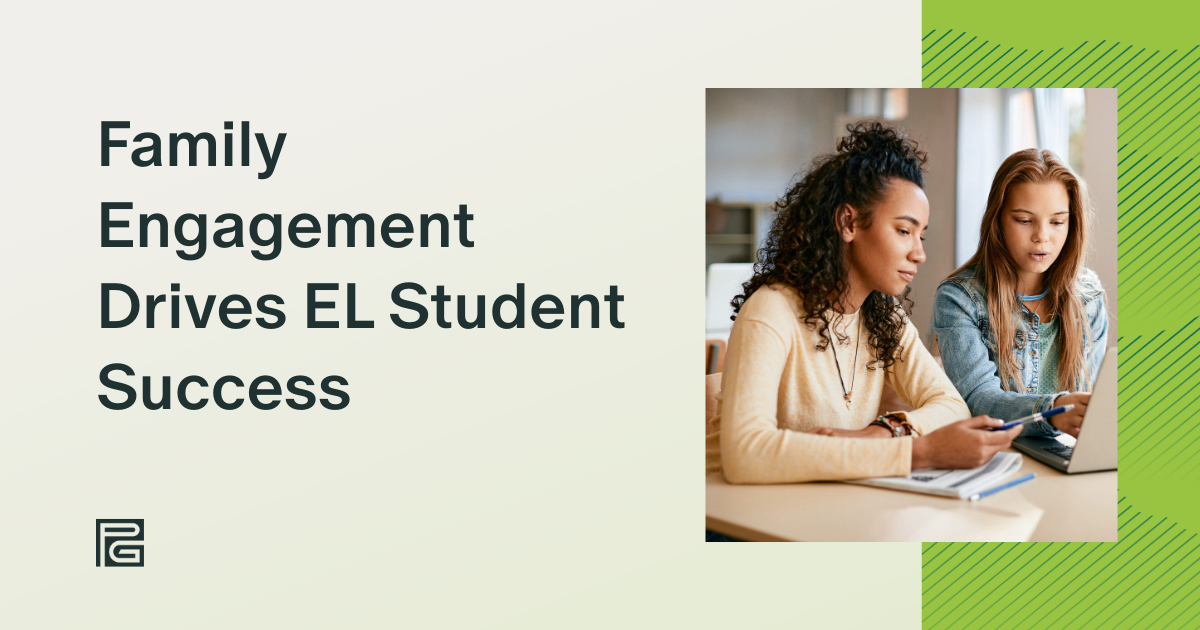
Family Engagement Drives EL Student Success: How Language Access Makes a Difference

More than 50 years of research from the U.S. Department of Education shows the irreplaceable impact of family engagement on student achievement. From higher grades and test scores to increased teacher morale and graduation rates, K-12 schools benefit from investments in family engagement.

Considering that English-learner (EL) students traditionally lag behind their peers’ academic performance, family engagement offers a bridge to better outcomes. However, most EL students have parents or caregivers who do not speak English fluently. Building and sustaining these relationships requires a strategic approach to generate measurable results.

Whether you are noticing an increase in EL students in your district or are considering how to improve outcomes for your existing EL students, family engagement must play a central role. While bridging the gap between languages and cultures can be daunting, a comprehensive K-12 language access plan identifies the necessary structure and resources to engage effectively with multilingual families.

Do you need help advocating for an increase in language access planning and resources in your district? We’ve rounded up the most common language access-related challenges facing K-12 schools today and paired them with solutions that are time-tested and supported by data. 


Challenge: Addressing Language Barriers between Teachers and Multilingual Parents/Caregivers

The majority of EL students come from households where English isn’t the primary language. Without meaningful language support, it’s much harder for schools to engage families in discussions about their child’s progress. This leaves EL students vulnerable to the adverse effects of minimal familial support, which will not help them catch up with their native English-speaking peers, who benefit from academic support at home. Also, when announcements and events are released only in English, multilingual families are excluded from socially integrating into the school community.

No matter what language is spoken at home, most parents are interested in tracking their students’ academic progress and working with teachers to support learning outcomes. Parents know their children are more likely to show better attendance, grades, and social development if they’re involved. The challenge facing K-12 schools is tackling the language and cultural barriers between them.


Solution: Factor Family Engagement into Your Interpreting and Translation Budget

To improve engagement, consider how and where schools communicate with families. Which conversations, resources, and events can lead to the greatest impact?  

Parent meetings are among the most important, high-touch opportunities to address student academic needs, so this should be one of your top priorities. If employing an on-site linguist is not an option, virtual remote interpretation is a cost-effective alternative that allows for greater flexibility and language variance. Creating a system for submitting interpreter requests in advance can help bring down costs further.

Next, official materials, such as handbooks, codes of conduct, and other essential information, should be made available in the languages spoken at home by families. Considering some of these resources are often perennial, with minor year-over-year updates, this investment can be of value for years to come.


Challenge: Ensuring EL Students with Special Needs Are Accommodated

EL students with special needs deserve additional attention to help ensure they receive adequate accommodations at school and support at home. Parents may lack the financial resources to help their children thrive inside and outside the classroom. Transparent communication with them is imperative and can significantly improve the students’ quality of life.

Special education often uses complex terms that can be hard to understand—especially for families who speak a language other than English. Multilingual parents of Deaf or hard-of-hearing students may feel excluded and overwhelmed when navigating the system.


Solution: Language Access Planning for Students with IEP and 504 Plans

In these cases, the IEP and 504 coordinators and language access coordinators need to team up. Language access planning must be inclusive of students with disabilities or special needs. Strategically considering this student population will allow educators, paraeducators, and coordinators to provide the appropriate accommodations and make informed decisions around budgets.

Since sensitive conversations, such as 504 and IEP planning sessions, chart a definitive path forward for EL students, parental involvement in the decision-making process is critical. Interpreters must be provided for these conversations to comply with Title VI non-discrimination requirements, whether for spoken language or ASL interpreting. Beyond compliance, interpreters provide much-needed precision and assurance when the stakes are high, enhancing trust in parent-teacher relationships. 


Challenge: Facing the Budget Conversation

If you’re tasked with family engagement and language access and simultaneously concerned about how to advocate for your budget, you’re not alone. It may sound simple, but framing the ask correctly is important. The administration’s job is to allocate spending to efforts that will be compliant, efficient, and beneficial to students. Your job is to help them understand why language access needs to be a priority line item. 


Solution: Align Your Ask with Data

As an advocate for EL students and families, you can help the administration see how family engagement enriches students’ academic experiences and builds trust with the community. 

The best approach to the budget conversation is to lead with data. Connect the dots between language access and family engagement, which they may (or may not) already know supports better student outcomes, test scores, teacher retention, and other key metrics.

Also, conclude with data. Demonstrate how your investment will lead to measurable outcomes aligning with your district’s priorities. Overall, budget decision-makers should walk away from your conversation understanding that in more ways than one, getting multilingual families more involved is a win for everyone. 


Challenge: Inconsistent Implementation of Existing Language Access Resources

Are you noticing inconsistencies across how different faculty members deploy language access resources? This is yet another common challenge. Between the long-term teachers with routines that are not easily disrupted, newer staff members still learning the ropes, or others who remain skeptical, uneven implementation of language access could allow EL students and families to slip through the cracks. This is especially disheartening after working hard to obtain budget and resources. 


Solution: Schoolwide K-12 Language Access Planning and Training

When training faculty on how and when to deploy language access, give them a purpose to hold onto—and focus their attention on the positive impacts. Sometimes, folks need a “why” answer before embracing change. This might seem simple, but it goes a long way toward turning skeptics into champions of language access. 

Partner with the expert PGLS team for K-12 language access planning and implementation. Learn more here and get in touch. 
Rethinking Learning: Insights from ATD 2025 and the Future of Talent Development

If there was one clear takeaway from this year’s ATD 2025 Conference, it’s this: the learning function is no longer a “nice to have.” It is the foundation of workforce transformation.

At Piedmont Global, we’re not waiting for the future—we’re building it. That mindset shaped my experience attending ATD, where learning and development (L&D) professionals, HR leaders, and technologists converged to discuss what comes next. The resounding theme? To navigate tomorrow’s work, learning must evolve beyond compliance checklists and mandatory courses. It must become immersive, personalized, strategic—and central to business outcomes.


Learning as a Strategic Lever for Change

In a world where only 26% of the skills needed in 2030 are present in today’s workforce, the traditional HR toolkit is no longer enough. Performance reviews and retroactive assessments can’t close the readiness gap. What can? Forward-thinking learning strategies that develop both competence and confidence in real time.

That’s why we’re reimagining our own approach to learning and development at PGLS. It’s not just about content—it’s about context, culture, and capability. As we design for a smarter, more adaptive workforce, our L&D program must cultivate behaviors and decision-making aligned to our values and mission. Learning is how we shape—not just support—organizational transformation.


The Build, Buy, Borrow Imperative

One of the more sobering insights from ATD: by 2030, the global workforce will be short over 85 million people with the skills needed to drive innovation and growth. Addressing this isn’t a matter of hiring faster. It requires a strategic reframe around talent—what we call the “build, buy, borrow” approach.

  • Build refers to growing capabilities internally through tailored training and coaching.
  • Buy means identifying and recruiting external talent for emerging needs.
  • Borrow acknowledges the value of strategic contractors and partners who can help you move faster without long-term overhead.

To make this model work, you need skill-level data—down to the task level, not just the job title. This is where AI and quantum labor analysis come into play. By understanding the “have, need, and want” of your workforce, HR and L&D leaders can target learning where it will move the needle, not just fill a seat.


Immersive Learning and Human Skills

One of the most exciting trends at ATD was the rise of immersive learning—using virtual reality and simulations to replicate high-stakes environments and train faster, better, and with more retention. Case studies from healthcare, defense, and corporate leadership showed that VR and simulation-based learning drastically improve retention, engagement, and speed-to-competency. According to a PwC study cited at the conference, VR learners trained four times faster than those in traditional classrooms. From leadership readiness to clinical training, the ability to “learn by doing” is driving measurable performance gains.

But speed isn’t the only metric. Quality matters. Which brings us to the growing importance of soft skills—what many now call “human skills.” Emotional intelligence. Cultural awareness. Communication. Leadership presence. Adaptability. These are no longer “soft” skills. They are business-critical and increasingly valued above technical know-how. Why? Because the landscape changes too quickly for tools and processes to be static. What endures is our ability to navigate uncertainty—and that’s where human-centered, culturally fluent learning comes in.

These skills are harder to teach—which is why experiential learning is so powerful. It allows people to practice in context, make decisions in safe environments, and build the confidence they need to thrive.


From Order-Takers to Value Creators

Too often, L&D teams are seen as service providers—executors of one-off trainings or check-the-box compliance. That’s not the model of the future. Learning professionals must become value creators, helping to align skill-building to organizational strategy, performance goals, and workforce transformation.

ATD reinforced the importance of strategic workforce planning. That means connecting L&D not just to HR, but to finance, operations, and executive leadership. It also means understanding which roles are critical—not just to today’s workflows, but to tomorrow’s growth.

This evolution requires better tools, yes—but also a mindset shift. Data has to drive decisions. And learning has to be owned not just by HR, but by every manager and leader in the organization.


Human-Centered Design and Listening at Scale

Another insight I’m bringing back from ATD is the value of human-centered design in L&D. Whether you’re building a course or a full-scale learning experience, the learner’s perspective has to be at the core. Tools like Qualtrics are helping organizations listen to employees at every stage of their journey—capturing sentiment, tracking engagement, and refining learning in real time.

The Kirkpatrick model was also emphasized as a way to measure learning effectiveness not just by test scores or attendance, but by behavior change, business impact, and ongoing engagement. When learning becomes an experience—not an event—it drives results.

This is something we’re actively applying at Piedmont Global. In 2025, we’re rolling out a new management development program focused on coaching, conversation, and community. It includes dedicated time each month for managers to develop themselves and their teams—and aligns professional development directly with performance and compensation. We’re building the future of leadership, one conversation at a time.


Why Language and Cultural Fluency Matter

As much as the ATD conference focused on tech and talent, one topic was notably underrepresented: language and culture. And yet, these are foundational to effective learning—especially in diverse, global, or multilingual workforces.

At Piedmont Global, we’ve seen firsthand how a lack of linguistic or cultural access creates friction—misunderstood expectations, uneven training results, and disengagement. That’s why we embed language and cultural fluency into every learning program we design or deliver.

eLearning isn’t effective if it’s not accessible. Immersive training won’t resonate if it’s not localized. And strategic workforce planning won’t succeed if teams don’t feel included in the journey.

That’s where we come in. As a Strategic Globalization Partner, we help organizations ensure their learning content is clear, relevant, and resonant—no matter the language, location, or audience.


Looking Ahead

My time at ATD left me more energized than ever. The world of work is changing fast, but so are the tools, strategies, and insights we can use to get ahead. We’re committed to putting learning at the heart of our workforce strategy—not just to train, but to transform.

We’re embracing new technologies like VR and AI, but we’re doing so with a human-first lens. We’re coaching our managers to lead with empathy and intentionality. And we’re building programs that reflect who our employees are—not just what we want them to know.

Because learning isn’t just how we grow skills. It’s how we grow people.


Ready to deliver impactful learning across cultures and languages?

At Piedmont Global, we partner with organizations to design and deliver culturally fluent, multilingual eLearning programs that accelerate understanding and performance across borders. Whether you need localization, interpretation, or multilingual content strategy, our team is here to support you.

Connect with our team!