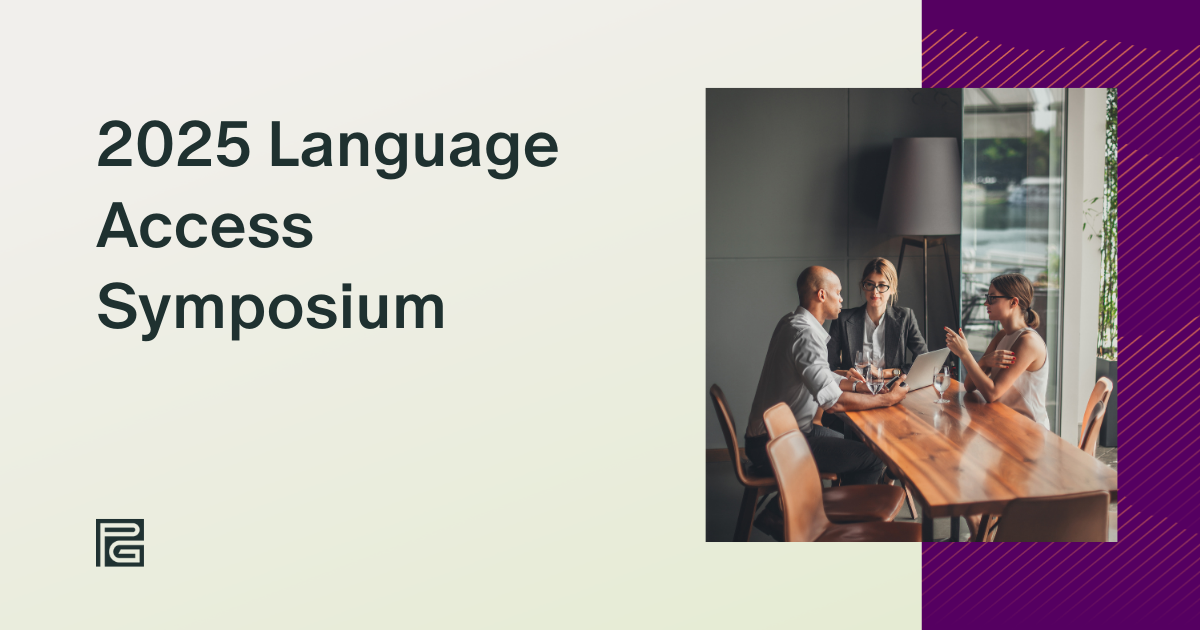
2025 Language Access Symposium: Positive Parental Engagement and EL Student Outcomes

In partnership with Fairfax County Public Schools Language Services, Piedmont Global hosted its second annual Language Access Symposium on May 8. Attended by educators from various school districts within the DMV area, the event brought together language access champions for an engaging half-day of conversations and camaraderie.

The question on everyone’s mind was, “What does the future hold for language access?” Bill Rivers spoke to the legal compliance focus of language access and the importance of continued advocacy on the Hill. While multilingual families and students are still protected by the Office of Civil Rights and Title VI, advocating for the value of language access is more important than ever.

As educators continue to connect the dots between spending and efficacy, much of the discussion centered on solutions and strategies to promote English learner (EL) student growth, with a special focus on engaging parents, analyzing data for trends, and creating stories of impact.


In Review: Family Engagement and EL Student Growth

As a group of evidence-based educators, symposium attendees brought a wealth of knowledge (and experience) to the conversation about EL student outcomes.

Plenty of research indicates that when parents are involved, children do better in school: advancing in socio-emotional learningtesting higher, and exhibiting more predictable behavior. However, when it comes to the impact of parental engagement on EL student growth, available data is lacking in specifics. This may account for some of the challenges educators face when engaging with EL families.

Most school districts invest time and resources into parent engagement. However, English-speaking families often have different relationships with teachers and administrators compared to EL families. Language access is a bridge to understanding, but if interpreter resources are not easy to use or not explicitly encouraged, educators may only use them sparingly, or only in reaction to a problem that needs to be solved urgently. As a result, the only conversations between teachers and EL families might be negative or challenging: disciplinary matters, poor academic performance, or other difficult conversations.

Many agreed there is room for improvement. Alternative strategies were discussed. For example, what would prioritizing proactive, positive engagement with EL families look like? Which academic milestones or school events should trigger a conversation, and how can language access leaders encourage teachers to take the initiative?

Another symposium speaker, Jason Velasco, also spoke to AI advancements that can help school districts bolster multilingual communication in the classroom.

While the heart of parental engagement is driving connection and building trust, determining measurable impact must also be factored into the plan.


How Language Access Leaders Can Make Their Case with Data

Symposium attendees also shared best practices surrounding data and storytelling. The group discussed ways that school districts can leverage student assessments and test scores to develop insights and points of reference for supporting EL student growth.

For example, looking at local norms, such as how the district’s students are performing, and modeling EL student data against these norms establishes a baseline. These figures can be helpful in figuring out what is working for EL students and what is not.

Prior to trying anything new, educators should have these baselines handy for comparison. If improvements to EL student performance are observable after implementing changes, such as a proactive parent engagement strategy, language access leaders can clearly spell out the impact of their programs.

Measuring long-tail impacts can be challenging, which is why educators need to find the lowest-hanging fruit. Educators need to look at not just grades, but also socio-emotional learning, attendance records, behavioral incidents, and other key indicators. Much of this data is readily available and can make all the difference when needing to advocate for resources, especially when budgets are tight.


The Future of Language Access is Bright!

Al Radford, director of Public Relations and Community Relations at Manassas City Public Schools, told Piedmont Global, “I had a lot of key takeaways to bring back to my district. I learned a lot that got me excited about family engagement.” On the value of coming together, Al also said, “Community is important. It helps us to understand that none of us are islands. We don’t have to work in isolation. At the core, all of us are about providing services to our families. Being able to talk with each other and share ideas is paramount.

This group of language access leaders shares an optimistic view of the future. As more schools prioritize relationships with EL students and families and adopt language access best practices, programs can continue to expand to meet their needs and give students the best chance at success.

Piedmont Global looks forward to our next opportunity to convene the DMV’s language access community in 2026. Thank you to our attendees and to our host, Fairfax County Public Schools Language Services, for providing such a great experience.

Stay tuned for more insights and discussion about language access in K-12 schools. If you would like to host a Language Access Symposium in your region, we’d love to hear from you.
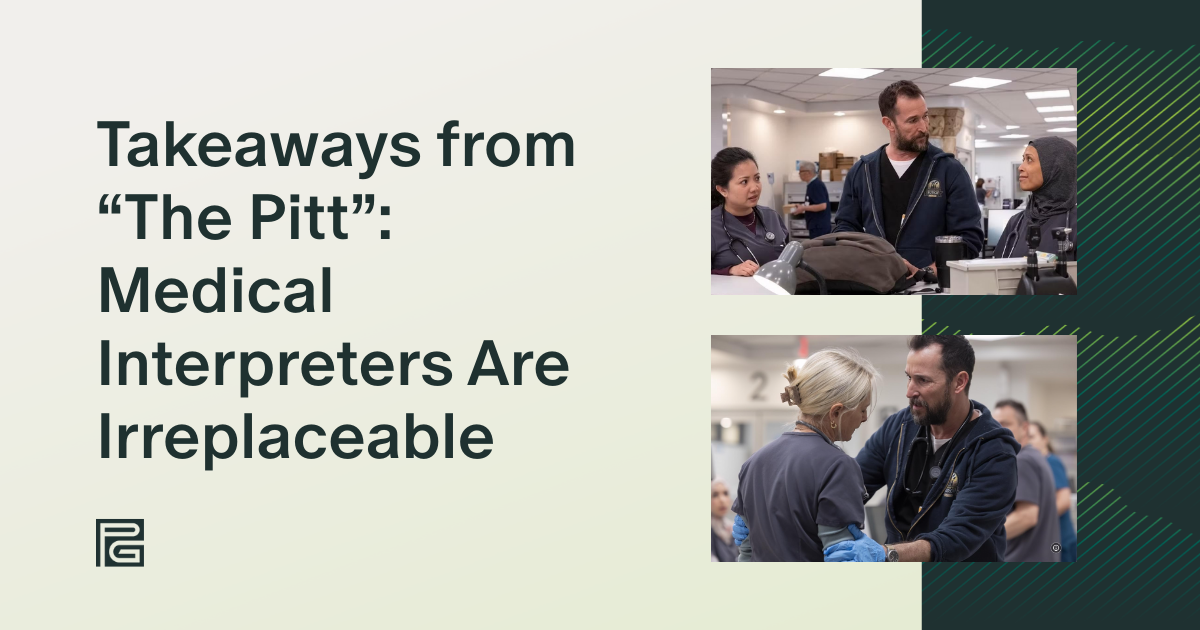
Takeaways from “The Pitt”: Medical Interpreters in Emergency Departments Are Irreplaceable

The 2025 breakout medical drama, The Pitt, received overwhelmingly positive reviews from healthcare workers for its realistic portrayal of an emergency department (ED) over a tumultuous 15-hour shift. Among the important, real-world issues presented by the show was one common scenario that every ED provider in the United States recognized.

In the series premiere, a patient arrives in an ambulance with a life-threatening injury. After Dr. Robby, a courageous attending physician played by ER’s Noah Wyle, and his team stabilize the patient, they quickly determine that no one knows what language she is speaking.

Patients with limited English proficiency (LEP) interact with healthcare systems differently than their English-speaking peers, often experiencing delayed access and worse outcomes. Medical interpreters are an integral part of the lifesaving work in EDs across the country, providing vital bridges to communication that enable providers to deliver the best possible patient care.

As linguists and partners in language access, we were thrilled to see The Pitt bring visibility to the needs of LEP patients and offer a window into the dynamic challenges faced by emergency department providers. Their commitment is nothing short of heroic. Here, we examine the impact of this LEP patient’s storyline and explore what it takes to ensure LEP patients receive support when they visit the emergency room.


There Are More Than 25 Million LEP Patients in the United States

According to the U.S. Census Bureau’s 2022 American Community Survey, more than 25 million people in the United States are limited English proficient. This population is growing, yet studies continue to show that LEP patients experience worse health outcomes on average.

Between lower rates of healthcare coverage among immigrant populations, language barriers with healthcare providers, and challenges with managing chronic conditions, LEP patients are vulnerable. When we work together to uplift the care and experiences of LEP patients in times of crisis, our neighborhoods and communities benefit exponentially.

Other studies have shown the impact of language barriers on hospital resources. Providers may feel more comfortable ordering additional tests or observing LEP patients over longer stays. These additional measures (and costs) may not be necessary if a qualified medical interpreter is available to assist with communication.


Language Access Supports LEP Patients in Emergency Rooms

Viewers and critics of The Pitt witness compassion and competence unfold in the fictional Pittsburgh Trauma Medical Center, and real-world healthcare workers say the portrayal rings true. It is the providers’ persistence and dedication that impressed audiences, while physicians and nurses found the medicine, pace, and colleague relationships to reflect their lived experiences in the ED.

Supporting LEP patients in emergency rooms requires close coordination and a clear process for locating interpreters. From our perspective, The Pitt handles this sensitive matter accurately. There isn’t much else Dr. Robby and his team can do to identify this LEP patient’s spoken language sooner, who arrives with a level one triage injury and a pain level that makes communication next to impossible. The language barrier likely goes unnoticed during the ambulance ride.

Once the patient’s condition is better managed, Dr. Robby leaves to contact language services—the correct action to take on behalf of an LEP patient. Later in the series, viewers discover that she speaks Nepali, and our heroic providers have activated a tried-and-true solution, especially for less commonly spoken languages: video remote interpreting (VRI). Viewers see the patient and providers communicate with the help of a Nepali-speaking interpreter through a portable, video-enabled device. The patient is on the road to recovery.

According to the Pew Research Center, there may be as many as 5,000 Nepali-speaking individuals in Pittsburgh, or less than 0.02% of the city’s population. While the numbers tell one story, the reality is altogether different. Regardless of national origin or size, every community needs access to emergency healthcare services. Language access significantly reduces harm, suffering, and loss of life, especially considering that VRI can provide coverage for most major languages.


Language Access in Hospitals Helps Providers Focus on the Medicine

The Pitt also reminds audiences to consider the vital role of nurses in hospital operations. Pittsburgh Trauma Medical Center clearly could not run without them.

Princess (Kristin Villanueva) and Perlah (Amielynn Abellera) perform challenging, hands-on tasks over their 15-hour shift, often sidebarring in Tagalog in moments of reprieve. Princess and Perlah offer a window into the experiences of the more than 150,000 Filipino nurses who have immigrated to the United States since 1960.

While nurses are an irreplaceable addition to any emergency department team, even multilingual nurses cannot replace the role of language access in hospitals. Between intakes and discharges, medicine management, coordinating with other departments, and plenty of other tasks, nurses’ obligations are nonstop. There is hardly room for on-call interpretation. Instead, the most effective way to support emergency department staff communication with LEP patients is through dedicated language access professionals.

Even as emotions run high and interpersonal disagreements simmer beneath the surface, The Pitt’s Dr. Robby and his staff function like a well-oiled machine. Small actions, such as calling an interpreter, can make all the difference to a patient who cannot communicate with doctors and nurses. This positive patient outcome was no accident. Viewers can assume that Pittsburgh Trauma Medical Center has a language access plan that explains how to deploy language services, lays out staff protocols, analyzes LEP patient feedback, and identifies opportunities for improvement.

In the case of their Nepali-speaking patient, Dr. Robby or Dana might consider asking the hospital’s language access manager to explore strategies for language identification before a patient reaches the ED. Perhaps the local paramedic team would benefit from a refresher training. Also, new technologies are emerging that can recognize spoken languages, reducing confusion and enabling providers to call on the right interpreter at the right time. This type of forethought streamlines patient experiences, allowing providers to remain focused on the medicine and saving lives.


Improving patient experiences with Piedmont Global interpreters

If you want to explore opportunities to support LEP patients in emergency rooms, our free eBook details the processes and considerations of building a comprehensive language access plan. As a strategic partner to hospital networks, Piedmont Global provides valuable planning assistance and VRI services in over 100 languages and regional varieties. Get in touch to learn more.

ChatGPT
Perplexity
Claude Claude
Google AI
Grok