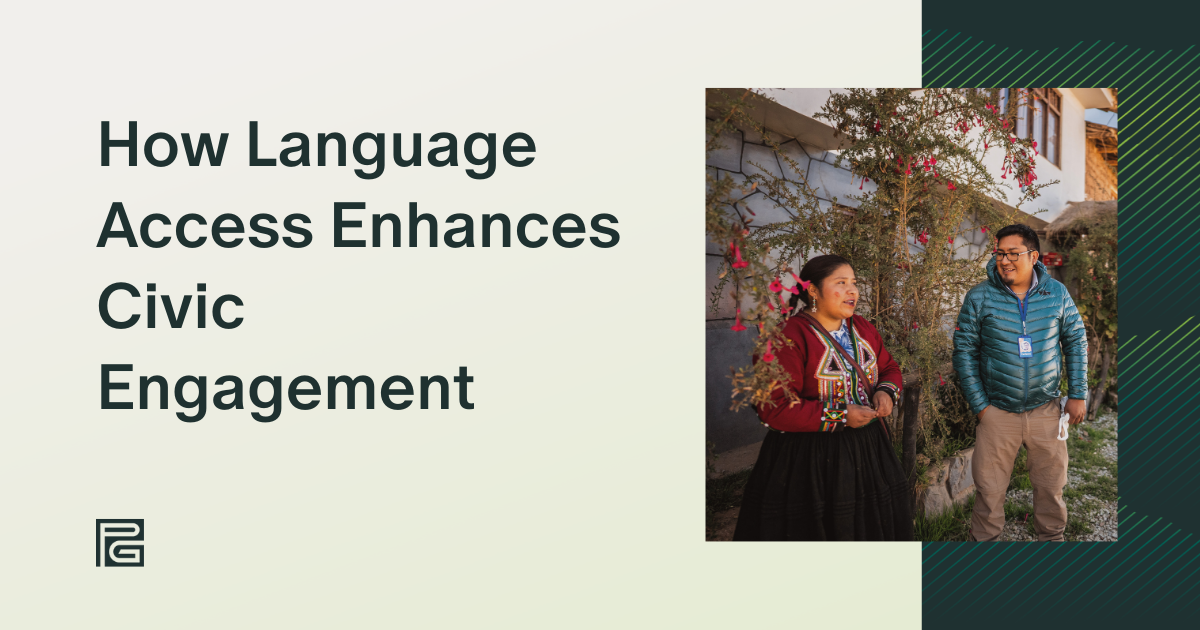
How Language Access Enhances Civic Engagement

In diverse societies, effective communication is essential to building community trust and fostering civic participation. Across the United States, more than 67 million people speak a language other than English at home, and this number continues to grow. For government bodies, community organizations, and local leaders, ensuring that these diverse voices are heard isn’t only a matter of accessibility—it’s essential to democracy.  

Providing multilingual support through language services for civic participation can build trust, foster inclusivity, and enhance residents’ access to public services and community initiatives. Here’s how multilingual support strengthens communities, boosts engagement, and creates lasting impacts on civic life. 

The Growing Need for Multilingual Civic Engagement

As communities become more linguistically diverse, government agencies and public organizations must rethink their approach to communication. According to the American Community Survey, more than 21 percent of U.S. households now speak a language other than English at home, with Spanish, Chinese, Tagalog, and Vietnamese among the most commonly spoken languages. Despite this demographic shift, many essential communications—such as public service announcements, emergency alerts, and voting materials—are often disseminated only in English. 

Failing to address this language gap can have significant consequences. It can alienate large portions of the population, discourage civic participation, and reduce trust in local governance. Multilingual support for community engagement and public services offers a practical solution to these challenges. Local governments and organizations can foster a more inclusive and engaged civic environment by meeting residents where they are, linguistically and culturally.

The Benefits of Language Services in Civic Participation

1. Promoting Inclusive Community Outreach

Language is a gateway to understanding and connection. When local governments provide information in multiple languages, they send a powerful message: all residents are valued, and everyone has a stake in the community. Multilingual outreach ensures that all community members, regardless of language proficiency, have equal access to information about public resources, emergency services, and civic initiatives. 

Example: During the COVID-19 pandemic, municipalities across the U.S. quickly learned the importance of multilingual communication. Cities that offered health guidelines, testing information, and vaccination instructions in multiple languages saw higher compliance rates and trust in public health directives. In New York City, for instance, health campaigns were distributed in more than 20 languages to reach as many residents as possible.

2. Facilitating Access to Social Services

Access to social services is a fundamental aspect of civic engagement, as it enables individuals and families to actively participate in and benefit from community resources. Multilingual support makes it easier for residents to seek assistance in areas like housing, healthcare, and education. When language barriers are minimized, people are more likely to reach out for support, ensuring that no one is left behind. 

Example: San Francisco improved access to essential city services for limited-English-speaking or non-English-speaking residents through its Language Access Ordinance.  The city’s Department of Public Health provides medical interpreters and translated materials in Chinese (Cantonese and Mandarin), Spanish, and Filipino, recognizing that healthcare accessibility requires clear communication.

3. Empowering Civic Participation Through Multilingual Ballots and Resources

Voting is one of the most direct ways residents can influence their community. For non-English-speaking citizens, however, accessing voting information can be challenging. Recognizing this, Section 203 of the Voting Rights Act mandates that areas with large populations of non-English speakers provide ballots in languages other than English. This ensures fair representation and empowers individuals to exercise their voting rights. 
 
Research shows that when multilingual ballots and election materials are available, voter turnout increases among minority language communities. Multilingual voting materials mean citizens can make informed choices, fostering a more representative democracy.

4. Strengthening Trust in Government Through Language Access

Language access is more than just a communication tool—it’s a bridge to trust and transparency. When governments actively address language barriers, they demonstrate a commitment to serving all residents, which can lead to greater trust in public institutions. Transparency builds loyalty, making residents feel respected, valued, and more willing to engage with local governance. 

Example: The City of Philadelphia implemented the Language Access Program, which requires city departments to create language access plans to serve the city’s diverse population. This program has not only enhanced accessibility but also improved trust and rapport between residents and city officials. As residents see their language needs met, they’re more likely to participate in public events and meetings, helping shape policies that impact their daily lives. 

The Role of Language Services in Meetings and Local Governance

Public meetings are a fundamental aspect of local governance, allowing residents to engage with decision-makers, voice their concerns, and participate in shaping their communities. However, without language support, non-English-speaking residents may find it difficult to participate meaningfully in these discussions. Language services, such as interpreters and translated meeting materials, can make these important gatherings more inclusive and accessible. 

Local governments can allow all residents to participate actively in discussions about policies, zoning, budgeting, and community developments by providing live translation and interpretation. Having a language access policy for public meetings strengthens democracy at the local level, ensuring that all community members, regardless of their language proficiency, can contribute to and influence decision-making processes.

Community Case Study: The Success of Seattle’s Language Access Programs

Seattle has set a high standard for multilingual civic engagement. Recognizing its diverse population, the city offers language support at public meetings, distributes bilingual city updates, and provides translation services for critical information. In 2021, Seattle’s Office of Immigrant and Refugee Affairs launched a Language Access Program, which included translated COVID-19 resources, interpretation services at virtual meetings, and language-specific outreach efforts. The city’s approach has not only made civic engagement more accessible but also cultivated a greater sense of inclusion among Seattle’s non-English-speaking residents. Today, Seattle’s multilingual outreach is a model for other cities aiming to strengthen community engagement through language services. 

Multilingual Support as a Pillar of Governance

Inclusive governance means considering the diverse needs of all residents, especially those who may face language barriers. By integrating language services into every point of communication, from ballot access to public health updates, cities and counties can better serve the interests of limited-English-speaking citizens who may often feel excluded from public life.  

Inclusive governance requires strategic planning, community involvement, and dedicated resources. Local governments that prioritize multilingual support will often see the following benefits: 

  • Higher Civic Engagement: Residents who feel included and informed are more likely to participate in public discussions, community events, and local governance. 
  • Increased Public Trust: Language access initiatives show local leaders value transparency and engagement with limited-English-speaking communities, leading to greater trust in public institutions. 
  • Improved Social Cohesion: Multilingual support fosters a sense of unity and belonging, helping communities bridge linguistic and cultural differences.

Implementing Multilingual Civic Engagement Programs

Creating a successful multilingual civic engagement program involves a commitment to understanding and addressing the language needs of a community. Below are steps local governments can take to implement effective language access programs: 

1. Conduct a Community Language Assessment

Understanding the primary or threshold languages spoken in the community is essential. Surveys and census data can help identify language needs, ensuring that resources are directed where they are most needed.

2. Hire or Partner with Language Service Providers

Professional language services can provide translation, interpretation, and localization for public documents, events, and online resources. Partnering with experienced language providers ensures accuracy and cultural sensitivity in all communications.

3. Invest in Technology for Language Accessibility

Tools like real-time translation, multilingual websites, and accessible platforms for virtual meetings can increase outreach and engagement. These technologies enable governments to reach non-English-speaking residents in a timely and efficient manner.

4. Engage Community Leaders

Community advocates and local leaders fluent in different languages can act as liaisons. They help bridge communication gaps and promote civic initiatives among non-English-speaking residents.

5. Monitor and Adjust Programs Based on Feedback

Regularly assess the effectiveness of language access programs through community feedback. Adjusting strategies based on resident input ensures that programs remain relevant and beneficial. 

Language Access: An Investment in the Future

As communities continue to diversify, the need for multilingual civic engagement will only grow. By investing in language services, local governments can create a more inclusive, engaged, and cohesive community. Effective multilingual support not only enhances civic participation significantly but also builds a foundation of trust, transparency, and shared purpose. 

Ultimately, language access is an investment in the future. An investment that empowers all residents to participate fully in civic life, strengthens democratic principles, and enriches the community.


What is Corporate Language Training? And How Does It Differ from University Language Learning?

With global mergers and acquisitions (M&A) bouncing back in the second half of 2024, and global supply chains poised for significant growth in 2025, it is no surprise that the demand for corporate language training has continued to rise. Its numerous applications demonstrate the value of corporate language training, including the competitive advantage of increased workforce productivity. 

Organizations leverage language training to build relationships with frontline employees. Executives rely on it to strengthen overseas partnerships. Specialty industries, such as healthcare and education, depend on it to communicate better with patients and students. 

Learning a new language can seem daunting to those who haven’t dusted off their language skills in years—especially among those who have never learned a second language. 

Here’s the good news: corporate language training is significantly different from high school or college language courses. 

Business language training curricula are designed to meet learners where they are, prioritizing effective communication over perfection. Training content is also highly personalized to meet individual, workplace, and industry-specific needs, prioritizing the most important vocabulary and real-world use cases for participants. 

Want to learn more about corporate language training? You’re in the right place. This blog post will explore why language training is an effective tool for productivity and employee engagement. We’ll also unpack some common misconceptions born from experiences in the university classroom. 

What is Corporate Language Training?

Corporate language training helps participants gain a working language proficiency in a relatively compressed period. As a customizable service, language training addresses highly focused, industry-specific language needs, such as manufacturing, finance, healthcare, education, and others. 

Borrowing from the military, studying language, regional expertise, and culture (LREC) maximizes personnel abilities to engage effectively with complex overseas assignments. That said, language training for companies is rather different, and examples (from a United States-oriented perspective) include: 

  • Plant supervisors learning the language(s) of their frontline staff  
  • Educators learning the language(s) their students speak at home 
  • Nurses and physicians learning their patients’ most commonly spoken languages

Commercial language training reflects real world trends, driven by industry growth, workforce changes, and immigration patterns. For example, a large contracting firm may train its site managers to become effective in construction Spanish. A startup incubator may put aspiring CTOs through Hindi language training to connect with software developer talent in India. Financial traders transferring to Hong Kong may enroll in accelerated Cantonese training with a special focus on professional culture and topics.  

No matter the use case, endeavoring to learn a new language can be daunting. Corporate language trainers are attuned to professionals’ needs, many of whom have not been in a classroom for years. Trainers create a supportive environment and a focused curriculum, which reduce learner anxieties and increase learner outcomes.

Corporate Language Training vs. University Language Learning

One frequent inquiry about corporate language training is how it compares to academic language learning.  

University-based language learning has a much broader scope to cover. In addition to linguistic training, professors engage students in the broader context of culture, etymology, history, geography, literature, and media. Students are graded on the perfection of their spelling, grammar, and syntax. Progress is measured in years. 

On the other hand, corporate language training serves a more focused purpose. Language trainers are adept at creating curricula that address the immediate needs of their participants and their sponsoring organizations. The workflow is accelerated, and the goal is to help learners obtain a basic working proficiency as soon as possible.

Services Provided by Language Trainers

Corporate language training is an in-person or virtually conducted service for individuals, small groups and large groups. Trainers are responsible for the end-to-end learner experience, starting with proficiency testing and concluding with final assessment and reporting.

Step 1: Language Testing

Language testing helps trainers gain a baseline understanding of students’ current proficiency levels. It also helps them refine the sponsoring organization’s goals and requirements of the training, including desired timelines. This step may be optional in some cases, such as when all students start with zero proficiency.

Step 2: Curriculum Development

Based on the results of the language testing and input from the sponsoring organization, language trainers develop a custom curriculum. Ideally, trainers will use a range of kinesthetic, visual, and auditory learning modalities so participants can build their skills through their preferred learning styles. 

Step 3: Measure Progress

At specific intervals, instructors measure individual student progress to ensure no one is lagging behind. The Interagency Language Roundtable (ILR) scale standardizes eleven spoken proficiency levels from zero to five, where level one is an elementary proficiency and level three is a general working proficiency. The ACTFL Proficiency Guidelines are another well-respected framework for measuring language abilities, with five main levels (novice, intermediate, advanced, superior, and distinguished) and three sublevels.

Instructors will use at least one of these systems to benchmark real-time student learnings against global standards of proficiency. This process helps identify the specific areas where students need additional support, such as vocabulary, comprehension, or complexity. Individual assignments and focused tutoring can help those students advance faster in the areas where help is needed most.

Step 4: Final Assessment and Reporting

The final assessment allows instructors to give a final report on each participant’s proficiency on the ILR scale. These reports are provided to the sponsoring organization. 

While the format and structure tend to be similar, every curriculum can be uniquely tailored to industry use cases. As roles that frequently interface with diverse groups of people, some of the most common applications include language training for executives, healthcare professionals, and educators. 

Executive Language Training

Business leaders working with overseas teams or moving to the United States from abroad can find great value in executive language training. The content is highly focused on business skills, management skills, local business customs, etiquette, and presenting to groups.

Even if a corporate leader is stationed in the United States, executive language training can be useful if overseas partners, clients, or satellite offices speak languages other than English. The effort to learn and communicate in a local language is a sign of respect, which can go a long way towards employee retention and client loyalty.

Language Training for Healthcare Professionals

Studies have proven that patients with limited English proficiency (LEP patients) experience worse outcomes on average, from longer hospital stays to higher rates of clinical error. Language training for healthcare workers can help close this equity gap by enabling better communication about symptoms, history, and pain between patients and providers.

Language Training for Educators

Language training for educators empower teachers and administrators to gain proficiency in the languages their students speak at home. Those languages are often Spanish, Chinese, Vietnamese, Arabic, or Tagalog.

Understanding the community makeup and immigration patterns of school districts can help educators relate to their students, communicate with parents, and even connect families to critical services.

Book Corporate Language Training for Your Organization

Investing in language training also comes with fringe benefits. One study found that bilingual children are better multitaskers than monolingual children. Not only can language training encourage productivity and help foster a sense of higher purpose among your workforce, but employers who invest in continuing education enjoy higher employee retention rates. 

When you’re ready to explore corporate language training for your organization, make sure you choose a provider who: 

  • Benchmarks learner progress against the ILR (or a comparable) standard 
  • Offers a welcoming yet rigorous environment for learners 
  • Creates tailored curricula for your specific industry needs and personnel requirements 


Piedmont Global is an industry-leading provider of language trainingContact us today to learn more.

Can ChatGPT Interpret Legal Documents Effectively? Exploring AI’s Role in Legal Language Services

Do you use generative AI at work? If you don’t, you’re no longer in the majority. A 2024 Glassdoor survey found that 62 percent of 5,000 surveyed professionals use ChatGPT or other generative AI tools at work, up from 43 percent in 2023. 

Although the technology still has a long way to go, tools like ChatGPT are gaining momentum as de-facto assistants for everyday office tasks. Need help with drafting an email reply? Want to read the key takeaways rather than an entire meeting transcript? Can’t think of a good synonym? ChatGPT is a handy helper in plenty of cases, especially for low-stakes, repeatable work products that are easy to fact-check. 

When working on a multilingual legal case, one frequent process that might benefit from generative AI’s impressive speed and capacity is legal document translation. Partners and paralegals alike are asking the question: can I use ChatGPT to interpret legal documents? 

It depends on what you mean by interpret. Your firm’s privacy and AI policies may (or may not) allow the use of ChatGPT to summarize content for legal briefs, decks, or emails. If, however, you’re wondering whether you should use ChatGPT to translate content from one language to another, the short answer is: don’t. Instead, you should leverage a large language model (LLM) built for legal language service needs (and supervised by an expert linguist). 

Let’s explore the best ways to leverage AI-powered translation in the legal field, including strategies that ensure accuracy, protect confidential data, and help you enhance client service.


Using ChatGPT to Translate Legal Documents: Do’s and Don’ts

There are appropriate use cases for ChatGPT, and there are others that should be avoided at all costs. Where should you draw the line? 

ChatGPT works well if you’re generating summaries and key points or hunting for additional research sources. Be careful, though — “hallucination” describes the phenomenon in which AI chatbots provide incorrect answers or invent facts. Generative AI has even been reported to fabricate legal cases that do not exist. How or why this phenomenon occurs is not well understood, making independent verification a core practice when evaluating a chatbot’s output. 

It stands to reason when approaching tasks that require additional nuance, specificity, or precision, ChatGPT should probably be avoided. You might be analyzing financial performance reports for an international business acquisition, reviewing paperwork for a citizenship application, or preparing to petition for an international adoption. As a rule, when the content is material to a case, translation should never be handled by a tool like ChatGPT.  

That doesn’t mean you should write off AI entirely. Just because ChatGPT is one of the most familiar, accessible chatbots doesn’t mean it’s your only option. Specialized LLMs can be a boon to efficiency, especially when translating large volumes of content under the supervision of expert linguists.


Benefits and Challenges of AI in Legal Document Translation

Using AI for legal document translation offers several key benefits. Law firms stand to increase both the velocity and efficiency of the translation process when using an LLM. The downstream effects can lead to increased team bandwidth for client and case management. 

But on the other hand, using AI for legal document translation can also create more problems than it solves. For example, ChatGPT does not guarantee translation accuracy. If you do not have a dedicated linguist on staff to verify the content, you could end up making decisions based on mistranslated information, which could compromise case outcomes. 

A second risk factor you might not consider is related to privacy, ethics, and compliance. At the time of publishing this blog post, the free version of ChatGPT uses inputs to train its model. Confidential client, case, or company information should not be shared with online tools outside your firm’s secure IT ecosystem unless expressly permitted. 

Finally, using AI for translation can present conflicts with intellectual property issues. Since large language models are trained on a variety of inputs, which can include copyrighted materials, it is important that any translations are independently verified to ensure there is no infringement on intellectual property, especially when filing for trademarks. 


How to Use AI to Translate Legal Documents

Due to the complexity and nuance of language, cultural differences, and context, translations powered by generative AI must be supervised and post-edited by expert linguists. AI tools must be a complement to, rather than a replacement for, skilled legal translators and interpreters. 

Human-supervised, generative AI-initiated translation can represent the best of both worlds as a scalable, high-tech process with a human guarantee. 

Rather than using ChatGPT to interpret legal documents, legal firms can enjoy the benefits of AI and avoid its predictable risks by partnering with a tech-enabled language services provider (LSP). Why?  

  • An expert LSP will use a legal-industry-trained LLM, ensuring a more precise and consistent translated product. 
  • An LSP with a legal industry background offers project management expertise that aligns with your case workflows and can execute on large volumes of content. 
  • An LSP’s team of linguistic experts post-edit and certify the accuracy of all LLM-initiated translations. They also develop a translation memory that helps to increase speed, consistency, and accuracy over time. 
  • Your LSP contract will ensure compliance with client confidentiality obligations. 


Partner with PGLS for Expert-Led, AI-Enabled Legal Document Translation

When it comes to professional-grade legal translation, ChatGPT leaves much to be desired. Instead, pairing linguist supervision and industry-specific models will help you reap the benefits of this emerging technology. This way, you can focus on serving your clients’ best interests. 

Piedmont Global aligns linguistic expertise with cutting-edge technology to elevate our service offering to the legal industry. Our team of expert linguists leverages industry-leading large language models to increase the velocity and precision of high-volume legal translation projects. Contact us to learn more about our services for legal firms. 

Why Legal Interpreters Are Essential for Fair and Accurate Trials

As American demographics continue to trend towards multilingualism, is the legal system equipped to conduct fair and accurate trials for all? According to the U.S. Census, eight percent of the total U.S. population reported to speak English “less than very well.” Over 67.8 million said they speak a language other than English at home, a number that tripled between 1980 and 2019. 

Language barriers are not new to the U.S. court system, but these numbers ought to correspond to an increase in demand for legal interpretation services. For example, forty-five percent of California’s population spoke a language other than English at home in 2021, up from thirty-nine percent in 2000. California’s superior courts counted 4.4 million interpretations between 2014 and 2018. 

By ensuring all parties fully understand the proceedings, legal interpreters help the courts to fulfill obligations related to Title VI of the Civil Rights Act and Title II of the Americans with Disabilities Act (ADA). Their work also supports justice, equity, and fairness and can help avoid preventable errors resulting in mistrials or wrongful convictions.  

Which laws mandate the presence of a legal interpreter, and under what circumstances is one provided by the courts? What is at stake if a person with limited English proficiency (LEP) does not have access to legal interpretation? This blog post will explore the importance of legal interpreters in trials, justice, and fairness in the United States.


What Is a Legal Interpreter?

legal interpreter helps people with limited English proficiency to communicate during trials, depositions, witness testimonies, and with their counselors. As specialized professionals, legal interpreters receive training that verifies their skills and fluency, with an emphasis on legal terminology and processes. 

Legal interpreters do not give legal advice, and all information shared with them is supposed to remain confidential. Legal interpreters do not summarize, answer questions, or explain what a lawyer, client, judge, or another person’s words might mean. Rather, their role is to relay information exactly as it was stated, working as a neutral intermediary on behalf of the LEP individual and the legal system.


Are Legal Interpreters Required by Law?

In short, legal interpreters are sometimes required to be present by law. However, whether a legal interpreter is contracted by the court or by the LEP individual depends on the type of case. 

In criminal cases where the defendant is not fluent in English, their counselor can petition the court to furnish a legal interpreter. More often than not, the judge will acknowledge that the court is obligated to provide one. 

In civil cases, depending on the jurisdiction, the court may not be required to provide a legal interpreter. Instead, private citizens are responsible for sourcing their own, often with the assistance of their legal counsel. In such cases, it is possible the judge will not permit a civil case to proceed until a qualified legal interpreter is present, as it is difficult to imagine a communication barrier would allow for a fair outcome. 


The Importance of Legal Interpreters in Trials

The importance of legal interpreters in trials, depositions, legal consultations, and other interactions with the United States legal system cannot be understated. In the broadest sense, ensuring full and equal participation in civic life is a linchpin of a free, democratic society. From a more focused perspective, law firms may consider the role legal interpreters play in improving communication, which can be a boon to client satisfaction and case outcomes. 

The impact of legal interpreters can be summarized into three key themes: compliance, ethics, and accuracy.


Legal Interpreters Fulfill Compliance Obligations

As recently as 2010, the Supreme Court of Georgia ruled that legal interpreters must be provided for criminal defendants with limited English proficiency. In Ling v. State of Georgia, the court held that: 

 “[…] one who cannot communicate effectively in English may be effectively incompetent to proceed in a criminal matter and rendered effectively absent at trial if no interpreter is provided.” 

The court’s ruling was based on the U.S. Constitution’s requirement of due process under the Fifth and Fourteenth Amendments. 

Title IV of the Civil Rights Act also establishes legal anti-discrimination protection by national origin, which has been interpreted to include linguistic variances. For example, if an individual is mandated to appear in court for a criminal proceeding and does not speak English fluently, providing access to a legal interpreter fulfills Title IV requirements.  

If an individual is Deaf or has a disability that impedes communication, an ASL interpreter or other accommodations are required per Title II of the Americans with Disabilities Act. Disability accommodations are an ADA requirement in both criminal and civil cases.


Language Access Is a Matter of Ethics

Communication barriers and cultural misunderstandings can lead to unjust outcomes in the criminal justice system, making language access and legal interpretation a matter of ethics.  

For example, if the court is not mandated to provide interpretation services (or, in many cases opts not to), judges sometimes allow a family member to stand in as an interpreter for an LEP individual. This practice is known as an “ad hoc permitted interpreter,” and experts say this practice presents several issues. 

A multilingual person may support their LEP family member by interpreting everyday interactions, but unless an ad hoc interpreter has legal training, they are unlikely to have an adequate skill set to provide clear, accurate interpretations. The vocabulary is technical, and mistakes can lead to significant consequences. Also, untrained interpreters may not understand they should not summarize or omit details. If they do, the LEP individual could miss out on learning key information related to their case. 

An ad hoc interpreter might seem appealing to an LEP individual, whether to save money or to provide familiar comfort in a stressful environment. The unintended consequences of imprecise interpretation could be even costlier. If the facts are presented to a judge incorrectly, or if the LEP individual does not understand their options, they could face more severe consequences.  

This does not mean all court-provided interpreters are perfect. In one case, a Spanish-speaking man in court for a traffic violation received an incorrect interpretation implying he committed a much more serious crime. As a result, he confessed to the traffic violation, seemingly to defend himself against the other nonexistent criminal charge. 

From an ethical standpoint, language barriers put LEP individuals at risk. Navigating the legal system without high-quality legal interpretation services may lead to more adverse outcomes compared to an English-speaking individual facing the same charges. 


Legal Interpreters Help Prevent Costly Errors

Language access not only supports equity for LEP individuals. It also can avoid errors that may lead to mistrials, appeals to correct unjust outcomes, and other costs to taxpayers. 

In 2012, a Minnesota county settled a lawsuit for $230,000 after a Deaf man was denied access to an ASL interpreter or TTY device while detained for three days in jail. There are also numerous instances of mistrials where the judge has thrown out a case due to incorrect information being relayed to a jury through incorrect interpretation.  

Wrongful convictions or mistreatment due to communication barriers can engender mistrust in the legal system among disabled communities and multilingual communities. Mistrials resulting from poorly rendered interpretations lead to justice not being served on behalf of victims. The effects of these preventable errors can adversely affect communities for generations. 


Providing Multilingual Legal Interpreters for Complex Cases

Complex cases can be emotionally charged, informationally dense, and overwhelming in a number of ways. Introduce a language barrier, and the difficulty is multiplied for an LEP individual involved with the legal system.  

Legal interpreters offer a much-needed source of impartial communication, which is especially important in complex cases. They ensure an LEP individual receives information exactly as it is stated, even if the content is nuanced and complex. They also ensure the LEP individual’s statements are conveyed exactly as delivered, whether to a judge, jury, on the stand, during a deposition, or in conversations with their lawyer.


Contracting Legal Interpretation Services for Law Firms

Law firms that source high-quality legal interpretation for clients are not only positioning themselves for the best possible case outcomes. They are also upholding a strong code of ethics, setting an example for the United States legal system to better support the needs and rights of individuals with language barriers or disabilities. 

If you are seeking interpretation services for law firms, PGLS can provide expert legal interpreters for over 200 languages and regional varieties, including certified legal interpreters for court cases. Our team of experts, including multilingual legal interpreters and ASL interpreters, will help you go beyond compliance obligations to improve client communication, increase client satisfaction, and reinforce your case strategy. 

Contact us to learn more about legal interpretation services for law firms.