
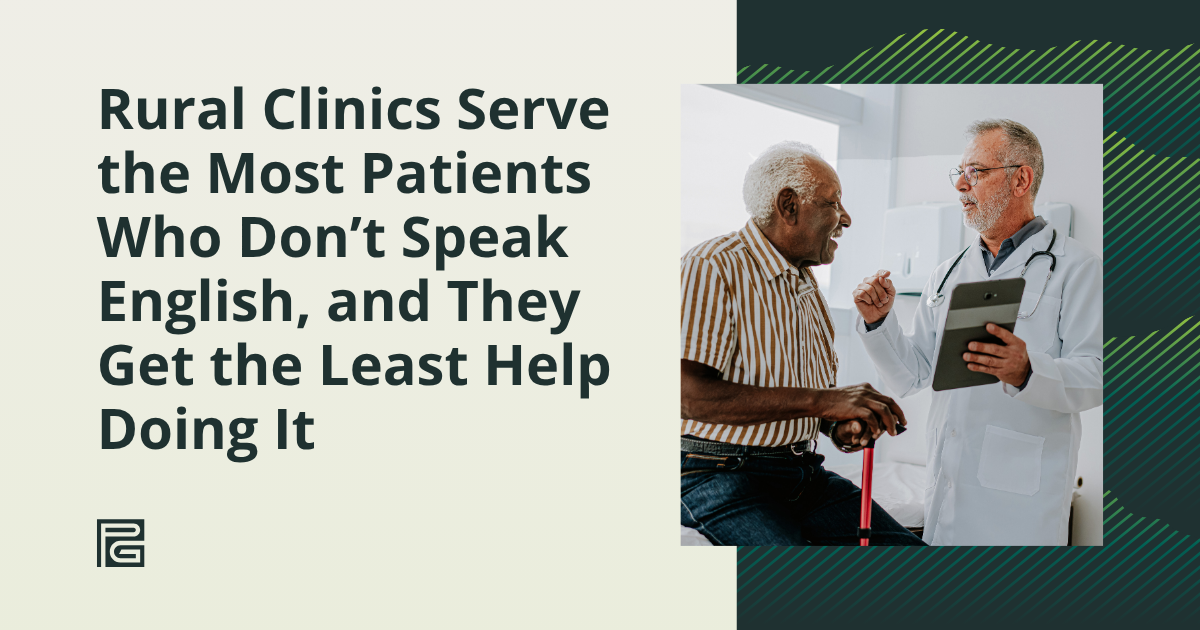
Rural Clinics Serve the Most Patients Who Don’t Speak English, and They Get the Least Help Doing It
More than 25 million people in the United States live with limited English proficiency. Rural hospitals and Federally Qualified Health Centers (FQHCs) carry a disproportionate share of that population, and they carry it with the thinnest staffing and the tightest budgets.
Here is the part that rarely gets said out loud: the problem is almost never a lack of willingness to solve the problem.
A rural clinic cannot keep a staff interpreter for every language that walks through the door. So it improvises – a phone line for one language, a video vendor for another, a bilingual medical assistant pulled off her own work, sometimes a patient’s own child. Every one of those carries a cost, and interpreting is one of the few clinical necessities that Medicaid and Medicare generally do not reimburse. You provide it because Title VI and Section 1557 require it and because it is the right thing to do, not because it pays for itself.
Where the Model Breaks
Walk a patient’s visit from the parking lot forward and the gaps land in the same places every time.
At the front desk, speed is what matters most. When a patient speaks a language the clinic can’t staff for – Somali, or Karen, a language spoken by many Burmese refugees – reaching an interpreter can mean calling one vendor, finding out they don’t cover it, then trying another and waiting on hold. While that plays out, the visit either stalls or moves ahead without a qualified interpreter, and the patient leaves without fully understanding their own care.
In the exam room, the stakes change. A medication reconciliation or a behavioral-health screen is not a place for a well-meaning family member. And after the visit, there is the part auditors care about: can you prove, encounter by encounter, that a qualified interpreter was used? For most clinics stitching vendors together, that record does not exist in one place.
None of this is a staffing failure. It is what happens when language access is bought one call and one vendor at a time.
What a Better Model Looks Like
Piedmont Global built this as one connected operation, not a single fix bolted onto the old vendor list. Our platform runs the day-to-day: one contract, one workflow, one record trail instead of a scramble of disconnected calls. Underneath it, our data intelligence work matches your interpreter and staffing plan to the languages actually walking through your door instead of last year’s grant application. And the workforce side of the model, covered further down, runs through that same operation rather than a separate hire-and-hope process.
- One usage-based contract: You pay for the minutes you use, with no monthly platform fee and no minimum. For a clinic whose volume swings with the season, the grant cycle, and the local population, the cost tracks reality instead of a flat line you pay whether you use it or not.
- 300+ languages including American Sign Language, on demand: Over-the-phone, video, and onsite interpreting from one network, so there is no per-language vendor to chase. ASL and Spanish run 24/7 on video; other languages vary by availability.
- Human interpreters for the moments that demand them: Clinical and high-risk conversations route to credentialed interpreters by design. For high-volume routine calls like scheduling and eligibility, the Speech-to-Speech AI Interpreter can carry the load in Spanish and English, with your team deciding by call type what goes to a human and what does not.
- A record you can hand to a reviewer: Every session captures interpreter credentials, language, duration, and encounter ID, exported in the formats HRSA, OCR, and the Joint Commission expect. Section 1557 evidence stops being a scramble.
One community health system that made this shift cut its annual language-access spend from roughly $3 million to under $500,000, and reduced communication-related errors in the process.
That’s the platform side of the model. The workforce side matters just as much, and it is where the provider in the room comes in.
The Provider in the Room Is Part of the Model Too
There is a workforce reality underneath all of this. Internationally trained physicians – foreign medical graduates – make up about 23% of the U.S. physician workforce, and rural, safety-net, and community settings lean on them far more heavily than that average suggests. In many low-income and rural counties, they are not a supplement to the care model. They are the care model.
A foreign medical graduate practicing as a physician or advanced practice provider (APP) often arrives with something you cannot recruit for on a spec sheet: the language and lived experience of the population the clinic serves. When a provider and patient share a language, patient trust measures higher than it does with an untrained family member interpreting, and about the same as care delivered through a professional interpreter. A Spanish-speaking family physician in an agricultural community, or an Arabic-speaking APP in a refugee-resettlement town, changes how care lands: fewer missed cues, and more of the quiet context that decides whether a treatment plan actually happens.
Here is the trap, though. When a clinic has one provider who speaks the patients’ language, that provider quietly becomes the language plan. They get pulled into other clinicians’ visits to interpret and carry a panel weighted toward every LEP patient in the building. It burns them out, it does not scale, and it is not the job you recruited a clinician to do. A bilingual provider is also not a qualified medical interpreter by default. Conversational fluency is not the same as accuracy under clinical and legal stakes, which is why provider language skills should be assessed, not assumed.
That assessment is itself a staffing decision, and it is where Piedmont Global’s work extends past the platform. Our MedConnect team places bilingual physicians, APPs, and international medical graduates in permanent roles for exactly this kind of population, so language-concordant hiring becomes something a rural system can plan for rather than something it gets lucky into. MedConnect does not replace the platform side of the model, and a bilingual hire does not discharge a Title VI or Section 1557 obligation on its own any more than a professional interpreter contract does. It is the other half of the model, not a substitute for either half.
The right model uses both, on purpose. Language-concordant providers do what only they can do: deliver care with cultural fluency already built in. The platform covers the rest – every other language in the panel, the after-hours call, the ASL request, and the moment your one Spanish-speaking physician is already in another room. That is what lets a foreign medical graduate practice at the top of their license instead of serving as the clinic’s default interpreter, and it is what makes their impact on the population durable rather than dependent on one person never taking a day off.
We Have Run This Play Before
Step back and the through-line is hard to miss. Every problem above describes a clinic keeping a critical function alive by improvising: a medical assistant pulled off her own work, a provider’s personal fluency, a patient’s teenage son translating a diagnosis in the waiting room. Healthcare has outgrown this exact pattern once already.
Twenty years ago, patient information lived the same way – paper charts in a back room, a fax to the specialist, and the one veteran nurse who knew where everything was filed. It worked until she retired. The electronic health record did not replace her judgment. It stopped the practice from depending on any single person’s memory, and it left a record you could actually stand behind.
Language access is sitting where recordkeeping sat then. A language-concordant physician is that veteran nurse: invaluable, and exactly the wrong thing to build an entire system on. The work is to put infrastructure underneath your people, so the care model holds whether or not one clinician is in the building that day.
The Honest Part
Moving off a patchwork is real work, not a switch you flip. There is change management in getting front-desk and clinical staff onto one workflow, and it is worth being clear-eyed about that going in. You lived through the EHR rollout, so you already know the shape of it – this is a far smaller lift, but it is not nothing. The alternative, though – rising volume, flat budgets, and thin documentation – is not a strategy. It is a risk you are carrying whether you name it or not.
If you run language access at a rural hospital or an FQHC, I would like to hear how you are handling the cost side of this. It is the question I get asked most, and the reimbursement gap makes it a hard one. Comment below or send me a message.
And if you want to see how Piedmont Global handles the coverage, the routing, and the reporting for a center like yours, I am glad to walk you through it.
Preston Rasmussen, Business Development Representative at Piedmont Global | Book 20 minutes.
